Verification notes (2026-10-28):
1. In 1887, Torakusu Yamaha, a medical-device repairer, repaired an organ at an elementary school in Hamamatsu and built an organ himself. The 1898 trademark showed a phoenix holding a tuning fork in its beak. Sources:
https://www.yamaha.com/en/about/history/innovation/ https://www.yamaha.com/en/about/history/logo/
2. Japan's first upright piano in 1900; its first grand piano in 1902. Source:
https://hub.yamaha.com/pianos/p-history/a-brief-history-of-yamaha-pianos/
3. Motorcycles: wartime propeller production; instructions to build a prototype in 1953; Yamaha Motor became independent in 1955. FRP boats in 1960; joint engine development with Toyota. Sources:
https://global.yamaha-motor.com/stories/history/stories/0001.html https://global.yamaha-motor.com/design_technology/technology/spread/001/ https://global.yamaha-motor.com/about/business/boats/ https://global.yamaha-motor.com/showroom/cp/collection/am_lfa/
4. FRP bathtubs (1964); the RT100i router (1995); VOCALOID (2003) and Hatsune Miku (Crypton, VOCALOID2). Sources:
https://www.yamaha.com/en/about/experience/innovation-road/collection/detail/0016/ https://www.yamaha.com/en/about/history/innovation/episode-18/ https://www.yamaha.com/en/stories/the-key/003-01/
5. Berkshire originated as a textile company in 1955, began acquiring insurers in the 1960s, and announced its acquisition of MidAmerican Energy in 1999. Coca-Cola was an equity investment, not an acquisition. Classifying Mitsubishi as “expansion outward from core technologies” is the speaker's categorization, not an endorsement of historical fact. Sources:
https://en.wikipedia.org/wiki/Berkshire_Hathaway https://berkshirehathaway.com/news/oct2599.html https://www.nytimes.com/1989/03/16/business/coke-says-buffett-has-6.3-stake.html
6. Newton's image of a boy playing on the seashore while the ocean of truth remains undiscovered comes from Brewster's 1855 biography of Newton. The post paraphrases it. Sources:
https://www.newtonproject.ox.ac.uk/view/texts/normalized/OTHE00088 https://mathshistory.st-andrews.ac.uk/Biographies/Newton/quotations/
7. Mitsubishi began in shipping in 1870; shipbuilding began in 1884. Sources:
https://www.mitsubishi.com/en/profile/history/outline/ https://www.mhi.com/company/overview/history.html
8. “Vine-like innovation” is Wu Bofan's term. “Finding the highest peak in thick fog” is the speaker's metaphor, not a claim endorsed as fact.
9. Following comparison with the sources above, claims without reliable provenance were removed and some statements replaced with traceable versions (fourteen changes in total).
----
Yamaha: a fully developed skill tree
Yamaha is a rare company whose businesses span pianos, motorcycles, boats, speakers, furniture, real estate, routers, and voice synthesizers. A broad range of businesses is not unusual in itself, but diversification on Yamaha's scale is relatively uncommon.
Many Yamaha businesses grew step by step from existing technologies.
When one product line encounters difficulties, another can thrive. As one business declines, another is there to take its place.
Yamaha's founder, Torakusu Yamaha, repaired medical equipment. In 1887, while repairing an organ by chance, he became interested in its internal structure. He made components based on what he had seen, experimented, and built an organ himself.
But he was an outsider to the field. The organ looked convincing, yet could not be tuned properly and was unusable. That did not stop it from becoming Yamaha's starting point. He went to Tokyo to learn tuning theory, returned to experiment again, built a satisfactory organ, and established an organ workshop. Yamaha's first logo later featured a phoenix with a tuning fork in its beak.
He subsequently expanded into repairing and making Western musical instruments, including pianos. Pianos resembled organs in construction, but were more complex. After repairing them for a while, he concluded that making pianos would be more profitable than repairing them. Yamaha began researching piano manufacture. In 1900, it built Japan's first upright piano, followed by the first grand piano in 1902.
A chain reaction followed: having figured out pianos, why not try other instruments? Yamaha moved into flutes, clarinets, trumpets, trombones, guitars, and drum kits. In the 1970s and 1980s, it entered electronic instruments, producing electronic keyboards, synthesizers, and digital synthesizers.
That is the timeline for musical instruments, one of Yamaha's main businesses. Its strength, however, is that it kept experimenting and opening up new fields along the way.
For example, woodworking and machining expertise developed through instruments led into furniture and aircraft propellers. After World War II, propeller-machining equipment became the starting point for motorcycles. In 1953, president Genichi Kawakami ordered the development of a prototype motorcycle engine. The YA-1 entered mass production in 1955, and Yamaha Motor became independent that same year.
Yamaha Motor later worked with Toyota under contract to develop several car engines. Yamaha then wondered: if we have engines, could we build personal watercraft? It eventually did build boats. Boatbuilding gave it expertise in fiberglass-reinforced plastic, which it then used to make bathtubs.
Yamaha is not only a major manufacturer; it also has numerous electronics businesses. When it began making electronic instruments, expensive components on the market were beyond its reach, so it researched signal processing itself. That led to home-theater amplifiers, digital signal processors, and professional audio equipment. In the 1990s, its accumulated electronics expertise also produced routers.
Once Yamaha had enough technologies and products, chemistry developed between them. Pianos and motorcycles originally had little in common, but many people say Yamaha engines sound the best because of its strong tuning expertise. Its audio expertise also produced VOCALOID singing-synthesis technology: enter lyrics and notes, and the software sings. The virtual singer Hatsune Miku, developed by Crypton, was created with the VOCALOID2 engine.
That is Yamaha's intricate product history. Traditionally, large diversified companies fell into two broad groups. One opens new fields through acquisitions and mergers, as Buffett's Berkshire did when it moved from textiles into insurers, energy companies, and other industries. The other expands outward from core technologies, as Mitsubishi did: starting in shipping, moving into shipbuilding, then using its accumulated technologies to expand into heavy industry and automobiles.
Yamaha represents a third path: begin with something currently needed and interesting, solve one problem at a time, and create new products as new problems arise.
Wu Bofan calls this model “vine-like innovation.” A vine keeps spreading as it grows. Imagine a climbing vine emerging from the ground like an ordinary blade of grass. As it climbs, it branches and spreads, growing from a point into a line, then a surface, until it covers a building. This spreading form of innovation is precisely Yamaha's characteristic.
Seen from the endpoint, it looks disorderly, with a little of everything. Start at the beginning, however, and every step connects with the previous one, making the eventual result seem entirely natural.
In other words, innovation often does not occur in isolation. Small improvements and changes to existing businesses and products evolve into new products or technologies. These retain structural or functional similarities to the original business, yet have independence of their own. Connecting many such results can allow a company to grow to substantial scale.
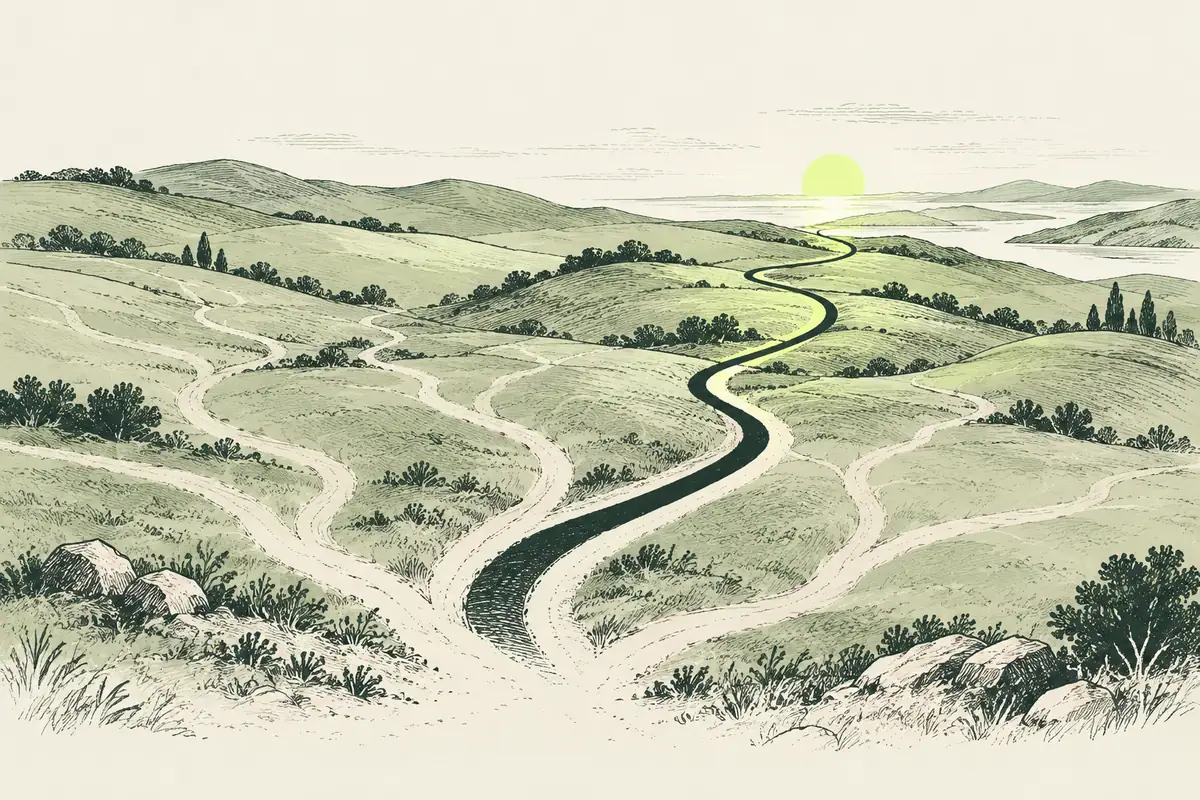
That is the lesson Yamaha offers as a company. Imagine life as hills covered in dense fog, with visibility of only a few meters. How can you reach the highest peak?
The simplest algorithm is always to take a step uphill. The risk is that if you start on a low hill, you can reach only its low summit, not the highest peak.
A slightly better algorithm introduces randomness: experiment and wander more at first to reduce the chance of climbing the wrong hill, then reduce randomness later. This gives you more opportunities to find the highest mountain.
The best algorithm, in fact, is to repeatedly place yourself at random locations across different terrain, then look back after multiple attempts and decide which mountain is highest.
The same applies to careers and life choices. Early on, perhaps “randomly” placing yourself in different terrain, experimenting and exploring, is better than following one path to the bitter end. It can keep you from circling low hills and open up broader possibilities. Once you are convinced you have found your own “highest peak,” however, there is even less reason to waste time on other mountains.
In other words, exploring possibilities is an infinite game. As Newton put it, undiscovered things lie before me, waiting to be explored.
#得到頭條20250218
----
Robin: “Starting a business and running an established company are somewhat different. For now, my suggestion is to focus resources on one point, excel at it, and become indispensable. If people can take you or leave you, you are easily replaced.
“Running a company, though, inevitably raises the issue of continual growth. After conquering one mountain, you want to conquer the next. Yet some companies remain focused on one field throughout.
“Yamaha's case reflects its era and some chance events. Personally, I do not think it can be copied wholesale. In today's highly specialized economy, there is no need to raise a cow just to drink milk. Still, nothing is absolute. Some people, like Elon Musk, can succeed at many projects and accomplish many things at once. For most people, however, I recommend focusing.”
DISCUSSION
Reader comments
What did this article make you think about? Different perspectives and constructive criticism are welcome.
Comments are public immediately. Do not include personal contact details or external links. Automated checks block suspicious solicitation, prohibited transactions and spam; they can make mistakes.
Comments load when you reach this section.
Administrator sign-in Sign out