Note 22 | A Pivot Is Not a Random Change of Direction. It Is a Structured Change of Assumptions
These are Robin Shen’s original reading notes and commentary, written in his own words after reading Eric Ries’s The Lean Startup: How Today's Entrepreneurs Use Continuous Innovation to Create Radically Successful Businesses. They are not the original book, excerpts from it, or an official publication. Methods and concepts from the book are attributed to Eric Ries; other sources are identified where stated. For reference only; not investment advice.
English translation of Robin’s Chinese reading notes and commentary. Passages are paraphrased, not verified verbatim quotations from the original English edition.
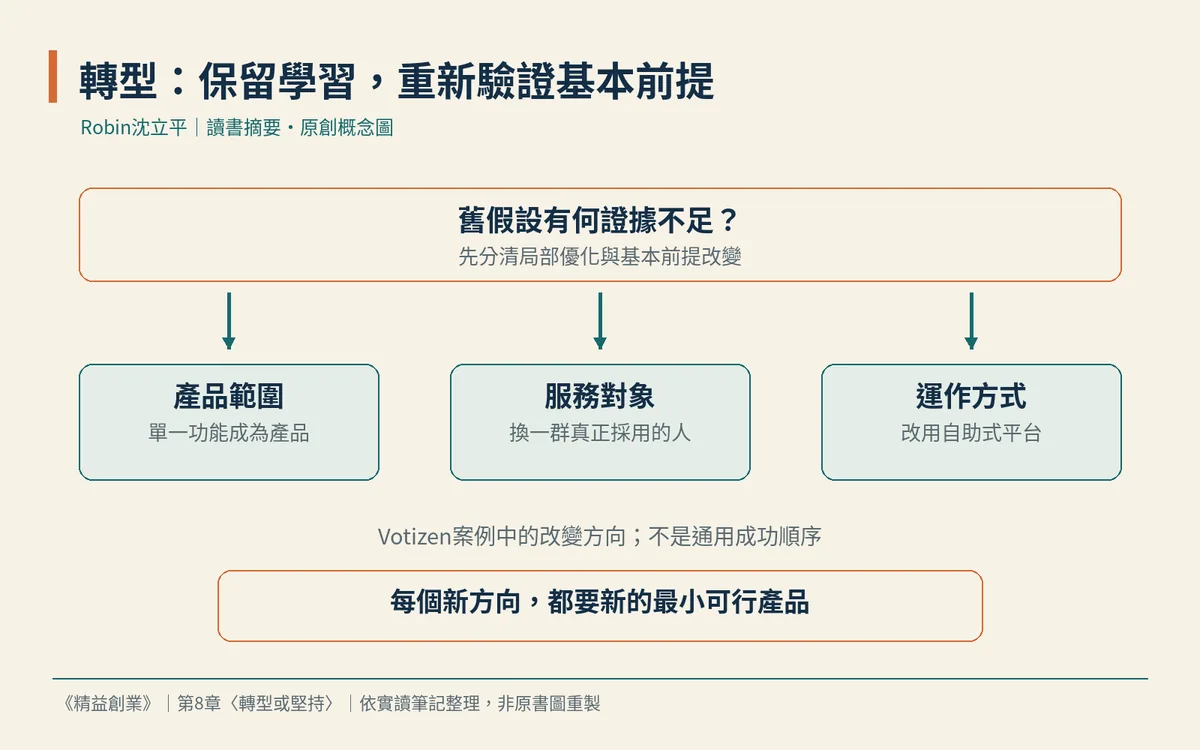
The same vision can travel through different products and business models, but not every revision is a pivot. In Chapter 8, Eric Ries defines a pivot as a structured change designed to test a new fundamental hypothesis about the product, the business model, and the engine of growth. The point is not how large the change is, but which premise that previously supported the strategy is being rewritten, and how the new premise will be tested next.
Votizen’s experience makes the definition concrete. As Ries narrates, David Binetti first hoped to build a social network of identity-verified voters, and from the start made quantitative forecasts for four hypotheses: registration, activation, retention, and referral. The point of this approach is that he did not merely say he would watch the response after going live. He first stated which behaviors had to appear for the model to have a chance of working.
Tests and optimizations did improve some steps, but they did not make the whole model run smoothly. If you emphasize only a bright spot or total usage, you can still package it as progress. The hypotheses written earlier, however, reminded him that a better front end did not mean users would stay and invite others. Ries discloses a holding or other interest in Votizen, so this passage should be read as his case narrative, not as results independently verified by this note.
The first important change was to take the voter-contact function from a complete social network and enlarge it into the product itself. Users identified with the idea and with the ability to verify identity, but they did not necessarily need to join another small new community. The new direction used existing social networks to help citizens convey messages to their representatives. This was not a matter of making the original interface prettier. It was a new answer to what users truly needed, and what value was worth acting on.
The team later turned to selling to organizations, received interest and letters of intent, and then expanded headcount and built features. But as Ries recounts, when it came time to sign, prospective customers delayed or pulled back one after another. This passage is especially important: a willingness to hear a pitch, or even to express an intention to cooperate, does not mean the other party is already an early customer ready to adopt. Learning a great deal also cannot pay salaries. If unrealized promises are treated as demand, resources will still be consumed quickly.
The team then turned into a self-serve platform, letting participants in different issues join and use it on their own. Ries describes a more viable combination of metrics in the new version, but the case cannot be reduced to “in the end, a platform was the right answer.” Each earlier constraint provided knowledge for the next round. Some technology could be reused; some features instead became legacy work to be dealt with. Learning is not a guarantee that every investment can be kept as it was.
This also explains why Ries stresses that a pivot still requires strategic thinking and human judgment. Data can make people admit that the old direction lacks progress, but it will not automatically specify a unique new product. “Structured” means putting the change back into a clear question, observable behavior, and a new test. It is not looking for a hot market whenever there is pressure, and it is not wiping away every past failure with the word “pivot.”
I think that when investors discuss a pivot, they should ask separately “why the old assumption needs to change” and “on what basis the new assumption is worth trying.” An answer to the former does not mean the latter is already established; but if the former can never be stated clearly, the team may only be changing the wording in place. The conclusion is that keeping what has been learned, clearly accounting for what is being abandoned and reused, and then seeking evidence with a new minimum viable product, is a disciplined change of course.
Three suggestions
For the current model, list a few key behavioral hypotheses and expectations, and keep the results separately. Do not use growth in totals or a single bright spot to declare that the whole model is established.
At a fixed review point, compare several rounds of improvement, first state which fundamental premise now lacks support, and then propose an alternative hypothesis. Do not call adding features or renaming the product a pivot.
Before a new direction starts, list reusable technology, accumulated knowledge, and features that should be dropped, design the next minimum viable product, and do not let interest or a letter of intent stand in for actual adoption.
#TheLeanStartup | Source: Chapter 8, “Pivot (or Persevere)”
These are reading notes and reflections based on my personal understanding. I recommend reading them alongside the original book for the full context.
Comments
What do you think? Share your experience or questions.
Sign in to comment, reply or like. Sign in / Sign up
Loading comments…