Preface | Entrepreneurship Is Not About Looking the Part. It Is About Building a Learning Process
These are Robin Shen’s original reading notes and commentary, written in his own words after reading Eric Ries’s The Lean Startup: How Today's Entrepreneurs Use Continuous Innovation to Create Radically Successful Businesses. They are not the original book, excerpts from it, or an official publication. Methods and concepts from the book are attributed to Eric Ries; other sources are identified where stated. For reference only; not investment advice.
English translation of Robin’s Chinese reading notes and commentary. Passages are paraphrased, not verified verbatim quotations from the original English edition.
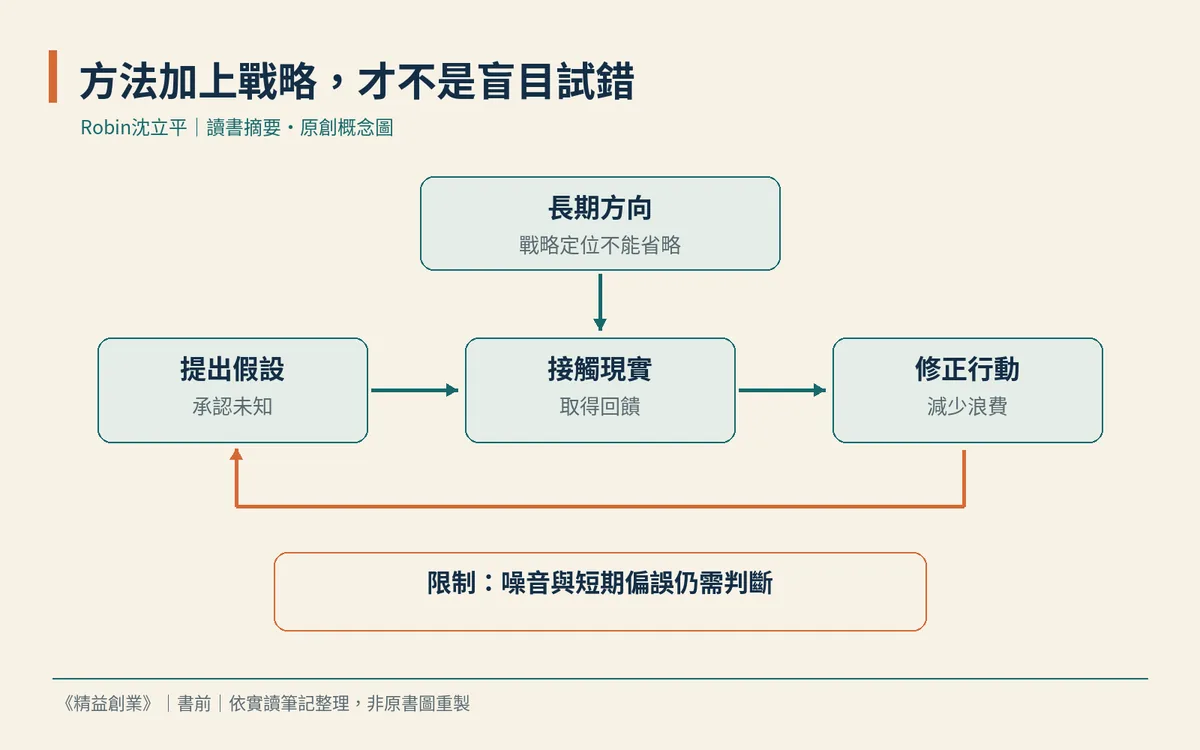
What people notice first in entrepreneurship is imagination and nerve. What they often miss is how you know you are doing the right thing. Reading the front matter of The Lean Startup, I took it as a shift in vantage point: do not start by envying the dramatic origins of successful founders. Start by looking at the process they used to face uncertainty.
In the preface, Eric Ries looks back on his own failures. The product, the team, the technology, and the timing all seemed right, and he still did not know how to turn an idea into a company. He rejects the story that success is simply genius plus effort, because that makes it too easy to mistake a survivor’s tale for a method you can copy. What he wants to address is whether entrepreneurship can become a management process you can learn.
The four forewords add different reminders. Gong Yan stresses that lean methods turn slow feedback into faster feedback, but strategic positioning still has to answer which mountain you start climbing. Cheng Hao puts the search for demand ahead of validation, and notes that the need may not be real and the solution may not be right. Fan Deng pulls attention back from offices, headcount, and appearances to real problems. Xie Weishan, from the angles of survival, management, and resources, asks what value the effort actually created.
These recommendations are not a guarantee of results. Gong Yan in particular points out that the same sample can be read in more than one way, and that market signals come with noise; chasing only the short-term payoff of trial and error can also mean missing a longer opportunity. Cheng Hao adds that a method cannot replace judgment about the larger trend. The front matter is therefore not asking us to abandon strategy. It is asking us not to use strategy as a reason to refuse to seek evidence.
My reading is that lean is not a rule that everything must be made small. It is a way of leaving room to adjust the parts that are not yet settled. The vision can be large; the first step should still be able to bring back a real response. For founders and for people who support them, the shared language worth building is not “believe me one more time,” but what beliefs have changed, on what basis they changed, and how the next step will be tested.
Three suggestions
Write down clearly the problem you want to solve and whom it is for. Separate uncertainty about the need from uncertainty about the solution, and do not rush to hide the questions behind a complete product.
Arrange early tests that reach real users, so that spending matches the questions still to be answered, not the appearances a startup is supposed to have.
Review short-term feedback and the long-term direction separately. Do not let one setback cancel the vision, and do not treat perseverance as a privilege that excuses you from validation.
#TheLeanStartup | Source: Front matter: blurbs, forewords I–IV, and the preface
These are reading notes and reflections based on my personal understanding. I recommend reading them alongside the original book for the full context.
Comments
What do you think? Share your experience or questions.
Sign in to comment, reply or like. Sign in / Sign up
Loading comments…