Note 1 | Being Busy Is Not Progress: Startups Need a Different Kind of Management
These are Robin Shen’s original reading notes and commentary, written in his own words after reading Eric Ries’s The Lean Startup: How Today's Entrepreneurs Use Continuous Innovation to Create Radically Successful Businesses. They are not the original book, excerpts from it, or an official publication. Methods and concepts from the book are attributed to Eric Ries; other sources are identified where stated. For reference only; not investment advice.
English translation of Robin’s Chinese reading notes and commentary. Passages are paraphrased, not verified verbatim quotations from the original English edition.
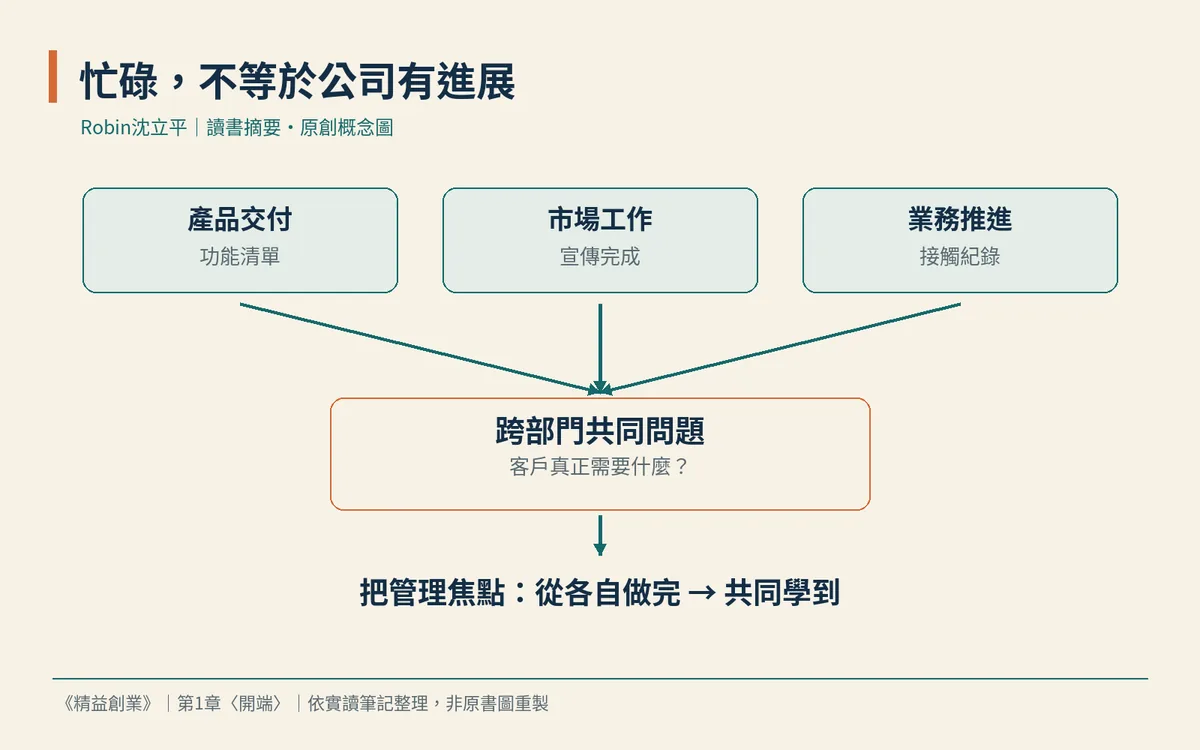
Everyone in the company can be busy without the company moving in the right direction. In Chapter 1, Eric Ries is not only taking apart a problem of efficiency. He is taking apart a misunderstanding of management: fearing bureaucracy, approvals, and rules, founders abandon management altogether, and scarce talent and time are then burned in chaos.
Starting a company, he argues, is starting an institution. As soon as people have to be coordinated, work assigned, and shared results owned, management already exists. Calling yourselves a startup does not make it disappear. He is not, however, asking you to import a mature company’s entire system. A startup does not yet know its customers or its product direction, and processes designed for a stable business may not answer the questions at hand.
The dilemma matters. Opposing rigid management is not the same as opposing all management. Accepting the need for discipline is not the same as relying only on detailed plans and layers of sign-off. What Ries offers is a form of management built for the startup setting, so that uncertainty can be worked with rather than pretended away.
He uses a programmer’s feel for the work to show the blind spot. After a full day of writing code, visible output is reassuring; meetings or questions that interrupt it feel unproductive. Yet if that code ends up in a product nobody wants, shipping on time and on budget does not prove the team created value. Local workload and company progress are not the same thing.
Lean thinking offers a new way to tell them apart. As Ries explains, it comes from manufacturing’s distinction between value and waste, and it also values workers’ knowledge and creativity. Moved into a startup, the question is no longer only how to finish faster, but how to find more quickly a direction customers actually need and will pay for. Reducing waste is not a matter of filling everyone’s calendar first.
He therefore suggests that a cross-functional team be accountable for a learning goal in each phase, rather than only handing work off by function. That does not make expertise unimportant. It means that if every department only completes its own list, no one may be accountable for the shared question. A finished product, a completed marketing campaign, and sales beginning to talk to customers do not automatically mean the need has been understood.
The change will not immediately feel efficient. Ries expects teams to complain that work is interrupted, that speed has dropped, and that they want to go back to handing off large batches. Learning is harder to see than code or a finished object. If managers still reward only visible output, teams will naturally avoid the interactions that might reveal a wrong direction.
The chapter says the way of measuring has to change, but it does not lay out the full method for evidence of learning here. That limit should be kept: you cannot simply rename the goal and count every discussion as progress. A learning goal for a given phase should at least let each function know what you are trying to clarify together, rather than turning “learning” into a shield that carries no responsibility.
So what the organization has to change is not swapping all “delivery” for “discussion,” but putting delivery back under a shared question. If skipping a meeting would teach you more about the customer, cut the meeting. If one cross-functional conversation can expose a wrong direction, it need not be treated as an interruption that steals output. Management has to tell those two cases apart.
I find this a useful reminder when looking at a team. Organizational discipline should show not only in a tidy schedule, but in the ability to stop and recognize wasted effort. What entrepreneurial management really protects is the team’s energy and talent, so that a group of serious people is not left efficiently doing the wrong work for a long time.
Three suggestions
Pick one unknown that several functions face together, set it as a learning goal for the phase, and have product, sales, and the other roles share accountability for it.
Check whether routine reports list only hours, features, and deliveries, and require an account of how the work helped you understand the customer, not merely how it added to the busyness.
Explain in advance that changing the process may reduce the short-term feeling of efficiency, and regularly cut handoffs and tasks that do not serve the shared goal, so the team does not slide back into working in silos.
#TheLeanStartup | Source: Chapter 1, “Start”
These are reading notes and reflections based on my personal understanding. I recommend reading them alongside the original book for the full context.
Comments
What do you think? Share your experience or questions.
Sign in to comment, reply or like. Sign in / Sign up
Loading comments…