Note 24 | Do Not Bring Only Numbers to a Pivot Meeting. Bring Alternative Directions Too
These are Robin Shen’s original reading notes and commentary, written in his own words after reading Eric Ries’s The Lean Startup: How Today's Entrepreneurs Use Continuous Innovation to Create Radically Successful Businesses. They are not the original book, excerpts from it, or an official publication. Methods and concepts from the book are attributed to Eric Ries; other sources are identified where stated. For reference only; not investment advice.
English translation of Robin’s Chinese reading notes and commentary. Passages are paraphrased, not verified verbatim quotations from the original English edition.
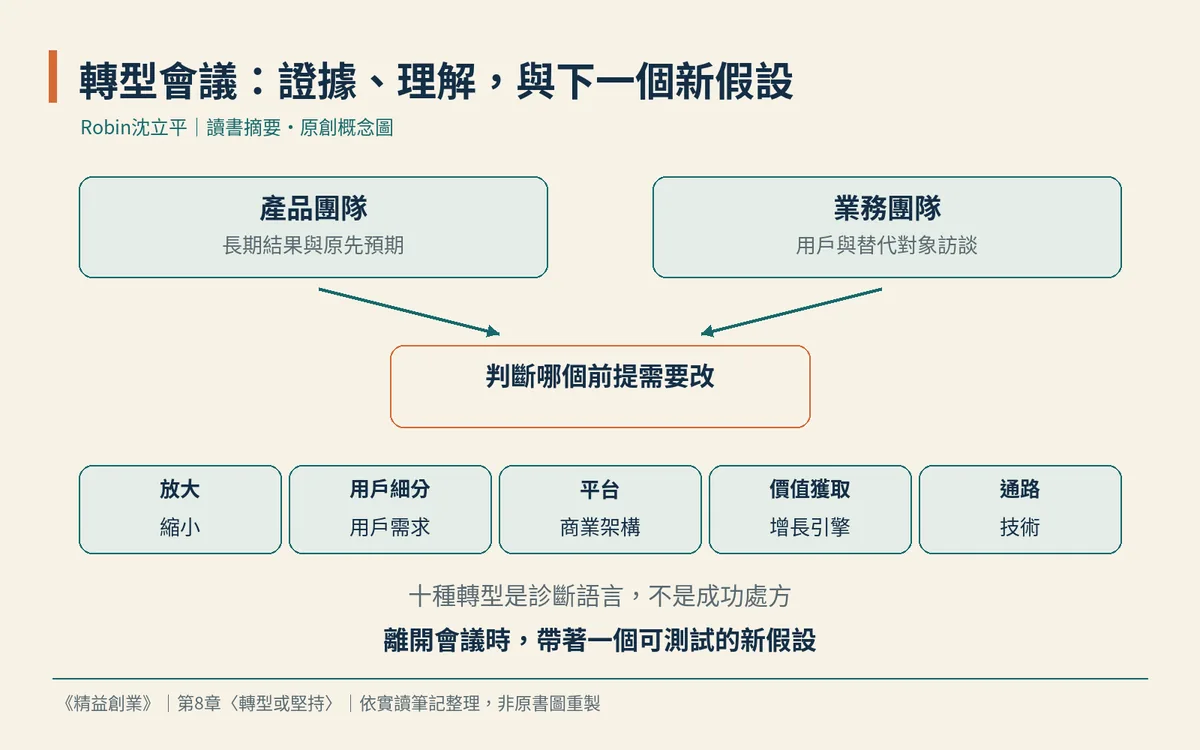
The data show that the current strategy is not working. Where should you go next? In Chapter 8, Eric Ries reminds us that a pivot involves human emotion and judgment, and cannot wait for a magical threshold to trigger itself. A regular “pivot or persevere” meeting is a way of putting the question on a planned agenda: the product team brings a comparison of long-term optimizations and expectations; the business team brings concrete records of conversations with current and prospective users.
Wealthfront’s predecessor, kaChing, first used a virtual investing contest to find capable amateur managers, then hoped players would convert into clients of a real-asset service. As Ries narrates, the game attracted a large number of participants, but it did not establish two key hypotheses: enough qualified managers, and enough paid conversion. Ries discloses a holding or other interest in Wealthfront, so the results of the case should keep his narrative standpoint, and not be treated as independent certification.
Looking only at those results, the team knew the original strategy had a problem, but still did not know how to fix it. They therefore spoke with professional fund managers and with users, and found that some managers were not afraid of transparency and in fact hoped to use it to prove their ability; users, meanwhile, were confused by the mixing of a game and a real-asset service. Qualitative research here is not a way of finding a step for failure to stand on. It helps propose a new direction that can be tested, and fills in what the numbers cannot directly answer.
The company later dropped the game, repositioned itself, and worked with professional managers, while keeping the technology for evaluating performance. Employees faced the unease of losing their previous work, which also shows that a pivot does not reset every accumulation to zero. Ries’s point is that a path once thought necessary may not be necessary. Only after understanding users and alternative counterparts can you identify which investments are still useful, and which are only an attachment to the past.
The chapter’s ten types of pivot can serve as a diagnostic language. Zoom-in and zoom-out ask whether the relationship between a feature and the whole product should change. Customer segment and customer need ask whether you have been serving the wrong people, or have grasped the wrong problem. The two look close, but they lead to different new hypotheses: that some people truly need the current solution, and that the same people in fact need a different one, cannot be vaguely covered by a single phrase about repositioning.
Platform and business architecture pivots involve the way an application and a platform work, or a shift between low volume and high margin and high volume and low margin. A value capture pivot reminds us that how you make money is not a minor feature to be added or subtracted at will. Engine of growth, channel, and technology pivots change the mechanism of growth, the path of delivery, or the technology used to reach a solution. These changes often pull on one another. You cannot assume that changing only the sales channel will leave price, product, and service commitments untouched.
The categories, however, are not a prescription, and not every meeting has to pick a noun and announce it. Ries says this is not a closed list, and still more strongly opposes copying a famous company’s successful pivot. That something worked for someone else does not mean our customers, timing, and team conditions are the same. Every new direction is only a new strategic hypothesis, and needs a new minimum viable product to validate it. A change of category does not automatically confer credibility.
I think a good meeting should allow both refusal and imagination: refuse arrangements that are not progressing, and keep room to test an alternative. This is not a demand to pivot every time, still less a way of packaging hesitation in ten nouns. The conclusion is to bring data in order to face the present situation, bring interviews in order to understand what is possible, and leave with a new premise that can be tested, so that a pivot becomes the next round of learning rather than an emotional fresh start.
Three suggestions
At the next review, have product and business prepare together, and account separately for the results of several rounds of optimization against expectations, and for concrete responses from real users about the problem and the solution.
For a candidate direction, contact current users and possible alternative counterparts, keep unexpected and contradictory findings, do not collect only opinions that support the original plan, and do not let interviews stand in for adoption.
Use the language of the ten types of pivot to clarify which premise is actually changing, write down what accumulation can be kept and what the next minimum viable product will be, and do not treat the name of a category as a guarantee of success.
Robin’s note | Taiwan startups and venture capital
If a Taiwanese team and its investors review a pivot together, they can discuss evidence for the old model, tests of the new plan, and remaining resources separately, and not rush to equate a change with failure or with a reason to invest again. That can let support and accountability coexist, but it cannot replace either side’s concrete judgment about risk and the arrangement of capital.
#TheLeanStartup | Source: Chapter 8, “Pivot (or Persevere)”
These are reading notes and reflections based on my personal understanding. I recommend reading them alongside the original book for the full context.
Comments
What do you think? Share your experience or questions.
Sign in to comment, reply or like. Sign in / Sign up
Loading comments…