Note 25 | Handing Work Off in Large Batches May Also Be Raising the Cost of Being Wrong
These are Robin Shen’s original reading notes and commentary, written in his own words after reading Eric Ries’s The Lean Startup: How Today's Entrepreneurs Use Continuous Innovation to Create Radically Successful Businesses. They are not the original book, excerpts from it, or an official publication. Methods and concepts from the book are attributed to Eric Ries; other sources are identified where stated. For reference only; not investment advice.
English translation of Robin’s Chinese reading notes and commentary. Passages are paraphrased, not verified verbatim quotations from the original English edition.
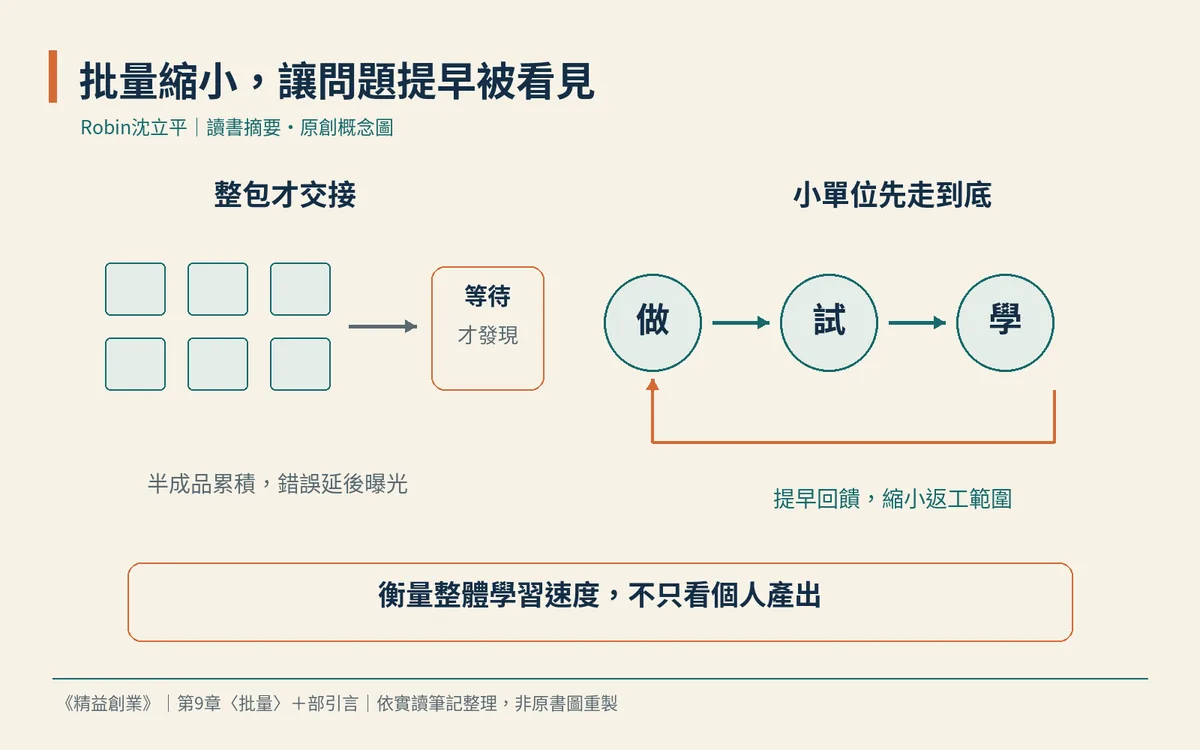
When a company starts to accelerate, the easiest questions are how often to ship and how each department can be more efficient. In the introduction to Part Three, Eric Ries first changes the question: the value entrepreneurship truly creates is validated learning, not piling up more product. If an organization only rewards each person for finishing specialized work, the whole may be even later in knowing whether anyone actually wants what it has made.
Chapter 9 uses the envelope-stuffing story to break an intuition. As Ries retells it from Lean Thinking, the child argues for folding all the letters first and then putting them into envelopes together; the father finishes one letter at a time, and is in fact faster. This does not prove that the father has quicker hands. It is a reminder that fluency in repeating the same motion is not the same as the speed with which the whole process delivers a result.
Batch size is the amount of work handed from one stage to the next at one time. Large batches leave piles of work in process, which then have to be sorted, stacked, and moved. More important, problems are delayed until later before they come to light. If the paper will not fit the envelope, and you discover this only after folding everything, the whole batch has to be reworked. Finishing one letter all the way through lets you discover a mismatch of size very early.
For a startup, the most expensive mismatch of size is that customers simply do not want to use the product. Many pages of design completed, many features written by engineering, a full set of materials prepared by marketing: each looks like output, but if users only encounter the work at the end, a false assumption has time to spread. Ries argues for smaller batches not to make everyone’s work more fragmented, but to reduce the time, money, and energy that are finally wasted.
When he discusses Toyota’s rapid changeover, he is also not asking workers to try harder. When the cost of switching products is high, the natural tendency is to make a great deal at once. Only by redesigning the changeover process can small batches become truly feasible. Moved into a startup, I take this as a demand that managers deal with the friction of handoff, testing, and communication. You cannot keep heavy procedures in place and at the same time order the team to ship every day.
Another counterintuitive practice is andon: if a problem cannot be removed at once, the line is stopped. A little output is lost on the surface, but defects are kept from continuing to flow downstream. Ries uses this to emphasize the performance of the system as a whole, which matters more than one step working without pause. If a designer hands over a large package of drawings and only then do engineers begin to raise questions, the efficiency of the earlier stage may only have transferred waiting and rework to someone else.
Large batches also form what Ries calls a death spiral. Handoffs create interruption, so people, to be interrupted less, make the next package even larger. The longer a release is delayed, the less this release can be allowed to go wrong, so people want to fix one more problem and add one more feature. The batch therefore continues to swell. What began as a way of reducing trouble ends by staking the company on a large version it dares not ship.
This does not mean that all work can be turned directly into single-piece flow. My reading is that you should first identify a unit that can go all the way to real feedback, rather than chopping tasks at random. Finishing half a design drawing, yet still being unable to know the customer’s response, may not shorten learning. Conversely, a very small process that can actually be used may expose earlier a place worth stopping or adjusting.
I think asking how much the team finished today is less useful than also asking when an error will be seen at the latest. What small batches truly change is the way risk accumulates: unconfirmed premises are not allowed to run forward with still more people. The conclusion is not to hurry everyone, but to let a problem arrive earlier at the person who can deal with it, rather than waiting until the investment is already too large to turn back.
Three suggestions
Pick one piece of cross-functional work, change a whole-package handoff into the smallest usable unit going all the way through, record the added cost of switching, and improve the handoff process together.
Track the time from the start of investment to the first real piece of feedback, and list waiting, rework, and the moving of information, rather than only calculating each department’s speed of work.
Write down the latest day you would know if customers did not need this result; move the validation point earlier, and do not use added features to postpone facing the answer.
#TheLeanStartup | Source: Chapter 9, “Batch” (including the introduction to Part Three)
These are reading notes and reflections based on my personal understanding. I recommend reading them alongside the original book for the full context.
Comments
What do you think? Share your experience or questions.
Sign in to comment, reply or like. Sign in / Sign up
Loading comments…