Note 34 | A Smaller Budget Is Not the Problem. The Fear Is a Cut Without Warning
These are Robin Shen’s original reading notes and commentary, written in his own words after reading Eric Ries’s The Lean Startup: How Today's Entrepreneurs Use Continuous Innovation to Create Radically Successful Businesses. They are not the original book, excerpts from it, or an official publication. Methods and concepts from the book are attributed to Eric Ries; other sources are identified where stated. For reference only; not investment advice.
English translation of Robin’s Chinese reading notes and commentary. Passages are paraphrased, not verified verbatim quotations from the original English edition.
Once a company grows large, innovation is almost treated as bound to slow down. In Chapter 12, Eric Ries does not accept this fatalism. His view is that an organization that has grown can at the same time look after existing customers, run existing product lines, and explore new business models. The premise is that managers are willing to switch to what he calls a portfolio of management thinking, treating work of different kinds separately, rather than managing every department by the same set of rules.
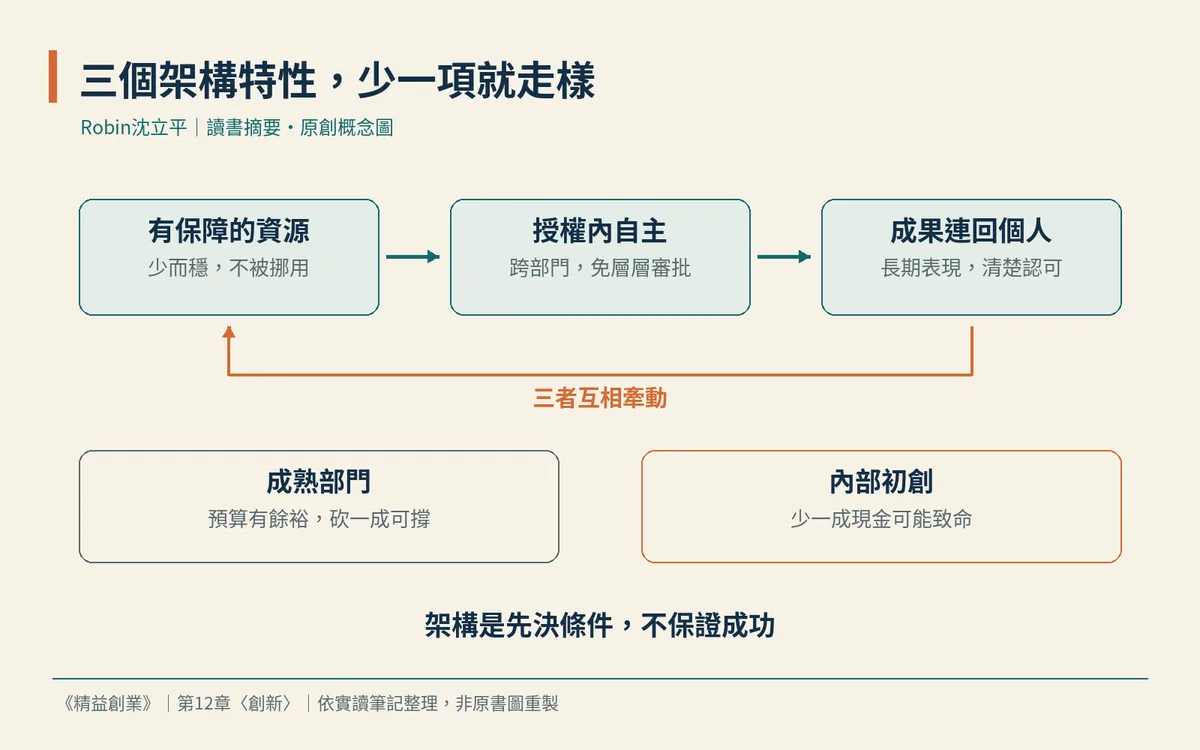
Ries first discusses organizational structure. He stresses that the right structure is only a prerequisite, and does not guarantee success; but if the structure is wrong, failure is almost certain. An independent startup, because it is small and highly independent, naturally possesses certain traits. An entrepreneurial team inside a company needs deliberate support from senior leadership in order to have them. He summarizes three structural characteristics that differ clearly from the needs of a mature department.
The first is scarce but secure resources. Managers of mature departments are skilled at winning budget, and the budget usually has slack; if a tenth is suddenly cut, they can tighten their belts and get through. A startup is the opposite: too much money and too little money are equally harmful, and it is extremely sensitive to a sudden adjustment. Ries says that if an independent startup suddenly loses a tenth of its cash, the blow is often fatal. So the total it needs is much smaller, but it must be absolutely safe and cannot be diverted. He describes running a startup as both easier and harder than running a traditional department.
The second is independent development authority. Within the scope of its mandate, the team can conceive, experiment, develop, and promote on its own, without waiting at every step for cumbersome approvals. Ries strongly recommends a cross-functional team, with each department sending a dedicated person to take part from early on, so that a product and service that can actually be used can be made, rather than stopping at a prototype. Handoffs and approvals slow the feedback loop, and also dilute the team’s sense of responsibility.
The third is tying personal performance to results. An independent startup can use stock options or equity. If an internal team can only pay bonuses, Ries suggests that they are best linked to the long-term performance of the innovation’s results. The interest is not necessarily money, especially in nonprofits and government. The parent organization should at least make clear who drove the innovation, and give recognition when it succeeds. Ries quotes an unnamed internal entrepreneur at a large media company: the project was his own, so he could not afford to lose, and wanted all the more to prove himself.
Ries also cites Toyota’s shusa system. As he understands it, the manager responsible for developing a new car from beginning to end has final decision rights over every aspect of the development, and employees even call it the shusa’s car. The counterexample is an unnamed, well-known technology company that advertised a culture of innovation: large promotions and raises were handed out at the discretion of senior leaders, with no clear standard, and teams felt as if they were buying lottery tickets, so they picked only projects likely to be approved, and the record of new products was disappointing. Both examples are Ries’s accounts; I have not verified them separately.
My reading is that the three characteristics pull on one another. Only when resources are secure will a team dare to decide according to the results of experiments, rather than being busy protecting its budget. Only with authority can results be clearly attributed. Only when results are tied to the individual will authority not become a freedom that need not answer for itself. If any one is missing, the other two easily go out of shape.
I think that when assessing a new venture inside a company, rather than first asking how large the budget is, one should first ask how long this money will not be taken back, how far the team can decide on its own, and whose credit it will be if it succeeds. The conclusion is that an innovation team does not need looseness. It needs a small but stable commitment: not much money, but money that will not be diverted; authority that has a boundary, but does not require approval at every layer; and success or failure clearly connected back to the person responsible.
Three suggestions
For one internal pilot, write a dedicated budget and a period of security, and agree that within the period, unless a condition written in advance is triggered, there will be no sudden cut or diversion.
List the matters the team may decide without prior approval, and from engineering, marketing, customer service, and other related departments appoint one dedicated person to take part throughout.
Link the rewards or recognition of the pilot’s members to the long-term performance of the innovation’s results, and write the criteria of assessment in advance, so that who should be promoted is not decided on the spot by senior leaders.
Robin’s note | Taiwan startups and venture capital
If a Taiwanese company is setting up an internal new venture or a corporate venture unit, directors or investors can first confirm the period of security for the pilot’s budget and the scope of decisions it may make on its own, and only then talk about scale. This is a conditional suggestion about governance. It does not describe how any company’s current system is arranged.
#TheLeanStartup | Source: Chapter 12, “Innovate”
These are reading notes and reflections based on my personal understanding. I recommend reading them alongside the original book for the full context.
Comments
What do you think? Share your experience or questions.
Sign in to comment, reply or like. Sign in / Sign up
Loading comments…