Note 33 | Merely Moving the Deadline Earlier Will Not Change the Organization’s Muscle Memory
These are Robin Shen’s original reading notes and commentary, written in his own words after reading Eric Ries’s The Lean Startup: How Today's Entrepreneurs Use Continuous Innovation to Create Radically Successful Businesses. They are not the original book, excerpts from it, or an official publication. Methods and concepts from the book are attributed to Eric Ries; other sources are identified where stated. For reference only; not investment advice.
English translation of Robin’s Chinese reading notes and commentary. Passages are paraphrased, not verified verbatim quotations from the original English edition.
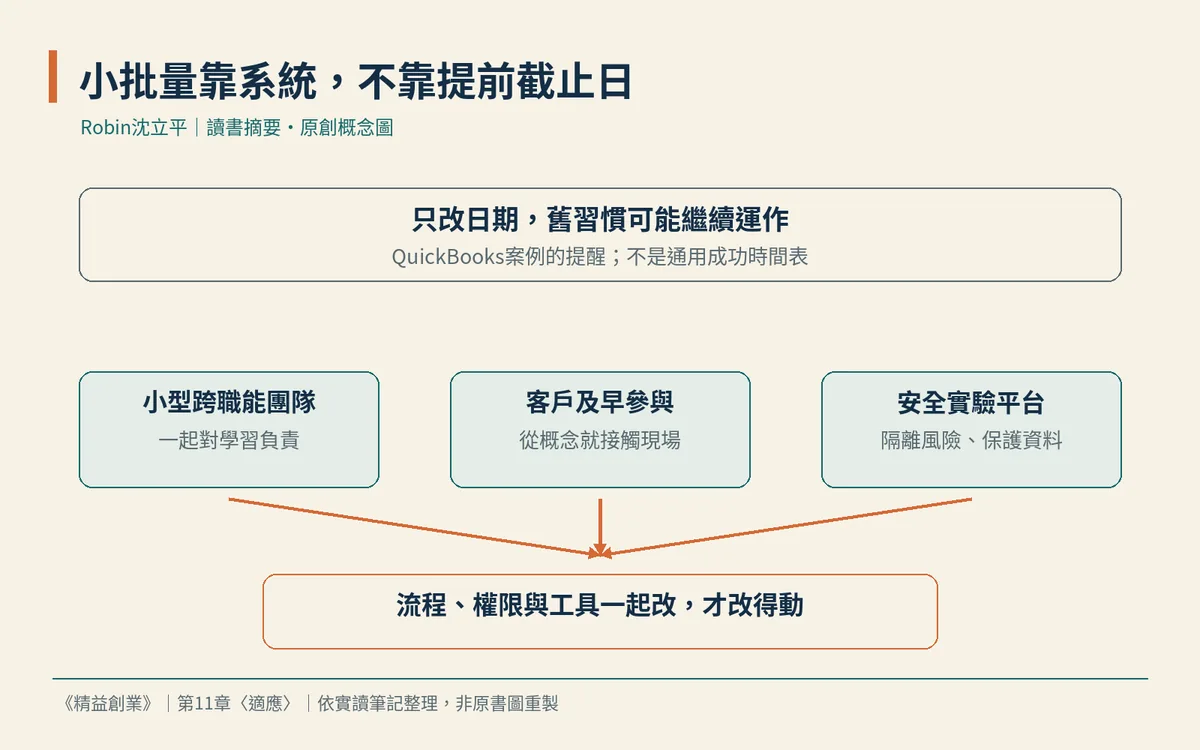
Changing an annual big release to twice a year looks like a smaller batch. Why is the problem still the same? In Chapter 11, Eric Ries uses the transformation of QuickBooks to remind us that the date is only the surface. If cross-functional handoffs, customer involvement, the technical environment, and decision rights have not changed, moving the deadline earlier may only be asking the original system to repeat itself under greater pressure.
As Ries narrates, QuickBooks originally spent several months planning, then a long period developing, and only near release obtained the first public-beta feedback. The beta mainly confirmed that the product would not crash or lose data; the design was already largely fixed. This process was good at delivering according to plan, yet it left the most critical question until later: can customers actually complete their work more easily? Technical normality does not necessarily mean that the experience meets the need.
The online banking feature in the book is a warning. As Ries describes it, after release the time customers needed for reconciliation became four or five times that of the old version, and that year’s Net Promoter Score fell twenty points. These are historical case figures Ries provides, not a verified account of the company’s present situation. The team had tested and had worked according to existing norms, and could still successfully execute a flawed plan, then spend a long time repairing it.
In the second year, Greg Wright, the product marketing lead, tried to shorten the cycle and move the release to midyear, yet the team still returned to old habits, and the internal beta was not completed as expected. Ries calls this the organization’s muscle memory: people accept the new goal in words, while everyday work still runs according to the old division of labor and method of handoff. Problems caused by the system will not disappear automatically because a manager has changed the timetable.
In the third year, the team no longer only adjusted the date, but together transformed the process, the technology, and the collaboration. Engineers, product managers, and customers took part together from the formation of an idea, and small cross-functional teams were built around ideas. As Ries narrates, a team had at most five people, and each team spent about six weeks completing the development of a new feature and a test with real customers. This is the arrangement in the case, not a universal standard for every company.
The resistance was not only a problem of tools. It also came from role identity. Some product managers thought they were already responsible for understanding customers, and that engineers need not go again; some engineers only wanted to know what to build, and did not want to talk with customers. Ries’s view is that both sides may sacrifice the team’s learning for local efficiency. Leaders therefore need to explain repeatedly why the old process failed, and that earlier feedback is the true goal.
Changing the culture alone, however, is also not enough. QuickBooks stores a business’s financial data, and cannot take the risk of damaging it for the sake of an experiment. Ries describes the team building a virtualized system so that selected customers could run the new and old versions at the same time; the new version could read the data, but could not permanently change it. This investment in a platform is what gave a high-risk product the chance to obtain earlier, real feedback on use, under protection.
Ries outlines that satisfaction rose and sales increased in the third year, but he does not provide a specific increase, and it should not be filled in as a handsome percentage. The subscriptions and more frequent releases of the fourth year should also be kept as attempts and prospects at the time, and not written as confirmed results. What is most worth learning from the case is not a successful timetable, but that batch, team, customer, and platform have to be adjusted together before the way of learning can change.
I think a cost of change that is often underestimated is asking people to set down a familiar sense of the value of their work. If you only demand speed, and there is no authority, protection, or shared understanding, it is not surprising that employees return to the old method. My conclusion is that a small batch is not an order to shorten a deadline. It is a working system that lets a small team reach customers safely, decide quickly, and correct course according to the facts.
Three suggestions
Choose one customer flow and try a small cross-functional team, let customers take part from the concept stage, and define each round’s result as a testable question rather than a count of features.
Build, according to the product’s risk, a testing mechanism that is isolated, read-only, or recoverable. First confirm the protection of the data, then let a small number of real users provide useful feedback.
In every communication of a change, state why the old process failed, what evidence you want to obtain earlier, and what support is needed, and check whether roles and permissions are still pushing people back onto the old path.
#TheLeanStartup | Source: Chapter 11, “Adapt”
These are reading notes and reflections based on my personal understanding. I recommend reading them alongside the original book for the full context.
Comments
What do you think? Share your experience or questions.
Sign in to comment, reply or like. Sign in / Sign up
Loading comments…