Note 36 | Today’s Pioneer May Become Tomorrow’s Gatekeeper
These are Robin Shen’s original reading notes and commentary, written in his own words after reading Eric Ries’s The Lean Startup: How Today's Entrepreneurs Use Continuous Innovation to Create Radically Successful Businesses. They are not the original book, excerpts from it, or an official publication. Methods and concepts from the book are attributed to Eric Ries; other sources are identified where stated. For reference only; not investment advice.
English translation of Robin’s Chinese reading notes and commentary. Passages are paraphrased, not verified verbatim quotations from the original English edition.
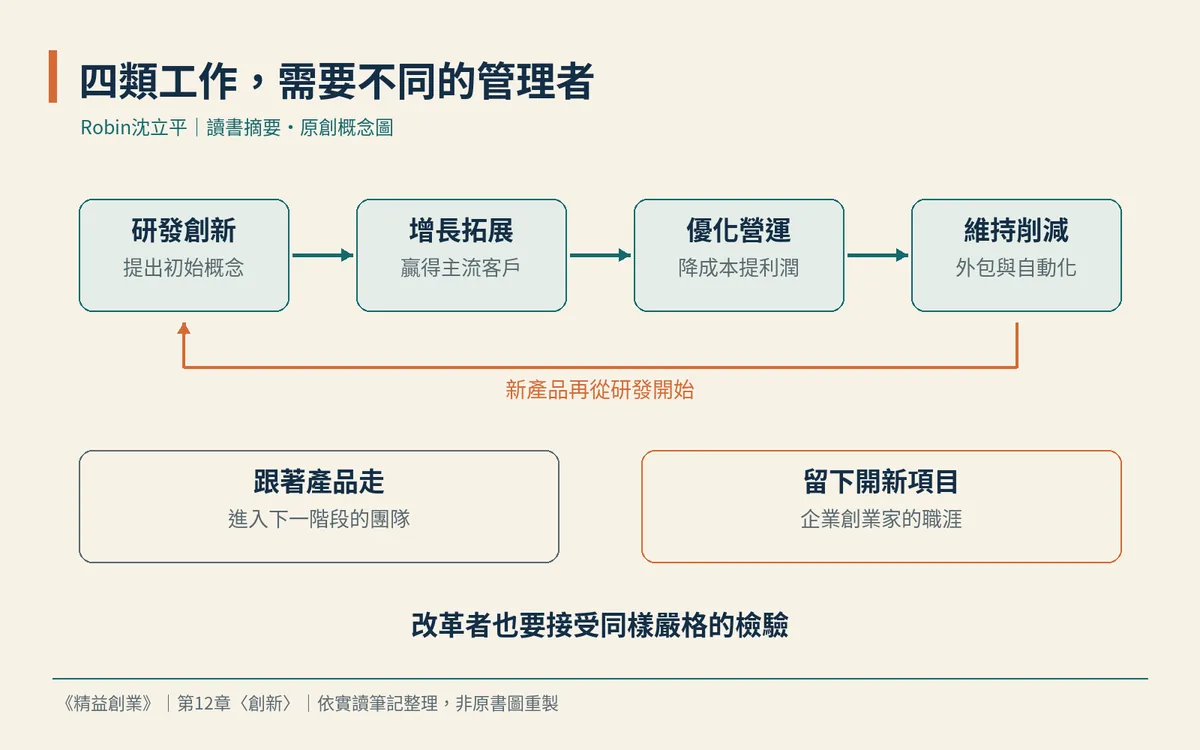
After a new product succeeds, the original innovator usually continues to grow and optimize it, and finally manages a mature department. This path of promotion looks only natural. In Chapter 12, Eric Ries argues that it may be one of the reasons an organization loses its creativity.
He divides the work into four kinds. The first is research and innovation, led by the entrepreneur who proposed the original concept. The second is growth and expansion: the product wins mainstream customers, becomes the company’s public face, and also begins to attract imitators. The third is optimization and operations: processes become routine, and outstanding operations lower costs and raise profits, bringing predictable growth. The fourth is maintenance and cost cutting: the product is aging, and the focus turns to outsourcing, automation, and saving money. Ries describes managers of this last kind as like baseball umpires: when they do well, no one notices; when they err, they are held responsible. But if the infrastructure or loyal customers once go wrong, the company may still fall into trouble.
He adds that it is not only large enterprises that have these four kinds of department. Any company at any moment is in all four states at once. Every successful product or feature begins in research and development, becomes part of the strategy, is then optimized, and finally becomes obsolete. The problem is that employees often travel with the product they developed through each stage, so creative managers become busy with growth and optimization and have no remaining capacity to develop new products. Every new project then has to compete with existing ones for resources, and the scarcest resource is talent.
Ries’s remedy is to make the corporate entrepreneur a concrete role. The four kinds of work are managed in different ways, each with a cross-functional team. When a product enters the next stage, it is handed off between teams, and employees can choose to follow the product or stay and start a new project. Ries says there is no right or wrong; it depends on personality and skill. Some people are inventors by nature; some are skilled at managing a mature business. Internal innovators should have a clear identity, be held accountable through innovation accounting, and receive corresponding promotion and reward, without having to leave the company in order to advance. After a product is incubated, it has to be reintegrated into the parent company. The ideal practice is to enlarge the sandbox gradually: for example, from the pricing page to the home page and search, and then to the whole site, rather than sending the team back into the standard process.
Then comes a very honest passage of self-description. Ries says that any system of innovation may become a victim of its own success: the sandbox expands, revenue grows, and yesterday’s innovators become guardians of the status quo. In his early years, advocating new practices, he was a thorn in the company’s side. Later, responsible for product development, the Lean Startup became the routine, and it was his turn to receive all kinds of contrary suggestions, from returning to waterfall development to demands for stricter statistics. His practice was neither to follow a script nor to compromise at every point, but to test by the same standard he had used at the start: can the theory predict the result, can a small team try it first, and can the impact be measured?
He also discusses Deming’s dilemma: when a new method is introduced, people tend to blame every problem on the new system, sometimes rightly and sometimes not. Distinguishing whether a problem is incidental or systemic requires a theory that can predict results. Ries observes that a transformation is often bitter first and sweet later, because the problems of the old system are invisible, while those of the new system are obvious. If you say in advance that productivity may fall temporarily, you can manage expectations earlier. This is Ries’s observation from experience; the book does not offer statistical support.
My reading is that this section is about the allocation of talent, not only an organization chart. I think that whether a company can keep innovating can be observed in whether the people who are best at starting things are now tied to optimizing old products. The conclusion is to let work at different stages be owned by people who fit it, to give innovators a career path on which they can stay, and at the same time to remind yourself: today’s reformer will tomorrow have to accept the same strict test.
Three suggestions
Take stock of the team’s current work and assign each item to research, growth, optimization, or maintenance, and find the pioneering talent that is trapped in optimization.
Design a handoff point for when a product enters the next stage, and let members of the original team choose clearly whether to follow the product or stay and start a new experimental project.
Every time someone proposes a change of process, first write the predicted result and a plan for a small team to try it, then judge whether the problems encountered are incidental or systemic.
#TheLeanStartup | Source: Chapter 12, “Innovate”
These are reading notes and reflections based on my personal understanding. I recommend reading them alongside the original book for the full context.
Comments
What do you think? Share your experience or questions.
Sign in to comment, reply or like. Sign in / Sign up
Loading comments…