Note 37 | Doing the Wrong Thing Efficiently Is the Waste Hardest to See
These are Robin Shen’s original reading notes and commentary, written in his own words after reading Eric Ries’s The Lean Startup: How Today's Entrepreneurs Use Continuous Innovation to Create Radically Successful Businesses. They are not the original book, excerpts from it, or an official publication. Methods and concepts from the book are attributed to Eric Ries; other sources are identified where stated. For reference only; not investment advice.
English translation of Robin’s Chinese reading notes and commentary. Passages are paraphrased, not verified verbatim quotations from the original English edition.
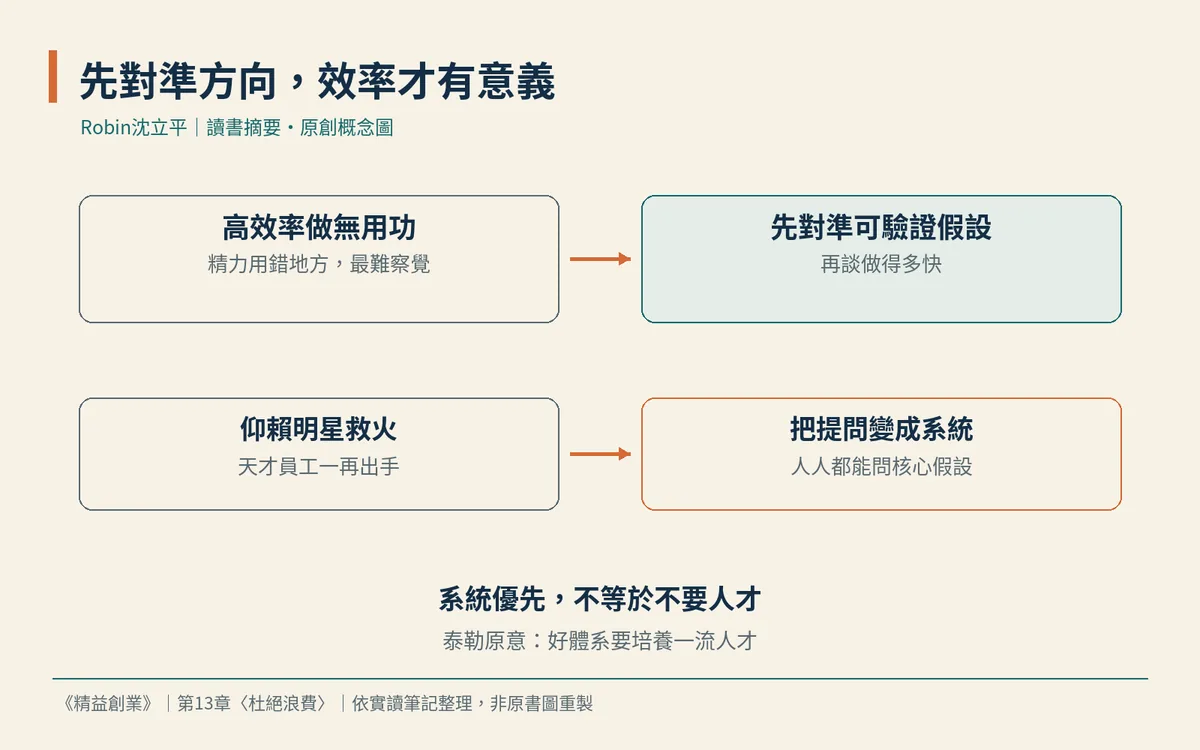
There is nothing so useless as doing efficiently that which should not be done at all. In Chapter 13, Eric Ries opens with this remark of Peter Drucker’s, and takes the time back to 1911, the year Frederick Winslow Taylor published The Principles of Scientific Management. The chapter has few cases and is mostly an argument. What it wants to answer is why organizations today are already so good at getting things done, and still waste so much human effort and creativity.
Ries gives Taylor a high evaluation: scientific management changed the twentieth century, and principles such as raising individual efficiency, management by exception, the standardization of tasks, and bonuses tied to the task can all be traced here. More critical is an idea: work can be studied and improved deliberately, a company is a system, and management should go beyond the level of the individual. But Ries also says the revolution was too successful, and is often misunderstood as a rigid management that treats workers as machines. Lean manufacturing later rediscovered every worker’s intelligence and initiative, and lifted the idea of efficiency from the individual task to the organization as a whole.
He then points to a new problem of the twenty-first century: productivity is already strong, and we can make almost anything we can imagine. The real difficulty has become whether we should make it. Ries quotes Taylor’s lament of the time: the waste of human effort in stupid, wrongly directed, or inefficient action is harder to see than the consumption of forests, coal, and iron. In Ries’s view, the passage is in one respect somewhat dated, because efficiency on the shop floor where physical things are made has already improved greatly; in another respect it fits the present exactly: our waste is not that work is poorly organized, but that energy is applied in the wrong place.
Ries says that in consulting and in talks, he hears employees of companies large and small tell similar stories: failed projects, poorly conceived plans, and the death spiral of large batches appear again and again. He also admits that it is hard to estimate the scale of the waste accurately, so this is an observation from experience, not a statistic. Common explanations include that projects are inherently high-risk, that markets change, that it is a disease of large companies, or that it is the short-termism of executives, investors, and the market. Common prescriptions are to slow down, strengthen process, and find more people of vision. Ries regards these as old-style answers. His claim is that once the cause is understood, most of the waste in innovation can be avoided. Merely motivating everyone to work harder is not enough, because the problem is precisely that too much is being invested in the wrong things. He also borrows Deming’s meaning: what matters is not setting a quantitative target, but finding a method for reaching it.
There is a story of a student in the book. This unnamed junior employee said that understanding Lean Startup principles was like having a superpower: in meetings with senior executives, asking only a few simple questions made everyone see that the project was built on testable hypotheses, and within minutes a plan for validation was offered, so he was called a genius. Ries’s reading is that his advantage was not talent, but a theory that can predict results and propose alternatives. Unfortunately, the managers who heard him did not see that what was truly needed was a systematic method, not still more outstanding people.
Ries also reminds us that putting the system first is not the same as not needing talent. Taylor himself said that the first aim of a good system is precisely to develop first-class talent, but this point was quickly forgotten. Later management became too rigid, and also overemphasized planning and prevention, which are suited only to a relatively static environment. Ries hopes the Lean Startup will not repeat that path, and he does not deny vision, courage, and perseverance. Precisely because these traits are precious, they should even less be wasted.
I think what is most worth taking from this chapter is the practice of examining effort and direction separately. The conclusion is that rather than expecting star employees to put out fires again and again, one should turn the way they ask questions into a method everyone on the team can use, so that every bit of effort is first aimed at a question worth validating.
Three suggestions
Pick the three most time-consuming pieces of work this quarter, write down for each which hypothesis it is validating, and pause and reassess any that cannot be answered.
Turn the questioning style of the person on the team who is best at catching problems into a fixed checklist, so that anyone can raise it at every project review.
At the next review, ask two questions as a rule: what is the project’s core hypothesis, and what is the fastest way to test whether it holds.
#TheLeanStartup | Source: Epilogue, “Waste Not, Want Not”
These are reading notes and reflections based on my personal understanding. I recommend reading them alongside the original book for the full context.
Comments
What do you think? Share your experience or questions.
Sign in to comment, reply or like. Sign in / Sign up
Loading comments…