Note 39 | Even the Method of Management Itself Is Worth Putting to Experiment
These are Robin Shen’s original reading notes and commentary, written in his own words after reading Eric Ries’s The Lean Startup: How Today's Entrepreneurs Use Continuous Innovation to Create Radically Successful Businesses. They are not the original book, excerpts from it, or an official publication. Methods and concepts from the book are attributed to Eric Ries; other sources are identified where stated. For reference only; not investment advice.
English translation of Robin’s Chinese reading notes and commentary. Passages are paraphrased, not verified verbatim quotations from the original English edition.
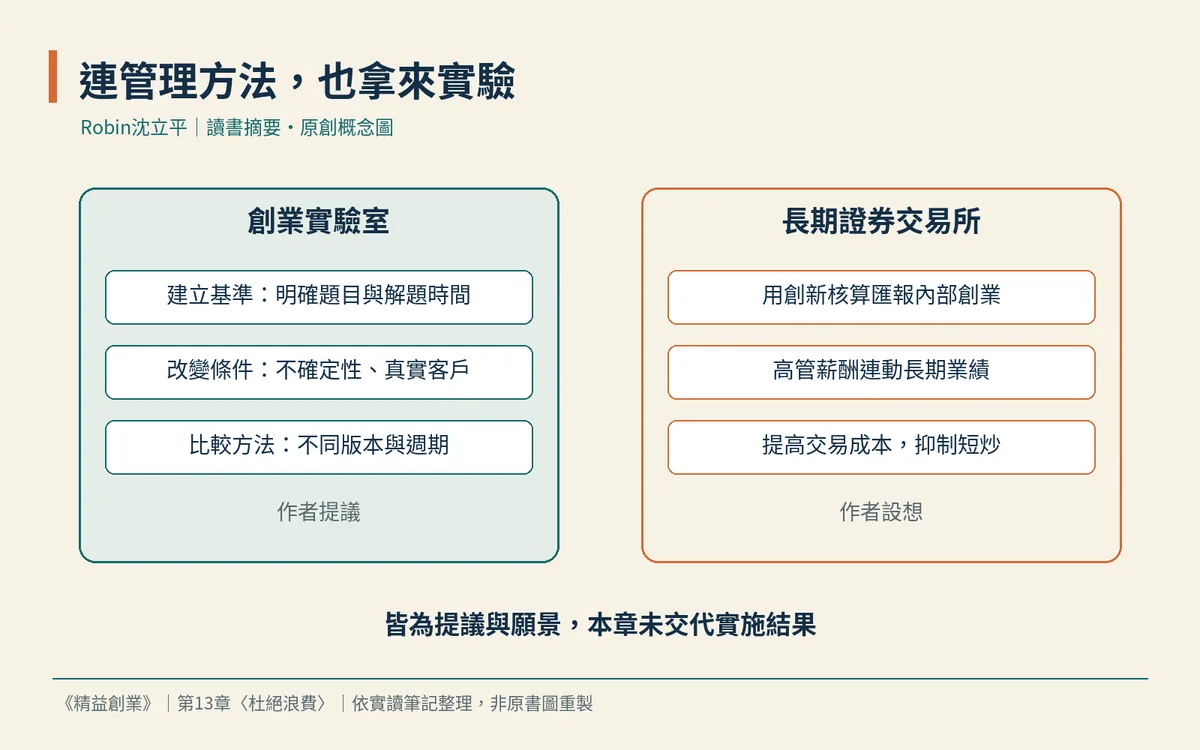
We often use experiments to test a product, and rarely use experiments to test the method of management itself. In the second half of Chapter 13, Eric Ries proposes two ideas: an entrepreneurial laboratory, and a long-term stock exchange. It should first be said clearly that these are Ries’s proposals and visions. This chapter does not report results of implementation, and I do not add background from outside the book.
Ries first makes a historical comparison. As he narrates, in the late 1880s Taylor began to study the best method of cutting steel, continuing for twenty-five years and conducting more than twenty thousand separate experiments. There was no academic or government research funding; companies paid, and the profits from the rise in productivity then funded later experiments. Other followers of scientific management also spent years studying bricklaying, farming, and shoveling, and were not satisfied with a craftsman’s experience or an expert’s word. Ries asks: do today’s managers of knowledge work take so deep an interest in their employees’ methods of work? And how much of our work of innovation is built on slogans that lack a basis?
His proposal is that companies establish an entrepreneurial laboratory to test various methods of product development. The idea is roughly as follows: first find small cross-functional teams, beginning with product and engineering development, and let them solve problems by different methods; use a bank of international programming-contest problems, whose questions are clear and whose answers are definite, to establish a baseline by time to solution; once there is a baseline, change the conditions, for example by raising the uncertainty of the problem, or by switching to a customer’s real problem and letting real consumers judge; you can also develop several minimum viable products to solve the same set of problems and see which conversion rate is best, or change the complexity of the development platform and the channel, and observe the effect of cycle time on actual productivity.
What Ries regards as most important is finding an exact way of holding a team accountable for validated learning. He admits that what this book proposes is innovation accounting with a clear financial model and an engine of growth, but that it is still too early to conclude whether this is the best method, and he looks forward to new methods appearing and being strictly assessed. Ries also imagines that research universities could form public-private partnerships with the entrepreneurial communities around them, and that the places where such research is done might become new centers of entrepreneurial practice.
The second idea is aimed at the whole ecosystem. Ries’s view is that, in part because public markets demand short-term profits, and because the way managers are assessed looks only at vanity metrics, many companies are forced to chase short-term numbers. He proposes establishing a long-term stock exchange, on which companies that value long-term development would list: besides quarterly profits, they would also report internal entrepreneurship through innovation accounting, for example by reporting revenue from new products; executive pay would be tied to long-term performance; transaction costs and fees would be raised substantially, in order to reduce short-term speculation; in exchange, companies would have more flexibility in internal management; and the exchange’s transparency would also provide data for research.
The chapter’s close describes an organization in which everyone states hypotheses clearly and tests them strictly by experiment, not in order to delay, but in a genuine search for the facts behind the vision; in which people no longer wrestle with a choice between quality and speed, because both serve the customer’s long-term interest; in which failure is faced honestly and learned from, rather than blamed on one another; and in which speed is raised by reducing work that does not help learning, rather than by slowing down or enlarging the batch. Ries says that what matters most is no longer wasting everyone’s time.
My reading is that what the two ideas share is treating the method of management and the system of assessment also as hypotheses that can be tested. I think an ordinary team need not wait for a new exchange to appear before it can first try something small inside the company. The conclusion is that if even the method of work will not be tested, even the best product experiments may be built on management habits that have never been validated.
Three suggestions
Pick a question about a method of work inside the team, such as the review process, design two approaches, and compare cycle time and the quality of the result.
In reports on innovation projects, add a separate column for revenue from new products and for actionable metrics, present them apart from short-term profit, and keep them from covering each other.
First try, on a small project, tying part of the responsible person’s assessment to long-term metrics, and write in advance the period of observation and the point of review.
Robin’s note | Taiwan startups and venture capital
If a Taiwanese investor sits on the board of a portfolio company, it may consider asking the team, in addition to the quarterly financial report, to attach actionable metrics and the progress of learning for new products. This is a conditional suggestion about the design of reporting. It does not involve the rules of any exchange or a regulatory requirement.
#TheLeanStartup | Source: Epilogue, “Waste Not, Want Not”
These are reading notes and reflections based on my personal understanding. I recommend reading them alongside the original book for the full context.
Comments
What do you think? Share your experience or questions.
Sign in to comment, reply or like. Sign in / Sign up
Loading comments…