Note 40 | The Author’s Reading Map: The Books from Which the Lean Startup Grew
These are Robin Shen’s original reading notes and commentary, written in his own words after reading Eric Ries’s The Lean Startup: How Today's Entrepreneurs Use Continuous Innovation to Create Radically Successful Businesses. They are not the original book, excerpts from it, or an official publication. Methods and concepts from the book are attributed to Eric Ries; other sources are identified where stated. For reference only; not investment advice.
English translation of Robin’s Chinese reading notes and commentary. Passages are paraphrased, not verified verbatim quotations from the original English edition.
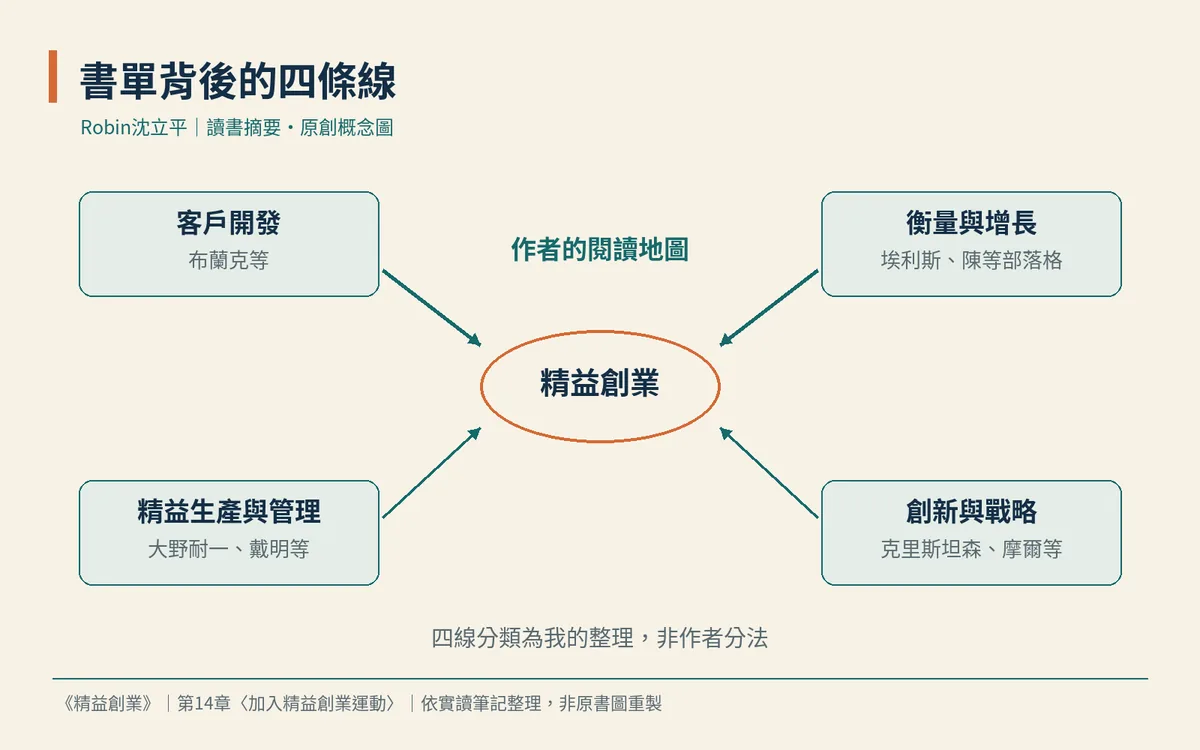
The last chapter of a book is usually a summary. Eric Ries’s Chapter 14 is more like a reading map: he uses only a short space to say that the Lean Startup movement has already gone global, then lists required reading and further reading. It should first be said clearly that Ries comments on only a few of the books; most have only a title and an author. The grouping below is my arrangement, not his.
The first book on the required list is Steve Blank’s The Four Steps to the Epiphany. Ries calls it the founding work of customer development, and says that while he was founding IMVU, this well-thumbed book was always at his side, an indispensable guide. In the disclosure at the end of the book, he states that he has an equity or other interest in IMVU. Another is Brant Cooper and Patrick Vlaskovits’s The Entrepreneur’s Guide to Customer Development, which Ries rates as a clear, concise, and compact introduction.
Then comes a string of blogs. Ries recalls that when he first began writing a blog on entrepreneurship, starting a company was far less common than it is now, few people discussed new entrepreneurial ideas, and people together discussed and refined those ideas online. The blogs he lists include Sean Ellis on how to bring marketing into a startup, Andrew Chen on viral marketing and startup metrics, Babak Nivi’s venture-capital playbook and the AngelList he later founded, Ash Maurya’s practice of the Lean Startup, and Sean Murphy’s blog on early lean development of software.
Further reading reaches farther. On disruptive innovation there are Clayton Christensen’s The Innovator’s Dilemma and The Innovator’s Solution, as well as his books on health care and education. Besides early works familiar to entrepreneurs, such as Crossing the Chasm, Ries especially mentions that Geoffrey Moore’s Dealing with Darwin is of reference value. On lean and management there are Donald Reinertsen’s principles of product-development process, Jeffrey Liker on Toyota, James Womack and Daniel Jones’s Lean Thinking, Taiichi Ohno’s Toyota Production System, W. Edwards Deming’s Out of the Crisis, and Peter Drucker’s The Practice of Management. On history there are biographies of Henry Ford and of Taylor, Taylor’s The Principles of Scientific Management, Alfred P. Sloan’s memoir of General Motors and related biographies. On software there is Kent Beck and Cynthia Andres on extreme programming. The last item is Getting to Plan B.
As I see it, this list can be roughly divided into four lines: customer development, measurement and growth, lean production and management, and innovation and strategy. This is an analysis I extend; Ries does not classify the books this way, and he does not say which part of this book each one influenced. The source of ideas the book states clearly is that the Build-Measure-Learn loop draws heavily on John Boyd’s OODA loop, which the next note takes up.
Why organize this map? My reading is that the Lean Startup was not invented from nothing. It joins ideas from several fields. If you read only this one book, it is easy to treat it as an independent set of techniques. Reading back along the list, you have a chance to see which concepts may come from the factory floor, and which from founders’ shared discussions online. These inferences, however, can be confirmed only by reading the original books. This note is organized only from the titles and comments Ries lists, and does not summarize the contents of those books.
I think the book list is best not treated as a to-read pile to be finished in one go, but as a single line chosen according to the problem in front of you. The conclusion is that Chapter 14 does not give a new method. It gives the method’s lineage. Readers can, according to their own situation, choose a starting point and follow it back.
Three suggestions
According to the problem that is most stuck at the moment, choose one of the four lines—customer development, measurement and growth, lean management, and innovation strategy—and first read one book.
After reading, pick only one concept, compare it with a passage of this book you have already read, and write down where the two are the same and where they differ. Do not force a complete correspondence.
Turn the concept you have read into a hypothesis that can be validated within two weeks, and design a small experiment, rather than only writing a reflection.
#TheLeanStartup | Source: “Join the Movement”
These are reading notes and reflections based on my personal understanding. I recommend reading them alongside the original book for the full context.
Comments
What do you think? Share your experience or questions.
Sign in to comment, reply or like. Sign in / Sign up
Loading comments…