Note 7 | The Hardest Thing to Delete Is Not the Code. It Is the Strategy You Believed Was Right
These are Robin Shen’s original reading notes and commentary, written in his own words after reading Eric Ries’s The Lean Startup: How Today's Entrepreneurs Use Continuous Innovation to Create Radically Successful Businesses. They are not the original book, excerpts from it, or an official publication. Methods and concepts from the book are attributed to Eric Ries; other sources are identified where stated. For reference only; not investment advice.
English translation of Robin’s Chinese reading notes and commentary. Passages are paraphrased, not verified verbatim quotations from the original English edition.
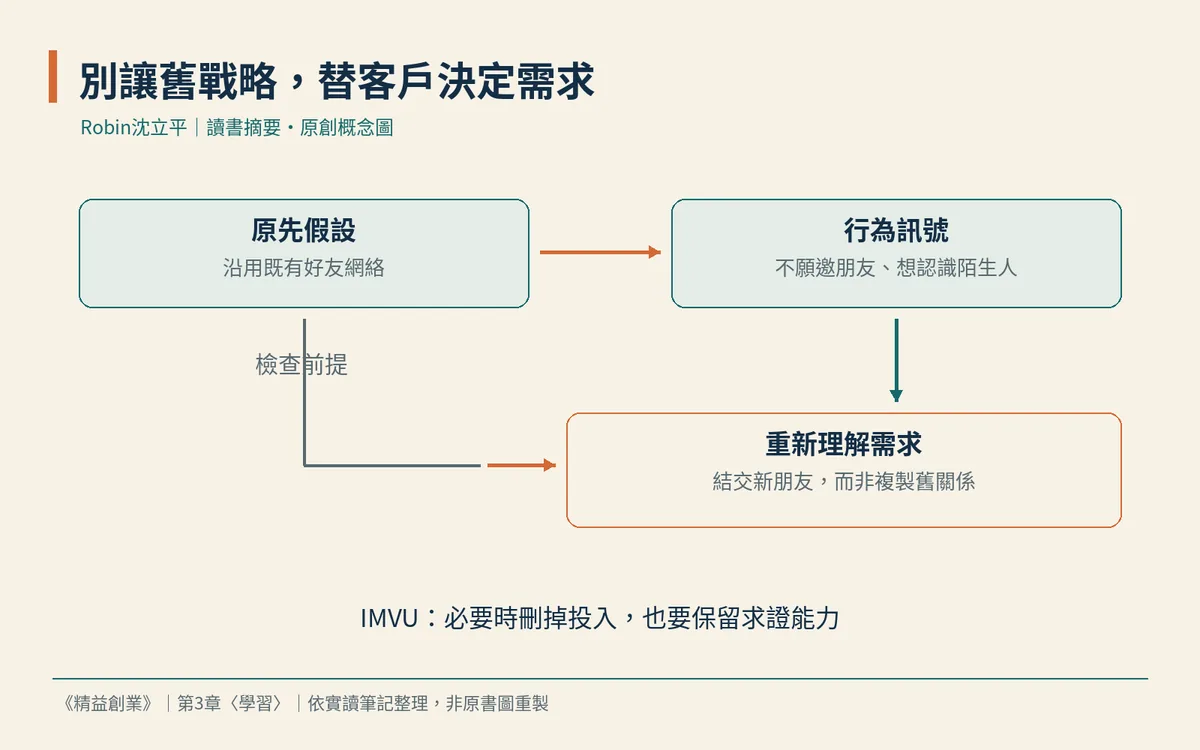
Even a highly persuasive strategy can take a team in the wrong direction. Looking back on IMVU in Chapter 3, Eric Ries does not describe the problem as a feature that was not polished enough. He admits that the team’s entire understanding of the market had to be rebuilt. That is a harder test for a founder than admitting a bug in the code.
As Ries describes it, IMVU first wanted to combine the wide use of instant messaging with the possibility that people would pay for avatars. The team judged that the social graph of existing messaging networks was a barrier to entry: users would not want to switch tools, and it would be hard to persuade friends to move. So they chose to build a plug-in compatible with existing networks, so users would not have to abandon the services they already used.
The strategy looked reasonable, and the engineering work naturally gathered around cross-network compatibility. Ries put a great deal of effort into it, and the team rushed to ship by a set deadline. The first signal from the market, however, was not that the product had too few features. Many people simply would not download it. Product details the team had debated at length never even had a chance to be seen.
Only later, in face-to-face contact with users, did the problem gradually come into view. Ries describes a young user who enjoyed dressing an avatar but would not immediately invite friends, because she had not yet confirmed that the product was fun and did not want to risk recommending a failure. The team had treated the absence of friends as a barrier in the experience, without first understanding the psychological cost of the invitation itself.
They first added a single-player mode, which still did not unlock the problem. Only after they added random chat matching did users begin to show interest. Then a new reaction overturned the original design: some people wanted to keep the new acquaintances, but did not want to put strangers into their existing friends lists. The existing social circle was not necessarily an asset that had to be borrowed. It could also be a boundary that needed to be kept separate.
Ries also found that the team had overestimated the friction of learning a new messaging tool and underestimated users’ habit of adopting several tools at once. The more central need was not to move old friends into a new virtual environment, but to make new friends safely. The plug-in strategy was therefore not merely something to improve. A great deal of work had been invested around a false premise.
The learning here was not a single interview that suddenly delivered a complete answer. It took many product adjustments, observations of behavior, and repeated collisions to overturn the original analysis bit by bit. Users also did not write a new strategy for the team at the outset. What Ries wants to show is that real interaction can expose problems the team had not imagined, rather than merely vote in favor of an existing idea.
Throwing away the cross-network compatibility code was painful for him. He admits that, for all his regard for agile development, he still built a product users would not buy. The sharper reflection is not “at least we learned something,” but whether, if the aim was to clarify the need, they really had to spend so much time and support so many networks to reach the same understanding.
That is why sunk effort and future judgment have to be kept apart. Elegant code cannot testify for a market assumption, and a complete strategic analysis cannot excuse you from observation. From this case it follows that when customer behavior does not match expectations, you cannot always blame insufficient explanation or missing features. You also have to go back and check the problem statement itself.
My reading is that true professionalism is not always proving that you were right, but being able to recognize which premise is no longer worth protecting. That is not an argument for copying IMVU’s product decisions. Ries says plainly that the specific tactics may not travel. What is worth taking away is the ability to let strategy be tested against evidence of behavior.
Three suggestions
Write out, one by one, the judgments about users that sit behind the strategy, and especially mark the premises that look like common sense but have not been confirmed by direct contact.
Observe the step at which users stop, then use conversation to understand why. Do not only ask whether they like it, and do not immediately cover the contradiction with more features.
Check whether current engineering is serving a false premise, allow work that is no longer necessary to be deleted, and put “could we have reached the same understanding faster” into the next plan.
#TheLeanStartup | Source: Chapter 3, “Learn”
These are reading notes and reflections based on my personal understanding. I recommend reading them alongside the original book for the full context.
Comments
What do you think? Share your experience or questions.
Sign in to comment, reply or like. Sign in / Sign up
Loading comments…