Note 6 | Less Rule by Fiat, More of a System That Lets Experiments Happen
These are Robin Shen’s original reading notes and commentary, written in his own words after reading Eric Ries’s The Lean Startup: How Today's Entrepreneurs Use Continuous Innovation to Create Radically Successful Businesses. They are not the original book, excerpts from it, or an official publication. Methods and concepts from the book are attributed to Eric Ries; other sources are identified where stated. For reference only; not investment advice.
English translation of Robin’s Chinese reading notes and commentary. Passages are paraphrased, not verified verbatim quotations from the original English edition.
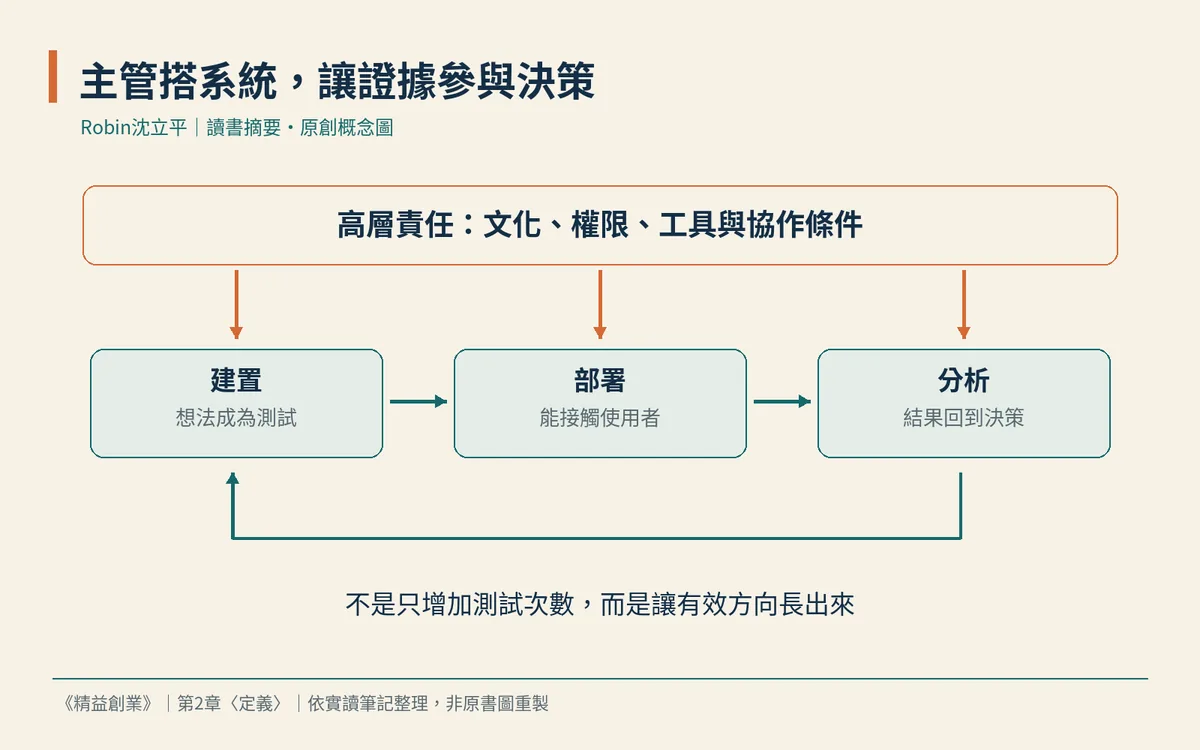
If the manager always has to pick the best idea, the organization will spend its energy on persuading the manager. In Chapter 2, Eric Ries quotes Scott Cook’s observation: when a company has only one high-stakes chance to test, employees become salespeople for proposals; when more ideas can be tested in practice, people can become entrepreneurs who dare to try and know how to learn.
This is not a rejection of analysis. It is a change in where judgment mainly happens. If a proposal’s fate depends only on how complete the slides are and how well the presenter can debate, internal persuasion can replace market evidence. Even a very smart leader cannot know the outcome of every innovation in advance by personal intuition.
Ries describes the background to Intuit’s change. By traditional standards the company was well managed, yet after reviewing years of new-product results, Cook was still disappointed by its innovation performance. The problem was not that the company had no capability at all. It was that existing capabilities were good at running a stable business, and not necessarily at exploring new ones. The inertia of successful management can also become a barrier to change.
The TurboTax story offers a concrete contrast. As Ries recounts from a senior executive, the team moved from preparing one major event a year to running many tests during tax season, and linked revision, testing, reading results, and redesign into short cycles. This is the company’s own account at the time the book was written, not a statistic about today’s average corporate performance, and the number of tests alone cannot prove commercial success.
What matters is that these cycles can actually be run. In the past, even if marketing colleagues had ideas, they could not test them if the website could not be updated quickly. Ries notes that Intuit invested in the speed of test setup, deployment, and analysis. A leader’s job is therefore not only to approve experiments, but to give the organization the conditions to run them.
Cook puts building a system for experiments squarely among the responsibilities of senior leadership. If the process is stuck in existing permissions, tools, and cross-department coordination, front-line enthusiasm will not be enough. Leaders need to move from directing every idea to building a culture and a system the team can use. That shift is more concrete than a few slogans about innovation.
A mature company cannot, however, ignore existing customers in the name of exploration. The book also notes that expectations of service quality and stable growth make change harder. Ries does not say that responsibility for the old business can be withdrawn. He says that a mechanism for innovation has to be built inside those constraints. The case is not an argument for turning all work into something that can be changed at any moment.
On measurement, Ries quotes Brad Smith’s attention to the customers and revenue contributed by recent new products. That keeps the discussion from stopping at how many tests were run, and returns it to whether new businesses are gradually taking shape. Ries also reminds us that for a large company, the results at that point were still early, and that systems and habits accumulated over years do not disappear with one announcement of change.
The effect of the system will also show in whether failures can be brought back for discussion. If a failed test is treated as a sign that the proposer lacks ability, more tools will only create an incentive to report good news. From Ries’s demands on culture and system, it follows that managers should hold people accountable for the process of seeking evidence, not require every starting idea to win.
I think this chapter’s most direct demand on managers is to use authority to remove barriers to experiment, not to monopolize every answer. The system should let ideas meet evidence, and let ineffective directions be retired in time. If you only increase the number of tests and still let rank decide the conclusion, you have merely put a more fashionable interface on rule by fiat.
Three suggestions
Walk one experiment from setup and deployment through the discussion of results, find the waits and permission barriers, and have someone with the authority to change the system remove them.
Turn part of proposal review into an examination of testable questions, so that employees do not first have to win a contest of eloquence before they can reach a real response.
Track both whether the experimental system is working and whether new products are beginning to contribute. Do not let the number of tests stand in for results, and do not neglect the duty to serve existing customers.
#TheLeanStartup | Source: Chapter 2, “Define”
These are reading notes and reflections based on my personal understanding. I recommend reading them alongside the original book for the full context.
Comments
What do you think? Share your experience or questions.
Sign in to comment, reply or like. Sign in / Sign up
Loading comments…