Note 9 | The Fantasy of Zero Traction Is More Addictive Than Modest Results
These are Robin Shen’s original reading notes and commentary, written in his own words after reading Eric Ries’s The Lean Startup: How Today's Entrepreneurs Use Continuous Innovation to Create Radically Successful Businesses. They are not the original book, excerpts from it, or an official publication. Methods and concepts from the book are attributed to Eric Ries; other sources are identified where stated. For reference only; not investment advice.
English translation of Robin’s Chinese reading notes and commentary. Passages are paraphrased, not verified verbatim quotations from the original English edition.
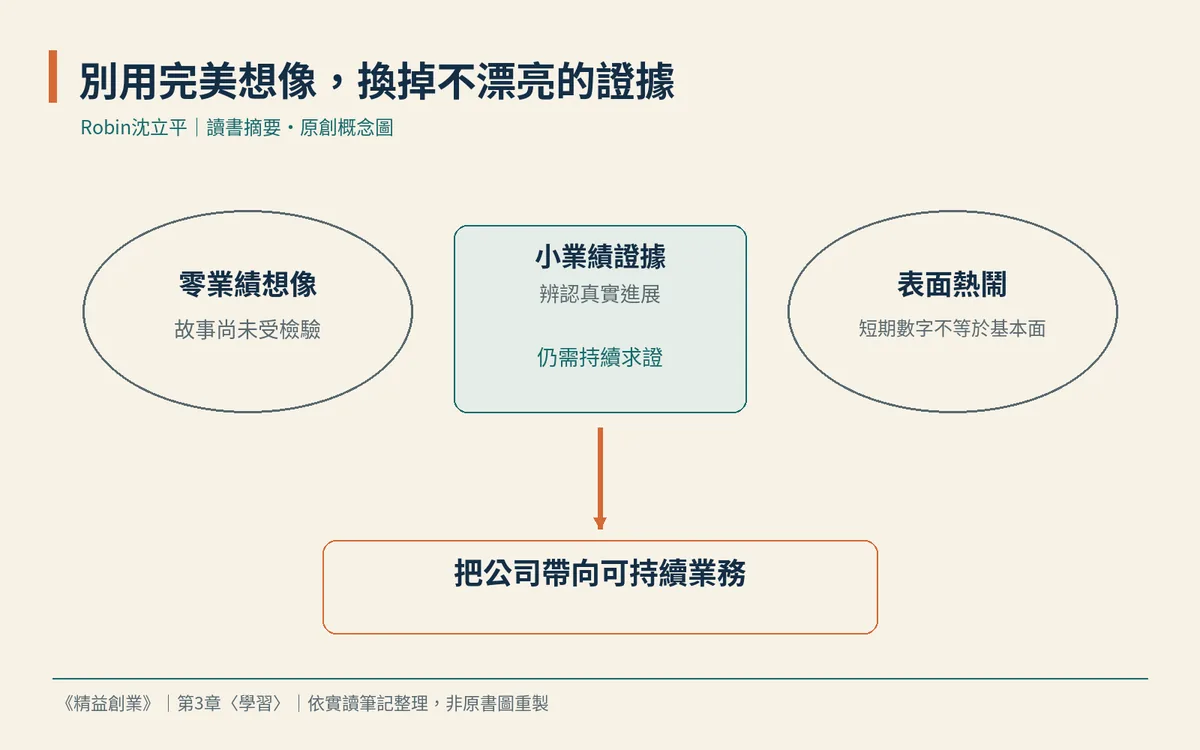
When there are no numbers, everyone can imagine a handsome growth curve. Once a little real traction appears, many embarrassments have to be faced. In Chapter 3, Eric Ries describes this peculiar pressure: a product that has not yet shipped can carry unlimited expectations, while the first modest results may suddenly exhaust supporters’ patience.
This is an observation Ries draws from IMVU’s early experience, not a universal law of every investment decision. It exposes a temptation: as long as there is no data, you do not have to prove the original story; once you start collecting it, the real world may be much smaller than the slides. Delaying validation is then easily packaged as protecting the brand, waiting for completeness, or avoiding misunderstanding.
As Ries describes it, IMVU set a very low early revenue target and still reached it only with difficulty. Even when things later improved, the numbers were not enough, in traditional performance terms, to restore confidence. Some advisors and people around the team began to doubt, and some investors even suggested taking the product down and returning to stealth development. Facing small numbers, the pressure on the team was real.
Ries does not therefore argue that earlier revenue should be as low as possible. What should be avoided is deliberately staying away from evidence in order to preserve a large imagination. If every encounter with reality is postponed, the team will keep adding features and costs on top of the original assumptions, and lose the chance to discover a problem of direction early. The absence of bad news does not mean that risk is not accumulating.
The other extreme is to offset the embarrassment with surface bustle. Ries reflects that inflated public relations or expensive promotion might temporarily create an impression of rapid growth, but the fundamental problem would still return. This is different from delaying the collection of data, yet it can serve the same purpose: letting the outside world see a reassuring story, rather than bringing the organization closer to a real need.
The meaning of modest traction therefore cannot be judged only by absolute size, and smallness itself is not automatically valuable. The question is whether product adjustments are better meeting real customers, whether related behaviors show a credible improvement, and whether those changes can support the next judgment. What Ries wants to demonstrate is that development is taking the company toward a sustainable business, not merely that the company was once noticed.
This also explains why “we have already shipped” is not the end of management. Pushing the product out and then leaving it to fate is no more scientific than keeping it hidden. The team has to understand the response, adjust the approach, and account to employees and supporters for the evidence obtained. Without that shared language, even real progress can be covered up by a revenue total that does not look good enough.
Conversely, “we look at learning” cannot be used to shut out every financial and behavioral question. Ries points out that learning needs the support of real customers’ experience. If there is still no visible improvement, you cannot rely only on the vision to demand that everyone keep believing. Learning is not a rhetoric for defending modest results. It is a way of making it clearer to everyone what is now known and what is still unknown.
I would read this passage as saying that early supporters need the capacity to live with unflattering evidence, and the founding team has a duty not to hide it. This is not a demand to stay optimistic about every downturn. It is a warning not to let the pressure to present handsome numbers reward the team for delaying validation, or divert scarce resources into manufacturing an appearance.
What is truly worth protecting is not an estimate that has not yet been punctured, but the ability to correct course after facing reality. Going from nothing to something often means first losing the perfection of imagination, and gaining information you can use to decide. If you retreat to the safety of having no evidence merely because the real results are too small, exploration loses its most important starting point.
Three suggestions
Before shipping, agree how early, modest data will be read, and require that changes in behavior and the problems still to be solved be presented together. Do not first promise a handsome growth story.
Examine the reasons for delaying the collection of data, and distinguish improving the conditions of a test from merely wanting to avoid an unflattering result. Do not let waiting become a habit.
Discuss surface changes produced by promotion separately from evidence produced by product improvement, and put resources first into understanding the fundamentals, not into maintaining a false sense of security.
#TheLeanStartup | Source: Chapter 3, “Learn”
These are reading notes and reflections based on my personal understanding. I recommend reading them alongside the original book for the full context.
Comments
What do you think? Share your experience or questions.
Sign in to comment, reply or like. Sign in / Sign up
Loading comments…