Note 10 | Split the Assumptions Before You Build the Product: Value and Growth Are Two Questions
These are Robin Shen’s original reading notes and commentary, written in his own words after reading Eric Ries’s The Lean Startup: How Today's Entrepreneurs Use Continuous Innovation to Create Radically Successful Businesses. They are not the original book, excerpts from it, or an official publication. Methods and concepts from the book are attributed to Eric Ries; other sources are identified where stated. For reference only; not investment advice.
English translation of Robin’s Chinese reading notes and commentary. Passages are paraphrased, not verified verbatim quotations from the original English edition.
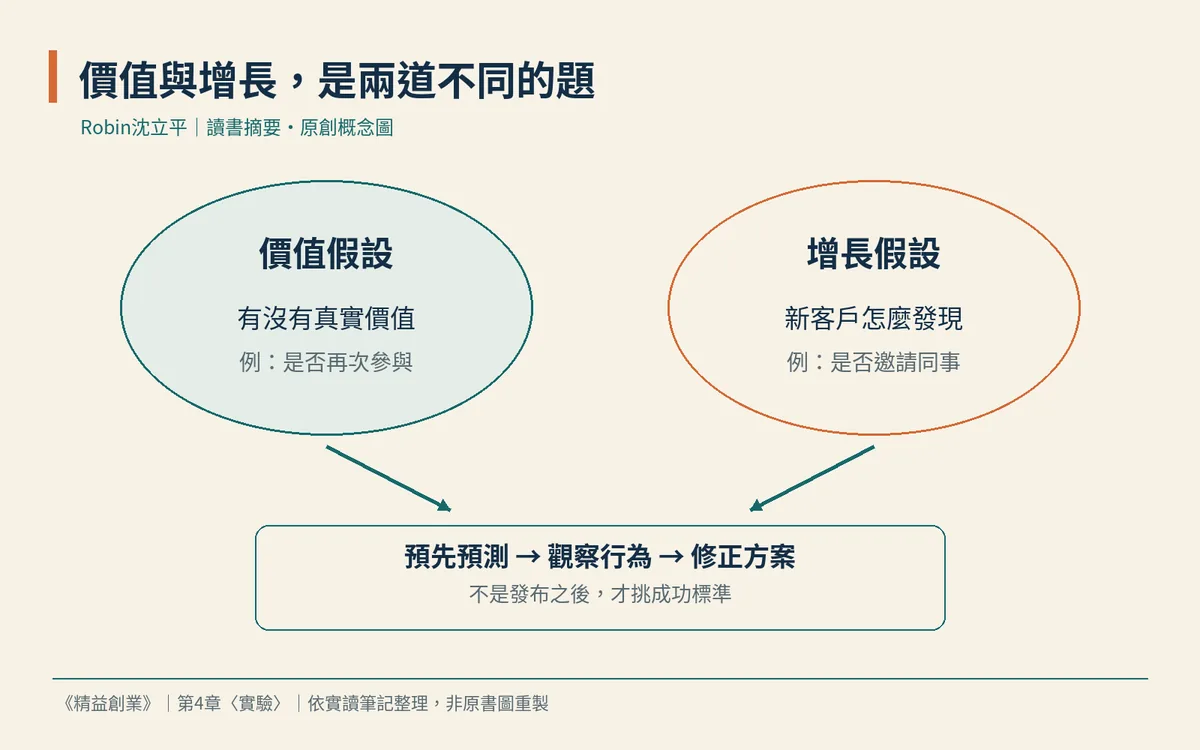
Shipping and then watching the response is not the same as running an experiment. In Chapter 4, Eric Ries stresses that you must first have a clear hypothesis and a predicted result, so you can tell which of your original understandings were supported and which need to be revised. Otherwise any outcome can be explained after the fact, and the team may see things happen without obtaining usable knowledge.
He separates two core questions. The value hypothesis asks whether the product or service truly creates value for customers. The growth hypothesis asks how new customers discover it. Willingness to try does not mean people will keep using it; satisfaction in use does not automatically explain how more people will arrive. The two are related, but they cannot be declared passed together on the strength of one lively launch event.
As Ries describes it, when Nick Swinmurn was exploring the idea that became Zappos, he did not first build a complete warehouse. He photographed inventory in a physical shoe store, and only after someone bought online did he go to the store, purchase the shoes, and ship them. The prototype first addressed whether customers would actually buy shoes over the internet, not whether the team could design a complete e-commerce system.
It was also more than collecting a survey of stated intent. A real transaction required payment, customer support, and returns, and therefore brought the team into contact with problems they might not have imagined. Ries uses this to distinguish behavior from a hypothetical answer: saying you would be willing to buy is one signal; actually completing a purchase is another. What was kept lean was the starting setup, not the customer interaction itself.
The difference between value and growth is even clearer in the experimental design Ries proposed for an HP volunteer program. Caroline Barlerin wanted employees to use their professional skills to give back to society, but existing programs were hard to scale. Ries did not first add promotion or extend the planning. He broke the large goal into whether employees saw participation as valuable, and how the program would spread.
As he suggested, value could be observed in whether people signed up again after completing a service; growth could be seen in whether early participants actively invited colleagues. Employees may endorse a public-spirited cause in words without actually taking part; a company may send many messages without participants being willing to spread the word. Separating the two questions makes it easier to tell whether the bottleneck is the experience, the motivation, or the method of diffusion.
Ries also suggests first finding early participants whose need is urgent, offering a more targeted experience, and then watching completion, return, and invitation. This is not a claim that a few people’s responses can precisely represent all employees. It is a way of first seeing, among those most likely to need the offering, whether the core assumptions hold, and then revising from there.
The prediction has to come before the result. If you originally expected participants to come back, and they generally refuse, you cannot close the file merely because the event ran smoothly. Ries sees this as the moment to obtain qualitative feedback and improve the offering, not as a reason to throw the vision away at once. Failure is not a decorative slogan. It is what brings a previously hidden problem to the surface.
I think what the two cases truly share is not a requirement to use one particular kind of minimum product, but first knowing which question you want to answer. An early experiment can bring back unexpected information, but it still needs a main question. Otherwise it is easy to pick only favorable signals and still be unable to say which judgment they actually support.
The conclusion is practical: only when you split the assumptions can you know where to reduce the investment, what behavior to watch, and how to act once the results are in. Small scale is not the goal. The point of an experiment is to obtain, at a reasonable cost, evidence sufficient to revise a decision. A long-term vision and present validation need not exclude each other.
Three suggestions
Write the value and growth hypotheses separately, and assign each an observable behavior. Do not treat a satisfied reply, repeat use, and an active referral as the same result.
Run a limited test with early subjects whose need is more urgent, and record what is special about them, rather than treating the sample as the whole market.
Leave a prediction on record before the test. When the result does not match, go back to the reasons and revise the offering, so you do not wait until the event is over to pick the success criterion that is easiest to explain.
#TheLeanStartup | Source: Chapter 4, “Experiment”
These are reading notes and reflections based on my personal understanding. I recommend reading them alongside the original book for the full context.
Comments
What do you think? Share your experience or questions.
Sign in to comment, reply or like. Sign in / Sign up
Loading comments…