Preface | Read the Advice of Thirty-Five People, Then Judge for Yourself Using Context and Evidence
These are Robin Shen’s original reading notes and commentary, written in his own words after reading Tren Griffin’s A Dozen Lessons for Entrepreneurs. They are not the original book, excerpts from it, or an official publication. Methods and concepts from the book are attributed to Tren Griffin; other sources are identified where stated. For reference only; not investment advice.
English translation of Robin’s Chinese reading notes and commentary. Passages are paraphrased, not verified verbatim quotations from the original English edition.
A Dozen Lessons for Entrepreneurs — Foreword to the Chinese edition by Wang Yue, “Listen Fully, Decide Alone”; Foreword by Scott Belsky; Introduction; and Concept Directory
The Chinese edition of this book was published in July 2019. Author Tren Griffin brings together the perspectives of thirty-five investors and founder coaches, drawing on roughly four years of interviews and reading before that. Its observations, examples, and arguments are a record of the time when it was written.
The first thing this book asks you to confront is a collection of sometimes conflicting advice, rather than a single set of answers. In his foreword to the Chinese edition, Wang Yue draws on eighteen years of joining startups, founding companies, investing, and mentoring to ask whether entrepreneurship can be cultivated. He describes the entrepreneur’s psychological journey as passing through a tunnel: anxiety rises and outside voices multiply. Some advocate going your own way or managing strictly; others favor a free atmosphere. Some want to validate the market first; others pursue speed. He argues that the real work is to listen, digest these voices, and develop your own judgment. In his view, entrepreneurship does not suit the vast majority of people, and not every small business or wish to get rich should be dressed up as entrepreneurship. No course can replace the journey itself; the people you meet and the failures you experience along the way are the learning material. He singles out convexity and contrarian investing, seeing both as practices that require cultivation. These were Wang’s judgments in his May 2019 foreword. Its title, “Listen Fully, Decide Alone,” captures the point: listen carefully first, then make your own decision.
Scott Belsky’s foreword describes entrepreneurship as the practice of reconciling contradictions. He argues that entrepreneurship education can hardly become a set of best practices that works everywhere, because entrepreneurship is fundamentally about creating something new. Successful experiences across industries, cultures, markets, and moments are valuable, but they often contradict one another. You can learn from advice, but you cannot apply it wholesale; founders still have to design their own approach. Industry experts have advantages, but sometimes outsiders are the ones who change the assumptions. Innovation must offer something different without making users feel lost. Belsky uses Behance, which he founded, as an example. Early on, creative categories were called “kingdoms” and groups were called “circles.” These were later replaced with more intuitive names that people could immediately understand. People also often cite famous founders’ behavior to justify their own choices, overlooking the different circumstances and timing behind those choices. Companies need to listen to customers, but customers cannot necessarily articulate needs they have not yet recognized. A business plan can be a useful starting point, but it is not a fixed route; an unknown market calls for even more action and correction. Belsky says the book gathers experience from multiple angles. That does not mean it contains standard answers. Readers must recombine these experiences into judgments that fit their own team and direction.
In the introduction, Griffin explains that these thirty-five people are arranged by surname. The founder coaches come first because their work is to use questions and advice to help founders grow personally and in management and leadership. Not every coach has to be an investor as well. He also argues that different backgrounds bring different perspectives, and he hopes the industry will become more open. More immediately useful to readers are the Concept Directory at the front and the glossary at the back. Different people’s chapters may address the same question in similar ways, or they may diverge. The directory is an index for comparing those differences.
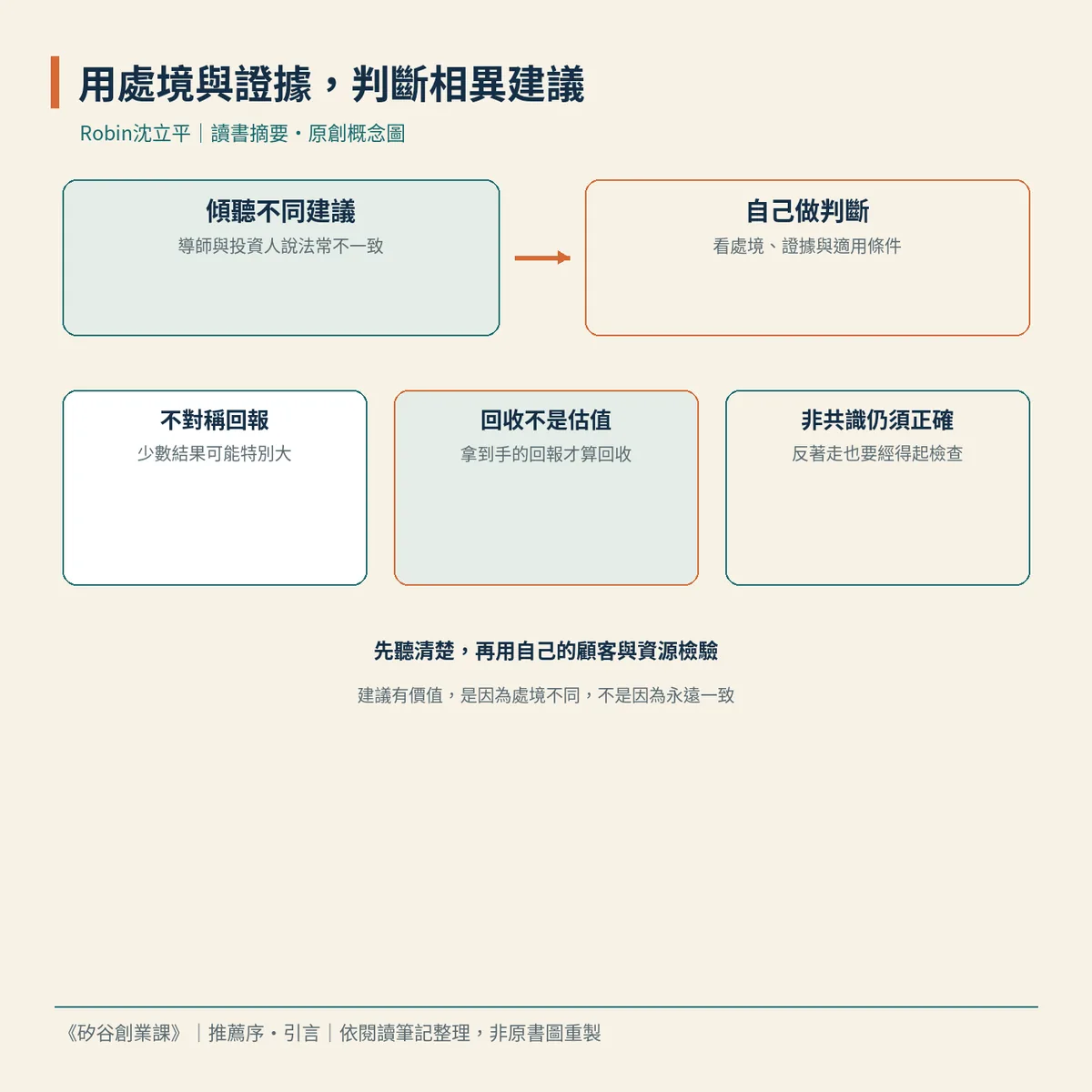
Three concepts recur in these comparisons and deserve to be distinguished upfront. The first is convexity. The author uses Jeff Bezos’s baseball analogy: in baseball, the most a single hit can do is take you around all four bases, but in business, a few successes can produce returns far above the ordinary. To increase the chances of such outsized returns, you cannot play conventionally every time. Yet basing every decision on unconventional approaches is also highly risky. The point is an asymmetric payoff: a few outcomes may be exceptionally large, while most may be ordinary or even failures. The second is a grand slam. In venture capital, this means an investment produces realized, distributable returns that are many times the capital invested. The author deliberately distinguishes this from a high valuation on paper. A high valuation, or merely an exit, does not automatically mean that many times the original capital has actually been recovered. The third is contrarian thinking: looking for opportunities most people overlook. The author relays Ray Dalio’s and Howard Marks’s caution that you must think independently. Simply doing the opposite of the crowd is often wrong too. Being both outside the consensus and right is difficult and easy to get wrong. Airbnb is cited as an example that seemed unusual at the time, when some people worried about strangers staying in their homes. Being nonconsensus is not enough. Your judgment also has to be right and open to scrutiny against later evidence.
The conclusion: the advice of these thirty-five people is valuable precisely because it comes from different circumstances, which also means it will not automatically agree. As you read, first ask: Under what conditions was this advice offered? What evidence supports it? Would it still hold for your customers and resources? Listen broadly, then judge for yourself using context and evidence. That makes these experiences more likely to become choices you can test, rather than a collection of conflicting quotations.
One deeper insight
I think the least useful response to conflicting advice is to collect another, more forceful quotation. A more useful response is to write down the other person’s stage, the evidence they saw, and the conditions you currently lack. Distinguish those clearly, and listening can become judgment. Fail to distinguish them, and you will end up swinging between different success stories.
Three suggestions
First, before reading about each person, write three sentences describing who your current customers are, where you are stuck, and what evidence you already have. After reading, compare the advice against those sentences. Mark which advice is directly useful and which applies only at a different stage or with different resources.
Second, when two pieces of advice conflict, write down for each: “What conditions must hold for this to work?” and “If those conditions are absent, what contrary signs would I see?” If you cannot identify contrary signs, do not rush to take sides. Gather more information, conduct interviews, or observe in the field as the question requires, then decide.
Third, examine a claim of high valuation or high growth that you are currently pursuing. Separately write down “How is this valued now?” and “What would actually have to happen to realize a return?” If the two do not line up, clarify the conditions for realizing a return before deciding how much time or how many resources to commit.
#ADozenLessonsForEntrepreneurs #EntrepreneurialJudgment #ReadingNotes
These are reading notes and reflections based on my personal understanding. I recommend reading them alongside the original book for the full context.
Comments
What do you think? Share your experience or questions.
Sign in to comment, reply or like. Sign in / Sign up
Loading comments…