Note 1 | First Distinguish Searching for a Model From Executing One You Have Found
These are Robin Shen’s original reading notes and commentary, written in his own words after reading Tren Griffin’s A Dozen Lessons for Entrepreneurs. They are not the original book, excerpts from it, or an official publication. Methods and concepts from the book are attributed to Tren Griffin; other sources are identified where stated. For reference only; not investment advice.
English translation of Robin’s Chinese reading notes and commentary. Passages are paraphrased, not verified verbatim quotations from the original English edition.
A Dozen Lessons for Entrepreneurs — Chapter 1, “Steve Blank” (Part I, “The Founder Coaches”)
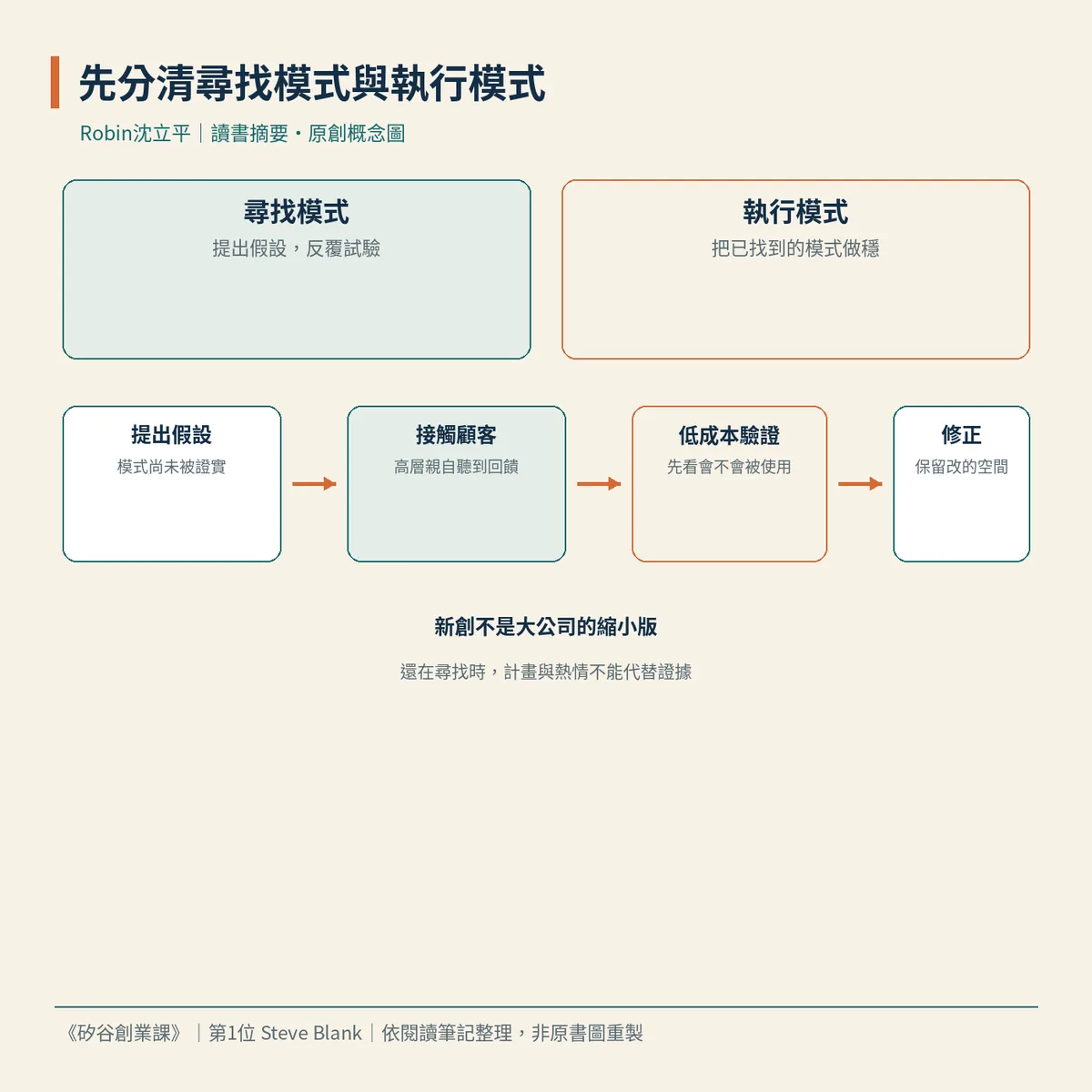
The book looks back at Steve Blank’s twenty-one years working at eight technology companies before he turned to teaching entrepreneurs and introduced the customer development process in The Four Steps to the Epiphany. Start with one distinction: a startup’s purpose is to search for a repeatable, scalable business model; an established company’s purpose is to execute a model it has already found. A business model describes how a company creates, delivers, and captures value. Finding one does not mean first writing a business plan that looks complete. It means forming hypotheses and testing them repeatedly to discover what actually fits.
This distinction changes many subsequent choices. A startup is not a smaller version of a large company. Until you know what you will operate, you cannot produce a fully developed operating plan, and plans often fail to survive the first real contact with customers. Once a company has grown through an existing model, it often resists developing new products or models internally. Exploration and execution naturally tend to pull against each other. If a new division in a large company is searching for a new model, it cannot be managed as an upgrade to an old product. Turning a vision into a revenue forecast before customer development begins, or undervaluing a new effort because its near-term revenue is small, can both substitute forecasting for validation.
Product development therefore needs ongoing customer contact by senior leaders. If product discussions happen only in the office and sales or marketing speaks for the product team, customer input can easily become a formality. Blank advocates getting out, forming hypotheses, meeting users, testing, and iterating. The approach is to start with a product and find a suitable market, rather than imagine an abstract market and force a product into it. “Build the company and customers will come” is not a strategy. If founders will not spend time establishing whether real, sufficiently large demand exists, the team can easily mistake hope for evidence as funding pressure rises. Early on, use lower-cost tests to validate whether customers will actually use or buy the product. Avoid committing too much time that is hard to recover to enthusiasm you have yet to test. Failure hurts, but discovering it earlier can reduce larger losses later.
To make correction possible, decision speed must keep pace with feedback from the data. Act quickly, spot mistakes, and correct them, leaving observable results from every experiment. Entrepreneurship also involves more than risk. With risk, both outcomes and probabilities are broadly known. With uncertainty, possible outcomes are known but probabilities are unclear. With ignorance, even the possible future outcomes are unclear. Blank also sees economic downturns as potential windows of opportunity because hiring, costs, and competition can sometimes be more favorable. That is his observation about cycles; you still have to examine your own customers and costs to see whether the assumptions can be tested. Returns are often uneven: a few outcomes are exceptionally large, while most are ordinary or failures. Blank cautions against treating the majority who do not get rich as failures. This also reminds me to be humble toward others and to test my own assumptions, returning to whether customers exist and whether the model can be repeated.
The conclusion: first ask whether you are searching for a model or executing one you have already found. If you are still searching, keep senior leaders in direct contact with customers, collect feedback through low-cost experiments, and preserve room for correction. Plans, forecasts, and enthusiasm can all be starting points, but they cannot replace evidence.
One deeper insight
I think the easiest mistake for a team to make is not an incomplete plan. It is moving at the pace of executing an existing business before confirming that the model works. Distinguish search from execution first, and speed becomes meaningful. What needs to move quickly is testing assumptions, rather than executing an unvalidated story more thoroughly.
Three suggestions
First, write your current business model assumptions on one page: what value you create for whom, how you deliver it, and how you earn a return. Label every sentence “Evidence available” or “Still an assumption.” If you cannot explain how to test a sentence labeled “Still an assumption,” define the test before increasing your commitment.
Second, during an upcoming work cycle, have the people making product decisions speak directly with several target customers or observe them using the product. Ask where they actually get stuck and whether they would use or buy it. Adjust the frequency and cycle to the product. The point is for the decision-makers to hear firsthand accounts themselves, rather than only reports from sales.
Third, design a lower-cost experiment with observable results for your most important current assumption. Specify upfront what would make you continue, correct course, or stop. Then decide whether to commit to a longer development effort.
#ADozenLessonsForEntrepreneurs #SteveBlank #CustomerDevelopment #ReadingNotes
These are reading notes and reflections based on my personal understanding. I recommend reading them alongside the original book for the full context.
Comments
What do you think? Share your experience or questions.
Sign in to comment, reply or like. Sign in / Sign up
Loading comments…