Note 14 | Make Something a Few People Truly Love Before Thinking About Scale
These are Robin Shen’s original reading notes and commentary, written in his own words after reading Tren Griffin’s A Dozen Lessons for Entrepreneurs. They are not the original book, excerpts from it, or an official publication. Methods and concepts from the book are attributed to Tren Griffin; other sources are identified where stated. For reference only; not investment advice.
English translation of Robin’s Chinese reading notes and commentary. Passages are paraphrased, not verified verbatim quotations from the original English edition.
A Dozen Lessons for Entrepreneurs — Chapter 14, “Paul Graham: Y Combinator” (Part II, “The Venture Capitalists”)
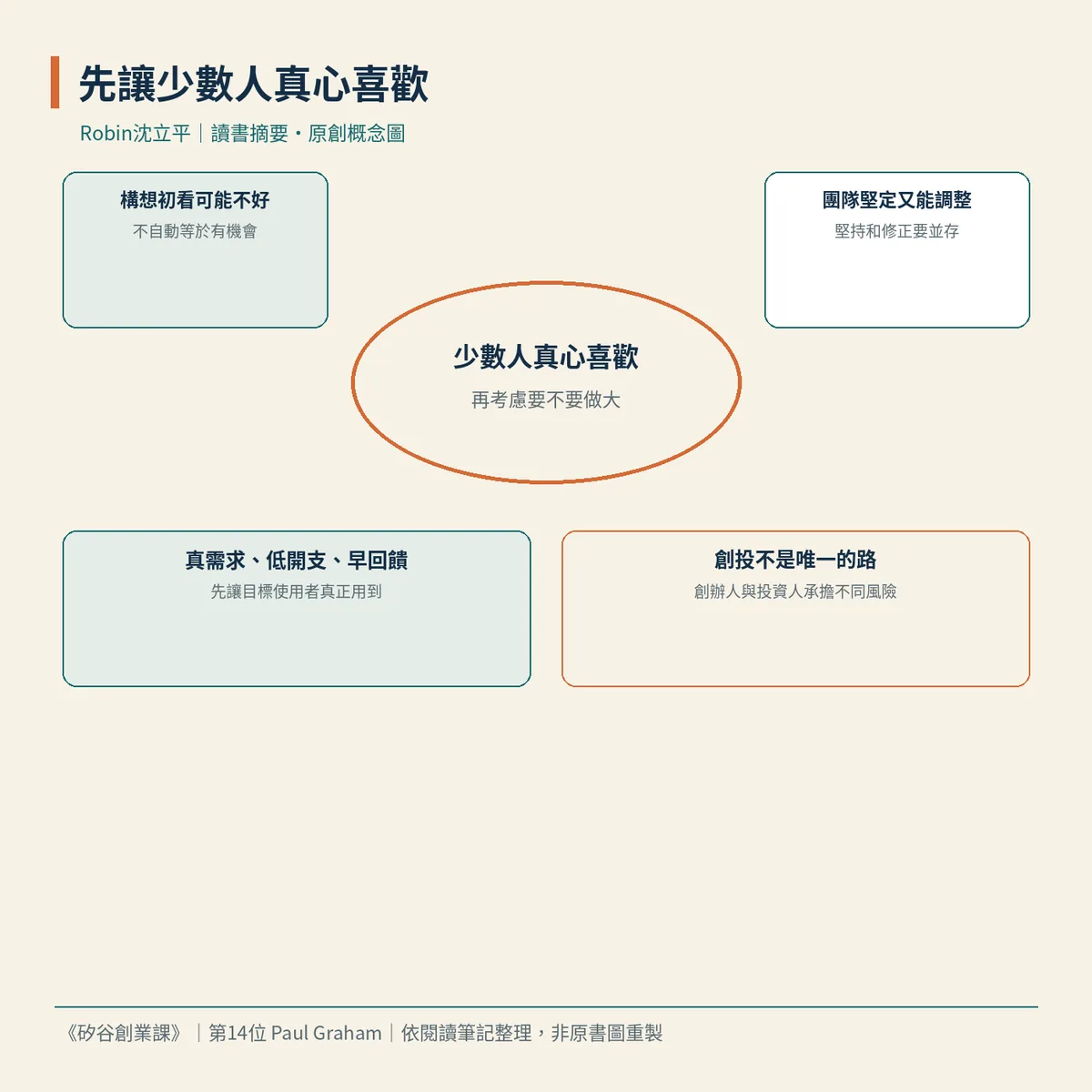
The book introduces Paul Graham as a cofounder of Y Combinator (YC). It describes YC as a place offering seed capital, advice, and opportunities for entrepreneurs to exchange experiences, with graduating teams going on to seek growth capital. One of his clearest judgments is to make something a few people truly love before considering scale. A broad offering that many find “okay” often cannot compete with solving a narrow problem people genuinely care about.
The best ideas often look unimpressive at first. Graham recalls that Google seemed unremarkable when many search services already existed. Facebook initially targeted college students with little spending power, and he felt browsing profiles was a waste of time. He was later glad the founders had not asked him to invest. When investing in Airbnb, he found the idea itself unappealing but invested because he admired the founders’ determination and imagination, avoiding a misjudgment. This was Graham’s own judgment. The author adds that strong teams are better able to adapt and attract talent and users. But persistence and adjustment must coexist: giving up too early means missing opportunities, while refusing to change can also take a company over a cliff.
To make something a few people love, the product must address what users truly want, while spending stays under control and feedback arrives early. Graham lists a good team, a product users want, and low expenses as success factors. The author particularly stresses finding users at very low cost. If you spend a long time refining internally and wait for a supposedly complete product before showing it, feedback arrives too late and resources may already be insufficient. Focus groups do not necessarily produce an amazing experience in advance, but that does not mean you can skip user contact. What you need to see early is whether anyone genuinely cares and keeps using it, rather than broadening the offering first so everyone finds it acceptable.
Founders and investors inherently bear different risks. Investors can use a portfolio to absorb outcomes in which a few investments are exceptional and most are ordinary or failures. Founders have far fewer chances to bet, so they need to pay even more attention to whether the idea addresses real demand and whether the team can adapt when the picture is unclear. This is also why venture capital is not the only route. The author points out that most entrepreneurs do not take this path. Funding can also come from savings, operating cash, or bank loans. Mechanisms such as YC are designed for teams suited to this kind of growth, rather than being mandatory stops for every new business.
The conclusion: first find a few people who will truly love the product and demonstrate its core value. Then discuss whether to scale. An idea that initially looks bad does not automatically represent an opportunity. Examine whether the team is both determined and able to adapt to evidence. Venture capital can be one path, but it is not the only one.
One deeper insight
I think growth discussions often begin with how many people a product can serve, and less often with whether anyone would genuinely recommend it. If even the small group that cares most cannot say they love it, broadening the scope mostly spreads “okay” farther.
Three suggestions
First, write down the small group you most want to love the product and what observable actions that love would produce, such as continued use or voluntarily telling others. If all you have now is “everyone might use it,” narrow the audience before validating.
Second, check whether current spending still allows you to get feedback early. If a complete product is a long way off, first build a version target users can actually use, and write down what would make you continue or adjust.
Third, if you are considering venture capital, examine separately how many mistaken judgments the founders can absorb, whether other funding sources remain available, and whether the team can adjust to new evidence when others doubt the idea, rather than only persist. If the three do not align, do not make fundraising the default next step.
#ADozenLessonsForEntrepreneurs #PaulGraham #ReadingNotes
These are reading notes and reflections based on my personal understanding. I recommend reading them alongside the original book for the full context.
Comments
What do you think? Share your experience or questions.
Sign in to comment, reply or like. Sign in / Sign up
Loading comments…