Note 20 | Choose a Problem Worth Your Time, and Keep Fund Requirements From Dictating the Company’s Path
These are Robin Shen’s original reading notes and commentary, written in his own words after reading Tren Griffin’s A Dozen Lessons for Entrepreneurs. They are not the original book, excerpts from it, or an official publication. Methods and concepts from the book are attributed to Tren Griffin; other sources are identified where stated. For reference only; not investment advice.
English translation of Robin’s Chinese reading notes and commentary. Passages are paraphrased, not verified verbatim quotations from the original English edition.
A Dozen Lessons for Entrepreneurs — Chapter 20, “Josh Kopelman: First Round Capital” (Part II, “The Venture Capitalists”)
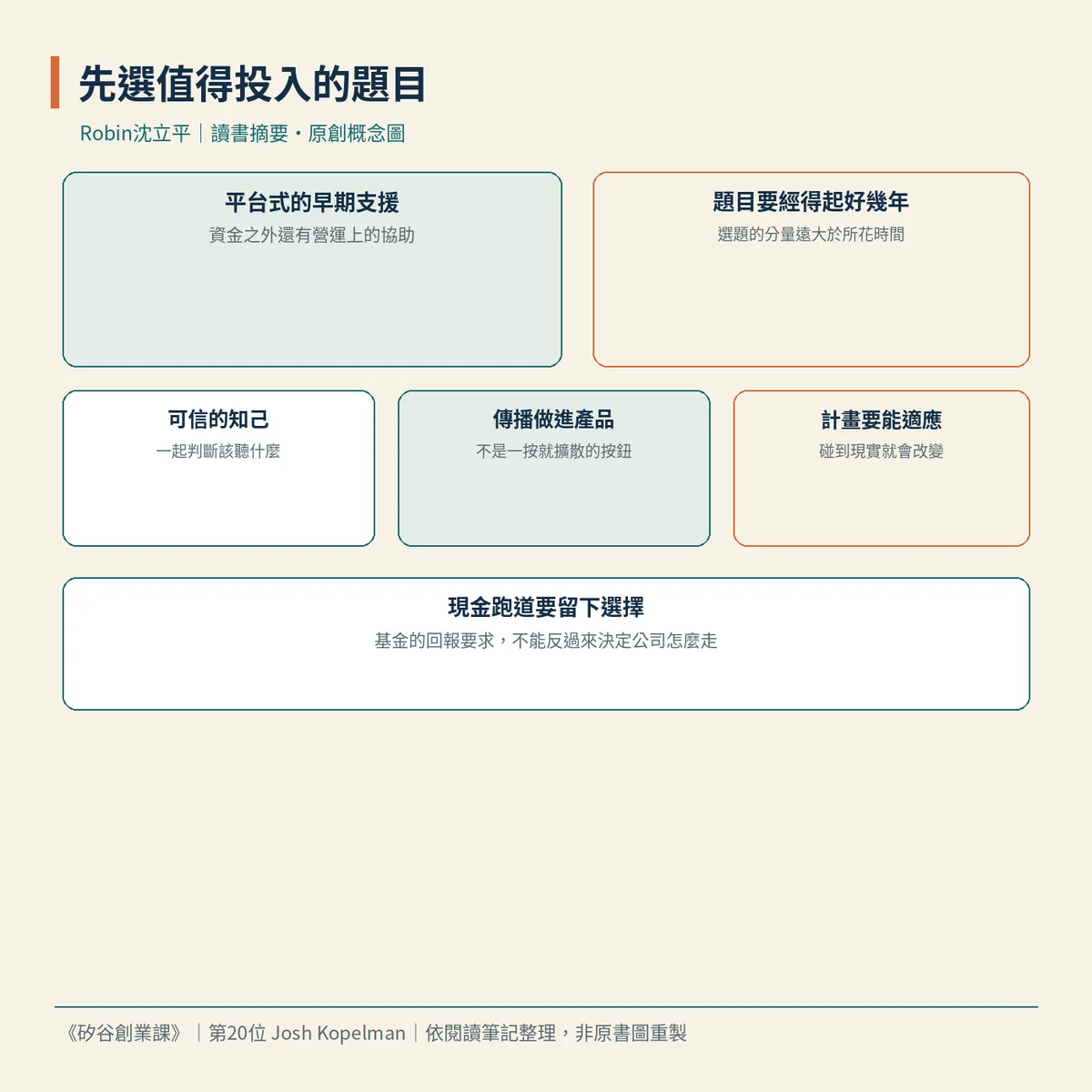
The book describes Josh Kopelman as a partner at First Round Capital, a seed-stage venture firm, and specifically notes that he comes from Philadelphia rather than Silicon Valley. These descriptions reflect the time when the book was written. First Round takes a platform approach to early support, providing resources and operating help alongside capital. Kopelman connects that approach to several more specific judgments: choose a problem worth many years of your life, have trusted confidants, build sharing into the product, adapt when plans meet reality, and leave enough cash runway to preserve options. A fund’s own return requirements must not dictate the company’s path.
Kopelman likes meeting entrepreneurs early, provided they have found an idea they want to pursue and are willing to commit fully. He believes it is easier to help before founders make poor business decisions. Professional investors generally do not want entrepreneurs working only part time. People genuinely absorbed by a user problem are more likely to make things work. The time spent choosing a problem often falls far short of the decision’s importance. If it will take years, the problem itself deserves scrutiny. Serial entrepreneurs sometimes rush the choice because they are confident and can raise money more easily. The author cautions that investors like ideas with the potential to become big, but craziness that cannot be explained at all is not the same as a good investment.
Unresolved problems and decisions arise every day in a startup. Founders need people they trust to help them think things through. Confidants can help sort useful advice from advice to set aside and spot things the founder has not considered. For a product to spread, sharing mechanisms need to be built into it. You cannot assume there is a button somewhere that will make it spread when pressed. If the product itself helps users understand its value and makes them want to tell others, customer acquisition can depend less on heavy advertising. That still depends on whether people genuinely like the product; it cannot be taken for granted. Plans change as soon as they meet reality. Kopelman values people who can adapt over those who think they can predict the future in one pass. The point is to stay flexible while keeping a clear goal.
On funding, Kopelman recommends aiming for 18 to 24 months of runway after a seed round and preparing for the next round before money is needed. That was his advice at the time. The author argues that sufficient runway preserves a margin of safety and options, rather than forcing a company to pull back as cash runs out. More fundamentally, company outcomes should drive fund returns. A fund’s numbers must not drive company decisions in reverse. Entrepreneurs can also conduct due diligence on prospective investors because the relationship may last many years. Other entrepreneurs are often the most direct source of information about an investor.
The conclusion: early support should go toward a problem worth pursuing. Preserve room for judgment through trusted confidants, sharing built into the product, adaptability, and sufficient runway. A platform can provide help beyond capital, but a fund’s requirements must not dictate what a company should become.
One deeper insight
I think a pitch deck can easily get pulled toward the scale a fund wants when the conversation turns to the next round. The questions to ask first are whether this problem is worth committing the next several years to, and whether the cash on hand still lets us finish building the product and making the necessary adaptations. We should not start by changing the company’s direction to fit a return formula.
Three suggestions
First, write down why this problem deserves the next several years of your life and where the risks lie if you chose it simply because it is easier to fund. If the problem does not convince you, do not treat platform support or the next round as a next step you have already thought through.
Second, check whether sharing is built into the product: why would users tell others, and how do people currently find it? If the only answer is more advertising, first strengthen the value people can understand and want to pass on through the product itself.
Third, list roughly how long current cash will last, what would trigger preparations for the next round, and what investors can actually help with besides money. Also write down which company decisions should not change simply to meet a fund’s return requirements.
#ADozenLessonsForEntrepreneurs #JoshKopelman #ReadingNotes
These are reading notes and reflections based on my personal understanding. I recommend reading them alongside the original book for the full context.
Comments
What do you think? Share your experience or questions.
Sign in to comment, reply or like. Sign in / Sign up
Loading comments…