Note 19 | Be Able to Absorb Failure and See the Potential for a Major Success
These are Robin Shen’s original reading notes and commentary, written in his own words after reading Tren Griffin’s A Dozen Lessons for Entrepreneurs. They are not the original book, excerpts from it, or an official publication. Methods and concepts from the book are attributed to Tren Griffin; other sources are identified where stated. For reference only; not investment advice.
English translation of Robin’s Chinese reading notes and commentary. Passages are paraphrased, not verified verbatim quotations from the original English edition.
A Dozen Lessons for Entrepreneurs — Chapter 19, “Vinod Khosla: Khosla Ventures” (Part II, “The Venture Capitalists”)
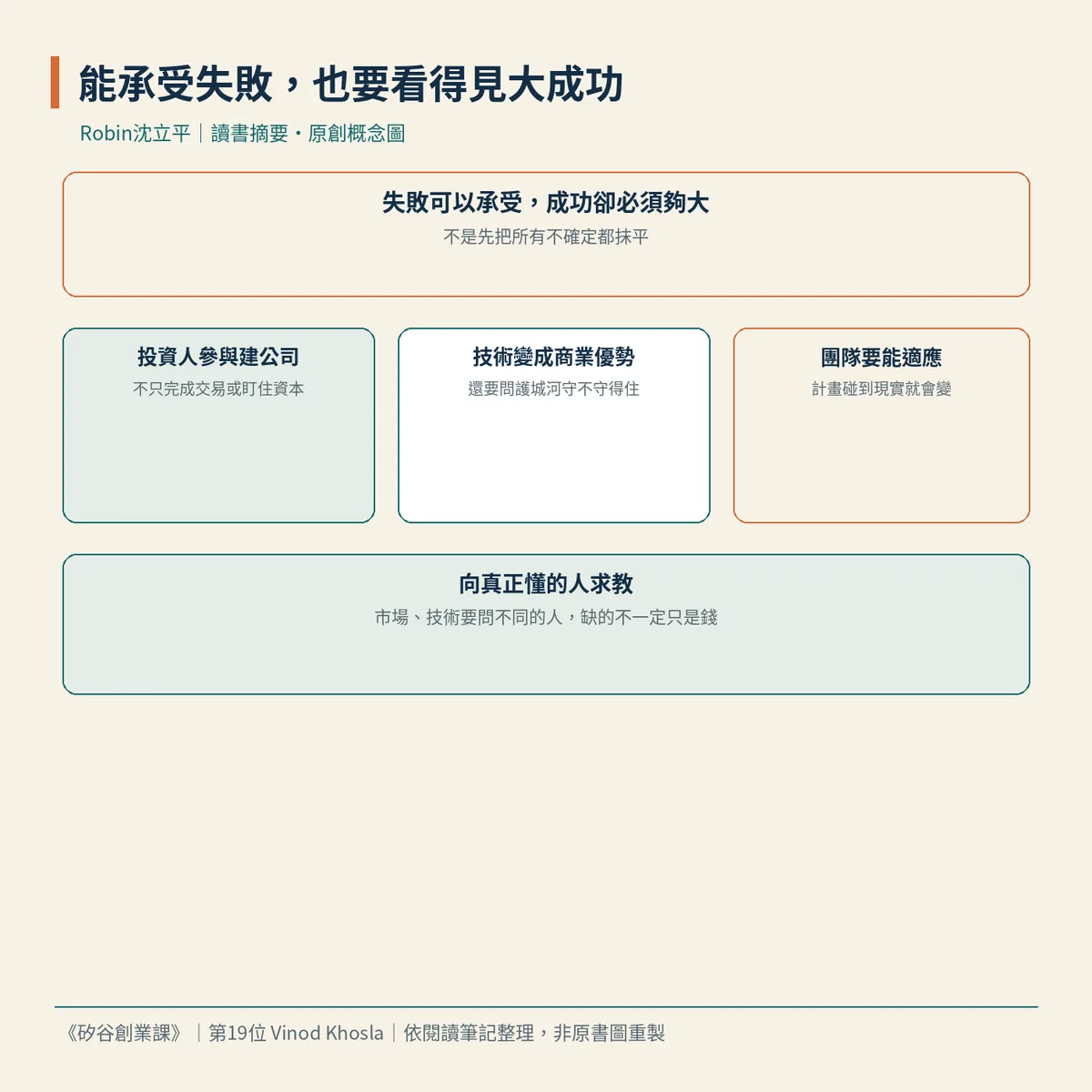
The book describes Vinod Khosla as an entrepreneur, investor, and technology expert who founded Khosla Ventures in 2004. These descriptions reflect the time when the book was written. His recurring point is not how to eliminate failure. It is that failure must be bearable, while success must be big enough to matter. Investors should help build companies, not just close deals or watch the capital. Technical differentiation has to become a business advantage, and that advantage has to be defensible. Plans change, so teams must adapt. Founders also need to know whom to ask about which kinds of problems.
Khosla does not aim to avoid every failure. The author adds that if someone reduces risk to the point where success is almost certain, the success itself may not be big enough. In fields where outcomes are hard to predict, spreadsheets often provide too little to go on. What matters more is whether investors believe in the company’s future and will spend time helping it grow. Khosla admires people willing to do the work of building a company together. The author explains that using skills, networks, and experience to create new value can sometimes do more to build a successful business than focusing solely on financial returns. That is the author’s inference, not a guarantee of returns.
A technical advantage does not automatically become a business. Khosla says that if several companies have the same technology, he will not invest. Investors should help turn technical differentiation into a business advantage, looking for the next useful move as they would in chess. Then they need to ask whether the company has an unfair advantage or a defensible moat: protected leading technology, for example, an innovative business model, a unique partnership, or an outstanding team. The author cautions that without defensible barriers, competition can drive prices down until very little economic profit remains. Plans change, so Khosla looks at people first. Founders who adapt have a better chance of moving forward than those who cling to a comprehensive plan. Failing fast can keep losses small and reveal what works. No detailed five-year plan survives its first encounter with the market unchanged. Almost every startup also goes through a difficult middle stretch. If founders believe in the product, they still need the persistence to keep going.
When weighing risks, Khosla prefers technology risk. The author explains that this reflects his technical training and experience: he has greater confidence that technical problems can be remedied. That is his circle of competence and investment style. Companies still face other risks, including financial, regulatory, and talent risks. Finally, entrepreneurs often struggle because they do not know what they do not know. Plenty of help is available, yet founders can easily assume that money is what they lack most. A more mature approach is to ask different people about different issues, such as markets and technology, and to learn from both those who succeeded and those who did not. Finding people who truly understand a field is itself a way to put circles of competence to work.
The conclusion: when the outlook is unclear, first ask whether failure is bearable and success would be big enough, rather than trying to remove every uncertainty. Investors need to help build companies. Technical advantages must become business advantages, with regular checks that the moat still holds. Teams need to adapt and know whom to ask for advice.
One deeper insight
I think discussions of risk often begin with how to avoid failure. Less often do we first ask whether success would be big enough, or who could help us understand the questions we have not yet resolved. If we make the plan too safe, the advantages and moats that could develop later often become weaker too.
Three suggestions
First, write down what would count as a sufficiently large success and roughly how much failure you can currently absorb. If you cannot clearly describe either, do not make “reducing risk until almost nothing can go wrong” your next step.
Second, list the technical or product differences you believe you have, how they become a business advantage users will pay for, and which might remain defensible as competition intensifies. If you cannot describe that path, you still have technology, not a business.
Third, write separate lists of whom to ask about the market, whom to ask about technology, and which judgments the team must still adjust itself as new evidence comes in. If the list contains only “raise more money,” first find people who truly understand the problem.
#ADozenLessonsForEntrepreneurs #VinodKhosla #ReadingNotes
These are reading notes and reflections based on my personal understanding. I recommend reading them alongside the original book for the full context.
Comments
What do you think? Share your experience or questions.
Sign in to comment, reply or like. Sign in / Sign up
Loading comments…