Note 22 | Build From Early Culture and a Small Team Into a Real Company
These are Robin Shen’s original reading notes and commentary, written in his own words after reading Tren Griffin’s A Dozen Lessons for Entrepreneurs. They are not the original book, excerpts from it, or an official publication. Methods and concepts from the book are attributed to Tren Griffin; other sources are identified where stated. For reference only; not investment advice.
English translation of Robin’s Chinese reading notes and commentary. Passages are paraphrased, not verified verbatim quotations from the original English edition.
A Dozen Lessons for Entrepreneurs — Chapter 22, “Doug Leone: Sequoia Capital” (Part II, “The Venture Capitalists”)
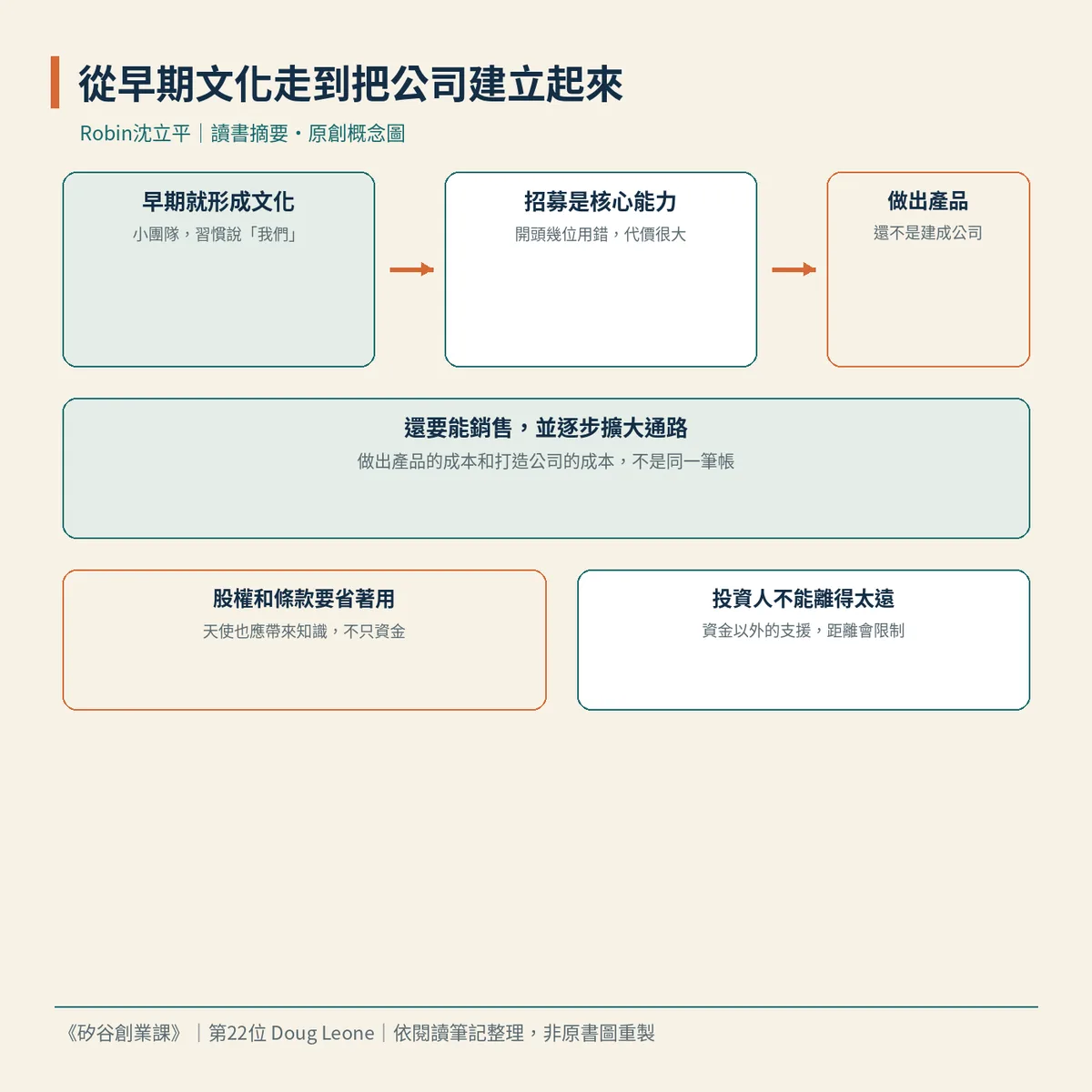
The book describes Doug Leone as a managing partner at Sequoia Capital, which he joined in 1988, becoming a partner in 1993. Before joining, he worked in sales and sales management. These descriptions reflect the time when the book was written. He values more than the check itself. He wants to partner with entrepreneurs from day one: what culture will take shape early, whether a small team can work together, how key people will be recruited, and whether the company can move from making a product to building distribution and a business. Equity terms and the investor’s distance from the company also determine how much support will actually be available.
Leone uses heredity as an analogy: important parts of a company’s culture, values, and practices are established very early. Good practices can be learned, but they cannot become a formula everyone copies. He also prefers small, strong teams and looks for founders who habitually say “we” rather than “I.” He favors initially raising a smaller amount as a buffer and adding more as needed, because equity is an expensive asset for founders to sell. Early engineers should be treated generously; hiring the wrong people for the first few positions is costly. He sees recruiting as a core startup capability. He is willing to help companies find their first few engineers, but believes they must eventually learn to recruit for themselves. The author explains that team composition and working chemistry affect outcomes, and great people attract more great people. A company that has raised money but still cannot recruit faces a warning sign. Progress is more evident when a founder attracts strong people and other companies start asking how they found them.
There is a long road between building a product and building a company. Leone cautions against treating the cost of making a product and the cost of building a company as one and the same. The author notes that creating a product, even finding product-market fit, is often only the first few steps. A company still has to make sales and gradually scale marketing and distribution. Many opportunities do not necessarily need venture capital. Whether a salesperson is right for the company also depends on its stage. When the market is unclear, domain knowledge or specialized skills matter more. Once the prospects are clear, generalist salespeople can contribute more readily. If the product itself is hard to sell, forcing more sales hires into the business often fails to solve the real problem. Small companies often benefit from attracting less attention and moving quickly. Time should first go toward proving product value and gathering user feedback, rather than unnecessary networking events.
Equity needs careful management and should motivate people who are truly critical and can be retained. Beyond price, terms also affect how much ownership remains later. Angel investing offers limited help if it brings only money, with no distinct knowledge or contribution. Investors who are too far away also struggle to provide ongoing help beyond funding. Leone says that if a company’s location makes it hard for him to contribute meaningfully, the investment may be unsuitable for both sides. In assessing investors, founders should look beyond valuation and ask whether they can truly spend time on future recruiting, product, and distribution needs.
The conclusion: get the culture and small team right early, make recruiting a core capability, and recognize the road still to travel from product to company to distribution. Be sparing with equity and careful with terms. When choosing investors, distance and actual support capacity often do more than a check to determine what help will be available later.
One deeper insight
I think discussions of “finding an investor” often start with valuation comparisons. Less often do we first ask how far that investor is from our day-to-day work, or whether they can really help with the next recruiting and distribution challenges besides providing money. If we cannot answer those questions, even a well-established early culture may leave the founder carrying the burden of building the company alone.
Three suggestions
First, write down a few cultural principles and working practices the team has actually used since the start, and how they became established. If all you get is slogans, add how new people will genuinely learn to work that way.
Second, list how you found the people in your most critical roles and whether you will recruit the next one or two key hires yourself or need outside help. Separately assess whether you are still proving the product or already building sales and distribution. Those stages call for different people.
Third, check how much room your equity position and terms leave, and where existing investors can actually help beyond funding. If they are far away or cannot describe specific support, include that in your criteria the next time you choose an investor.
#ADozenLessonsForEntrepreneurs #DougLeone #ReadingNotes
These are reading notes and reflections based on my personal understanding. I recommend reading them alongside the original book for the full context.
Comments
What do you think? Share your experience or questions.
Sign in to comment, reply or like. Sign in / Sign up
Loading comments…