Note 23 | Build People and Culture From Within, and Match Fund Size to Attention
These are Robin Shen’s original reading notes and commentary, written in his own words after reading Tren Griffin’s A Dozen Lessons for Entrepreneurs. They are not the original book, excerpts from it, or an official publication. Methods and concepts from the book are attributed to Tren Griffin; other sources are identified where stated. For reference only; not investment advice.
English translation of Robin’s Chinese reading notes and commentary. Passages are paraphrased, not verified verbatim quotations from the original English edition.
A Dozen Lessons for Entrepreneurs — Chapter 23, “Dan Levitan: Maveron” (Part II, “The Venture Capitalists”)
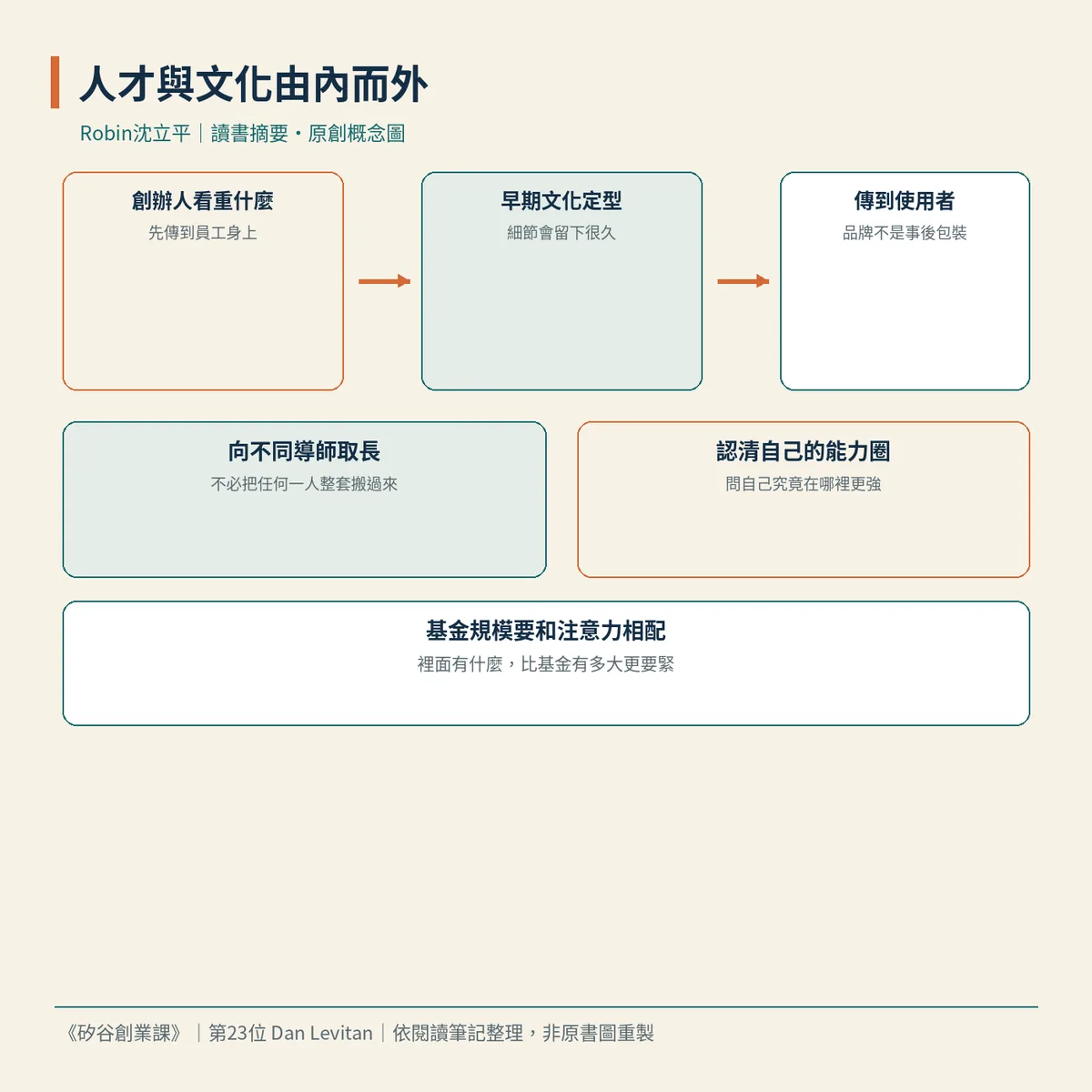
The book notes that Dan Levitan cofounded Maveron in 1998 with Howard Schultz, then the chief executive officer (CEO) of Starbucks. Levitan argues that venture firms can specialize and values mentors and the right team. These descriptions reflect the time when the book was written. He builds consumer-brand investing around several connected ideas: start with people, understand how culture becomes a brand from the inside out, learn different strengths from different mentors, know your circle of competence, and match fund size to the attention you can provide.
Levitan says people matter most early on, and he says it more than once. The author adds that the earlier the investment, the greater the uncertainty and the more a team needs to respond to unexpected change. Chemistry and trust make collaboration more efficient. A strong team often has a decisive influence on eventual success. Recruiting is therefore a core CEO capability. Levitan has posed this question: if a young company that has completed its seed round claims to value recruiting but consistently cannot attract good enough people, its CEO needs to take a hard look at why. Early employees establish the culture that follows. Schultz has used the analogy of constructing a high-rise to stress that every detail has to be right. Nor is a brand packaging added afterward. It starts with what the founder values, passes to employees, and reaches users through the expectations people have of one another. Schultz has also discussed the need to protect a company’s core reason for existing and its boundaries, creating value and meaning for users within those boundaries. Early capital also represents the people you choose to travel with. Capital with costly terms and little useful help may deliver nothing but dilution.
Different mentors can strengthen different capabilities. There is no need to adopt anyone’s entire approach. The author records several people Levitan sought advice from over many years: Schultz, Bill Campbell, Duke University’s Coach K, and Joel Peterson. Campbell repeatedly emphasized the product itself. Schultz would put a head of human resources in place first. Coach K taught him to keep asking whether he still loved the team. Their different perspectives made them useful. The point is to learn from each person’s strengths, rather than choose one mentor and accept even the parts that do not fit.
Maveron’s decision to invest only in consumer-facing brands is a specialization strategy. Spending time on the same kinds of problems makes it easier to build up solutions and provide meaningful help to founders. That is their choice, not a template every venture firm should copy. Founders and investors alike need to ask where they are genuinely better than others and where that advantage can be used. Bigger funds are not always better either. Levitan believes that when the media ask how big a fund is, they should ask more about what is inside it. In a smaller fund, a few critical successes can often make a meaningful difference. The author explains that once assets reach a certain scale, a single company may no longer be enough for the fund. The firm must find more new business, scattering attention and potentially making it hard to invest more in the same company. Scale should match the number of companies the firm can support attentively. If the team is strong and solving a real problem, funding is not necessarily the biggest obstacle. The quality of the market and the people matters more than treating capital as the only bottleneck.
The conclusion: lasting consumer brands start with people and culture built from the inside out, supported by founders and investors who know their circles of competence. Specialization and an appropriately sized fund preserve attention for teams worth accompanying over the long term. Their purpose is not to make the institution itself bigger.
One deeper insight
I think brand discussions often start with external messaging. Less often do they first ask what the founder truly values and what early hires bring into daily work. If those are not aligned internally, external packaging is just another layer of explanation. If the fund is also too large to manage attentively, even the time available to choose people gets squeezed.
Three suggestions
First, write down the two or three things the founder values most, how employees actually convey them to users today, and which cultural influences will first shape new hires. If the three do not align, fix the inside before discussing external brand messaging.
Second, list the people you seek advice from or would like to, and the particular strength you want to learn from each. Do not combine their different views into a single set of rules. Respecting a mentor does not require accepting everything they do.
Third, check whether your available time and attention are enough for your existing companies and the new opportunities you are considering. If the fund or business scope has grown so large that you can no longer seriously put more into the same company, write down what you will narrow and how you will judge the right size.
#ADozenLessonsForEntrepreneurs #DanLevitan #ReadingNotes
These are reading notes and reflections based on my personal understanding. I recommend reading them alongside the original book for the full context.
Comments
What do you think? Share your experience or questions.
Sign in to comment, reply or like. Sign in / Sign up
Loading comments…