Note 26 | Success Looks Like Foresight, but Requires Acknowledging Uncertainty, Patience, and Luck
These are Robin Shen’s original reading notes and commentary, written in his own words after reading Tren Griffin’s A Dozen Lessons for Entrepreneurs. They are not the original book, excerpts from it, or an official publication. Methods and concepts from the book are attributed to Tren Griffin; other sources are identified where stated. For reference only; not investment advice.
English translation of Robin’s Chinese reading notes and commentary. Passages are paraphrased, not verified verbatim quotations from the original English edition.
A Dozen Lessons for Entrepreneurs — Chapter 26, “Michael Moritz: Sequoia Capital” (Part II, “The Venture Capitalists”)
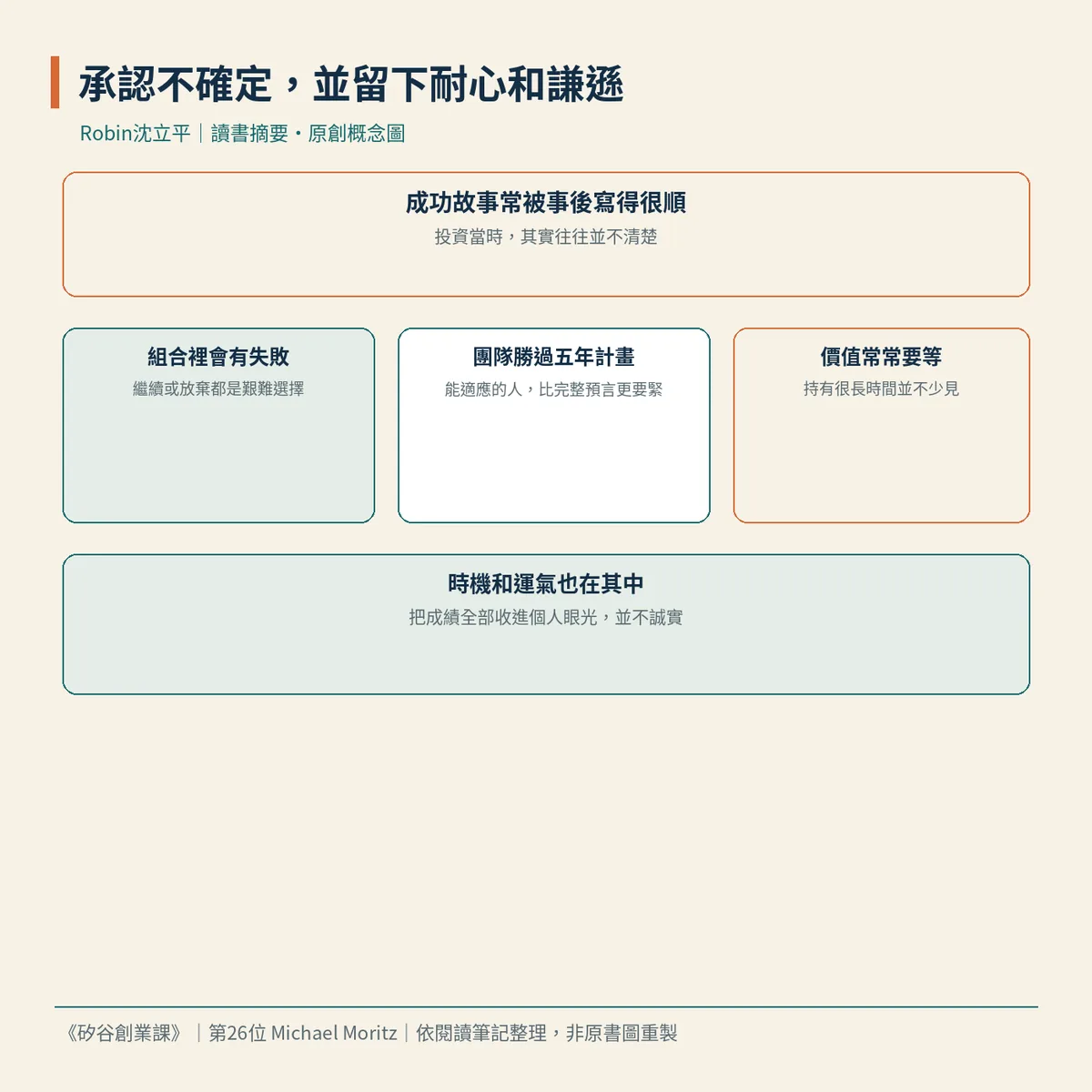
The book describes Michael Moritz as chairman of Sequoia Capital, a journalist before entering venture capital, and the author of a biography of Steve Jobs. These descriptions reflect the time when the book was written. In his view, successes later described as inevitable were often unclear at the time of investment. Results often come from acknowledging uncertainty, being willing to wait, and recognizing the role of the times and luck, rather than relying only on foresight that looks precise in hindsight.
Moritz says that a company may not look like a good idea when it first comes together. Later, marketing and public relations portray it as brilliant all along, rarely mentioning the lack of early clarity. The author argues that venture capital can produce good outcomes precisely because uncertainty causes some opportunities to be mispriced. The upside has to be large enough to potentially carry an entire fund. Every check carries hope, but a portfolio will still contain failures and difficult decisions about whether to keep investing. Withdrawing support is among the most painful decisions because it affects people the investor has come to know. Outperforming the market often requires a view that genuinely differs from conventional thinking. Difference alone, however, is insufficient: the judgment must also be right. Pattern recognition is a skill, but new value often emerges only by breaking established rules. Moritz also values supporting small companies that are out of favor at the time but can create value for users.
The best companies are generally built by founders who stay for the long term. Careful, small investments usually stand up to scrutiny better than trying to force an outcome with a large infusion of money. Five-year plans cannot easily eliminate uncertainty; teams that respond to change matter more. Real value also often takes a long time to emerge. It is not unusual for venture investors to hold a company for more than ten years. During an economic downturn, starting a company, investing, and finding talent can sometimes be easier because there is less noise and weaker competition. These are conditional observations, not guarantees about downturns.
Moritz also discusses learning indirectly. Reading and observing other people’s mistakes can reduce the price of learning. Reflecting on the opportunities in 1986, he suggests that luck may have mattered as much as hard work. The author presents this as a form of humility: acknowledging the era one happened to enter rather than attributing every outcome to personal foresight. This is a retrospective in the book, not a market-timing strategy that can simply be copied today.
The conclusion: success that later looks like foresight was generally still uncertain when the investment was made. Acknowledging that portfolios contain failures, allowing founders time to create value, and maintaining discipline during downturns better reflect the work than a smooth story told afterward. Luck and timing both matter. Humility is a way to keep exercising judgment.
One deeper insight
I think the more complete a success story becomes, the easier it is to forget how unclear things were at the time. The questions worth preserving are how much of the apparent inevitability was added afterward and which uncertainties remain unwritten. Without the patience to wait for value to emerge, even sharp foresight merely produces a faster conclusion.
Three suggestions
First, choose a company widely described as successful. Separately write down the reasons its success now seems inevitable and what may have been unclear early on. If you can only repeat the later success narrative, you have not yet understood the uncertainty.
Second, review your current portfolio or work: which efforts still deserve time and money, and which should actually stop? Separate “We cannot bear to give up” from “There is new evidence,” then decide.
Third, write down roughly how much time this effort will really need to show its value, and what you have prepared in talent, cash, and attention if the market cools. Also record which outcomes may reflect timing. Do not credit personal judgment with every achievement.
#ADozenLessonsForEntrepreneurs #MichaelMoritz #ReadingNotes
These are reading notes and reflections based on my personal understanding. I recommend reading them alongside the original book for the full context.
Comments
What do you think? Share your experience or questions.
Sign in to comment, reply or like. Sign in / Sign up
Loading comments…