Note 25 | Connect Technology Trends, Platforms, and Valuation Discipline
These are Robin Shen’s original reading notes and commentary, written in his own words after reading Tren Griffin’s A Dozen Lessons for Entrepreneurs. They are not the original book, excerpts from it, or an official publication. Methods and concepts from the book are attributed to Tren Griffin; other sources are identified where stated. For reference only; not investment advice.
English translation of Robin’s Chinese reading notes and commentary. Passages are paraphrased, not verified verbatim quotations from the original English edition.
A Dozen Lessons for Entrepreneurs — Chapter 25, “Mary Meeker: Kleiner Perkins Caufield & Byers” (Part II, “The Venture Capitalists”)
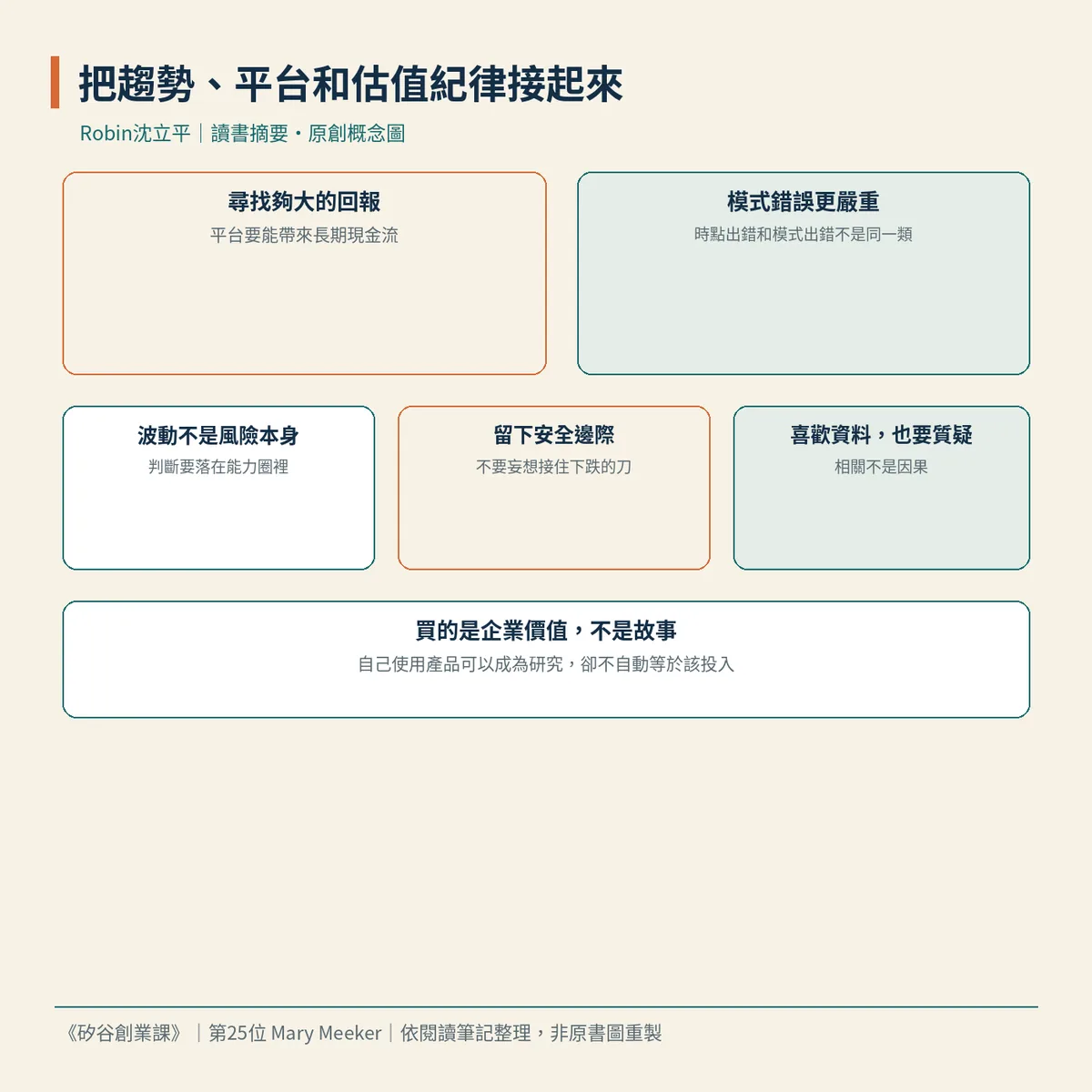
The book describes Mary Meeker as a partner at Kleiner Perkins Caufield & Byers (KPCB) who publishes a report on internet trends each spring. These descriptions reflect the time when the book was written. Her approach to technology investing is not to follow popular stories. She connects long-term trends, a platform’s ability to generate cash, and valuation discipline. First ask whether the returns are large enough and the business model holds up. Then address volatility, the margin of safety, and whether the data can be trusted.
Meeker says her job is to find a few companies each year that can deliver tenfold returns. Tenfold here refers to investment returns, not a price-to-earnings ratio or a revenue multiple. She repeatedly emphasizes that building platforms and driving free cash flow for more than ten years is what truly separates winners in the internet economy. The author explains that once a platform develops network effects or a defensible advantage, it can scale, and the incremental cost of serving another user may be very low. That is a possible mechanism, not a promise that every platform will succeed. In discussing turning points, she recalls reading about Mosaic in 1994 and sensing that a shift in online publishing had begun. The author separately records what he saw at the time: capital pouring in, increasingly extravagant launches, and excitement that could not last forever. Those are the author’s observations, not Meeker’s account of her own experience.
Getting valuation or entry timing wrong is different from getting the business model wrong. She believes the latter is often more serious. The author adds that if investors ignore unit economics and flaws in the model, a comprehensive-looking forecast cannot rescue faulty assumptions. To challenge an incumbent, a product usually needs to be significantly better and cheaper, and maintain that difference long enough to give people a reason to switch. Technology stocks certainly fluctuate, but volatility does not necessarily equal risk. Within one’s circle of competence, volatility can sometimes create opportunity. No one can precisely catch a falling knife, and no one rings a bell at the bottom. A sounder approach is to assess the business’s value first and leave a margin of safety.
Contrarian investing can sometimes deliver high returns, but the judgment has to be right. Being different for its own sake is not enough. In her experience, it pays to buy when no one is interested in technology and to be more cautious when everyone is enthusiastic, including people unfamiliar with the sector rushing into hot new listings. Do not fall in love with a technology company’s story. What you are buying is the value of a business. Using the product yourself can be excellent research, but finding it useful does not automatically make it a buy. The point is to better understand what users actually need. She likes data and also advocates questioning it. Correlation is easily mistaken for causation, and readily available numbers are not necessarily the ones that help judgment.
The conclusion: in technology investing, understand the trends and whether a platform can generate long-term cash flow, then apply valuation discipline to the business model and margin of safety. Volatility, enthusiasm, and data can all lead people astray. What endures is an understanding of how the company makes money and whether its assumptions hold.
One deeper insight
I think the more complete the presentations and data on the next hot technology investment, the easier it is to assume we already understand it. We should first ask how the company actually generates sustainable cash, which failed assumptions would bring down the story, and whether we have simply been persuaded by numbers that were easy to obtain.
Three suggestions
First, write down where the company you are evaluating would generate free cash flow over a ten-year horizon and what sustains its platform or advantage. If you can only tell a story about trends, you cannot yet claim to understand the business.
Second, separate your current judgment into two categories: where valuation or timing might be wrong, and where the business model itself might be wrong. List evidence for the model’s assumptions separately. Do not blend the two beneath an attractive forecast.
Third, examine the data you are using: what does it actually measure, are you confusing correlation with causation, and could you still explain the company’s value without it? Also write down what using the product yourself has helped you understand, and what remains only a preference that does not yet justify buying or committing resources.
#ADozenLessonsForEntrepreneurs #MaryMeeker #ReadingNotes
These are reading notes and reflections based on my personal understanding. I recommend reading them alongside the original book for the full context.
Comments
What do you think? Share your experience or questions.
Sign in to comment, reply or like. Sign in / Sign up
Loading comments…