Summary 2 | Investors and Boards Should Help Companies Grow Through Time and Pacing
These are Robin Shen’s original reading notes and commentary, written in his own words after reading Tren Griffin’s A Dozen Lessons for Entrepreneurs. They are not the original book, excerpts from it, or an official publication. Methods and concepts from the book are attributed to Tren Griffin; other sources are identified where stated. For reference only; not investment advice.
English translation of Robin’s Chinese reading notes and commentary. Passages are paraphrased, not verified verbatim quotations from the original English edition.
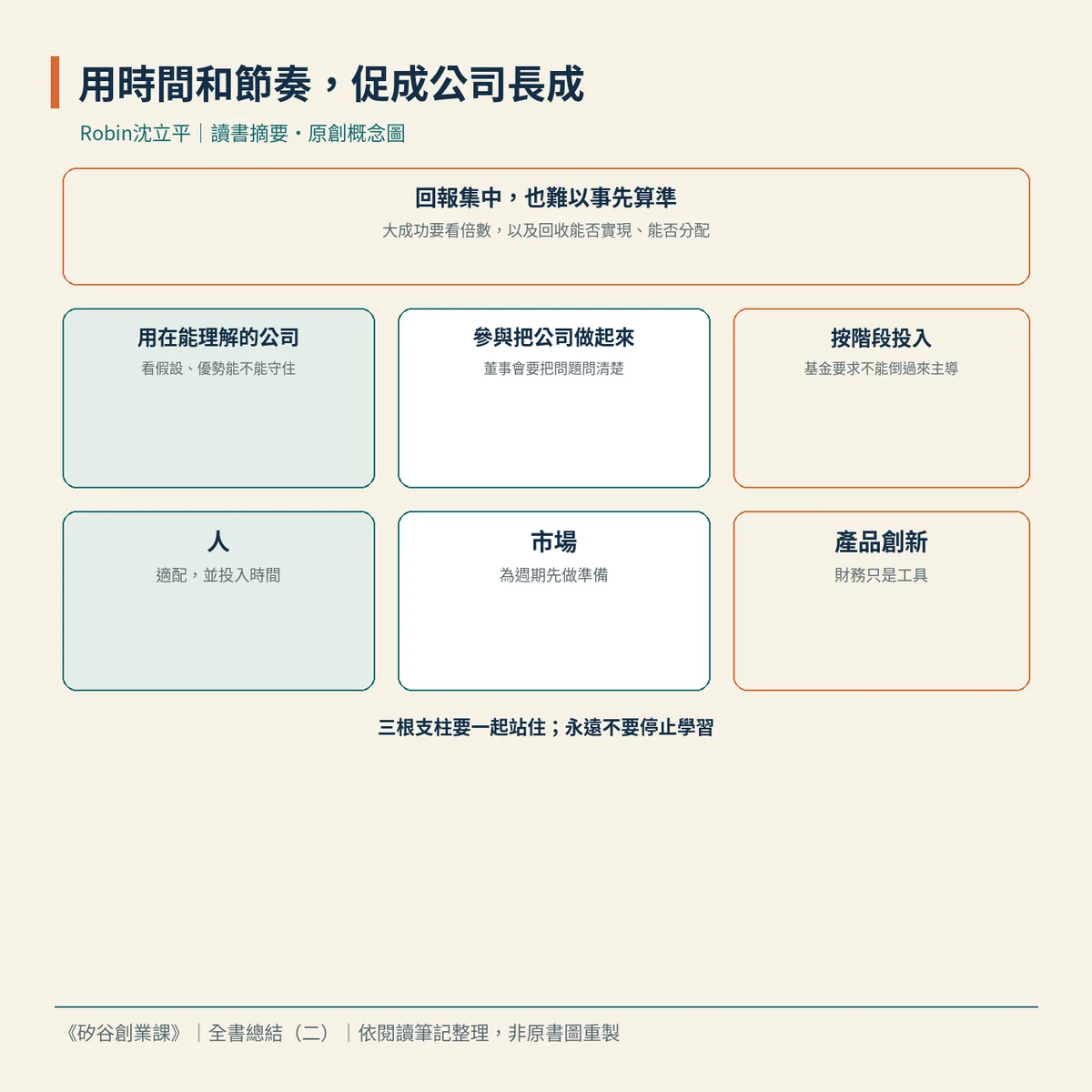
A Dozen Lessons for Entrepreneurs — Summary 2: For Investors and Boards
After reading A Dozen Lessons for Entrepreneurs, the most useful thread for investors and boards is not to grow every company equally. First acknowledge that outcomes are concentrated and hard to predict. Put capital and attention into companies you truly understand, set the pace according to what has been proven, spend time clarifying critical questions, and keep fund requirements from dictating company decisions. In the conclusion, Tren Griffin describes venture capital as a service business, with finance only a tool. People, market, and product innovation must stand together. The ten insights below draw on Notes 00–36. The ten actions turn the same thread into steps you can check.
Ten deeper insights
- The major successes venture capital seeks are not just valuations that earn the unicorn label. They also depend on proceeds relative to invested capital, and whether those proceeds can be realized and distributed. Griffin distinguishes grand slams from paper valuations at the start. Later, several investors repeatedly explain that returns often concentrate in a few outcomes. First ask whether value can ultimately be realized, not just whether the valuation story is attractive.
- Failure must be bearable, but success has to be big enough to matter. Vinod Khosla does not aim to avoid every failure. Marc Andreessen also cautions that breakthroughs are hard to predict and missing winners is unavoidable. Portfolios, long-term capital, and practical support are ways to bear this. Reducing risk until almost nothing can go wrong can also leave success too small. This is a trade-off involving portfolio construction and circles of competence.
- Capital and attention should go to companies you genuinely understand. Bill Gurley emphasizes first understanding how a company makes money, its key assumptions, and whether its advantage is defensible. The spreadsheet may look complete while its inputs fail under questioning. Test a moat by whether the business can keep earning returns above its cost of capital. Temporarily high prices or excitement do not establish that a barrier truly exists.
- An investor’s job is to help build companies, not merely close deals or watch the capital. Khosla admires people willing to spend time building together. Peter Fenton presents Benchmark’s deep involvement as a strategic choice: complementary talent, board questions that get to the point, and product feedback. Teams expecting close discussion of critical issues need different partners from teams that mainly need broader platform support.
- Fund size, terms, and return requirements must not dictate company decisions. Kopelman warns that company outcomes should drive fund returns. Gurley and Dan Levitan both caution that attention gets diluted when scale exceeds the capacity to support companies. Heidi Roizen points out that financing terms, liquidation preferences, and payment priority can affect what founders actually retain more than headline valuation does. Too much money can sometimes also replace strategy with spending.
- Commit resources in verifiable stages. Chris Dixon moves from deep market knowledge to a testable prototype. Fred Wilson argues against large-scale hiring or rapid cash burn before the product, people, and processes are proven. Judgments about mission and execution should also connect to current product and team evidence, capabilities still missing, and potential returns and losses.
- A board’s value comes from working together to clarify what remains unclear, not cheering from the sidelines. Bill Campbell connects product, people, and operations. Fenton reminds readers to reserve time for questions not yet fully thought through. Investors are not cheerleaders, but deep involvement does not mean turning internal division into a management method. Horowitz advocates laying out the information within a conflict, understanding it, making a decision, and accepting responsibility for the effects on people.
- Entrepreneurs and investors need to fit, and both sides should conduct due diligence. Jenny Lee cautions that willingness to provide money does not make someone a suitable long-term partner. Other entrepreneurs are often the most direct source of information about an investor. Leone also notes that investors who are too far away struggle to provide ongoing help beyond capital. Choosing an investor means choosing capabilities and time. Distance and support capacity sometimes determine future help more than valuation does.
- Business conditions and funding markets both have cycles. Turning points are hard to predict, but preparation is possible. Jim Breyer cautions against treating sentiment or a timetable for “eliminating a set of risks each year” as certainties. In discussing consumer businesses, Green also considers who can get through the middle stretch when results are still far away. Mary Meeker distinguishes volatility from permanent loss and leaves a margin of safety. Wilson says venture cycles are often more extreme. Having capital and discipline ready for a cold market is more practical than claiming to predict timing precisely.
- I think investors and boards are most easily carried away by “Accelerate again, raise another round, increase the valuation again,” forgetting the conclusion’s three-legged stool. People, market, and product innovation must stand together. Financial sophistication cannot compensate for a poorly run company. Venture capital is a service business requiring effort, judgment, and some luck. Saying “yes” also means saying “no” to other opportunities. “Never stop learning” is not a sign-off. It means every allocation of capital and every board meeting can still be examined through more precise questions.
Ten suggestions
- For a company under review or about to be discussed, write separately how large the proceeds could be relative to invested capital if it succeeds, when and how they could be realized and distributed, and the cost of being wrong. Do not substitute a valuation label for these questions.
- Review the current portfolio: are failures bearable, are successes big enough, and do the investments spread uncertainty across different companies? If every deal is described as almost certain to succeed, ask how much upside remains.
- Use one page to describe how the target company makes money, its three most critical assumptions, the current evidence, and whether its advantage remains defensible as competition intensifies. If the assumptions exist only in spreadsheet calculations, first deepen your understanding of the company itself.
- List what you can actually do for this company besides providing money, how much time you can commit each month, and which critical questions the board plans to clarify. If you cannot describe concrete support, do not yet include “value-add” in the investment rationale.
- Check whether fund size, ownership requirements, and return targets are rewriting the company’s product, pace, or fundraising plan. If so, write down which company decisions should not change solely to fit a fund formula, and how the terms affect the room founders retain.
- Specify what the next investment needs to prove: the current evidence on product, people, or processes, and the capabilities still missing. Do not fill unproven gaps with mass hiring. Write down possible returns and losses too, then judge whether committing now is worthwhile.
- Before the next board meeting, list two or three questions not yet fully thought through and give them priority for discussion time. Lay out the facts each party sees, then decide how to proceed. Do not set them aside merely to maintain apparent agreement.
- If you are a founder, ask other founders about their actual experience working with this investor, and clarify how far away the investor is and what help they can offer in recruiting or distribution. If you are an investor, also write down whether the team genuinely wants close discussion or actually needs another form of support.
- Prepare for a market that could cool: how good and stable is the capital, what alternatives exist if further fundraising becomes difficult, and how will you preserve a margin of safety when markets overheat? Remove “We will predict the turning point” from the plan and replace it with executable discipline.
- Use one page to check what currently supports the company’s people, market, and product innovation, which leg is weakest, and whether the financial structure advances those three things or merely dresses up the numbers. Before saying “yes” to this opportunity, also list the alternatives you will give up.
#ADozenLessonsForEntrepreneurs #Summary #ReadingNotes
These are reading notes and reflections based on my personal understanding. I recommend reading them alongside the original book for the full context.
Comments
What do you think? Share your experience or questions.
Sign in to comment, reply or like. Sign in / Sign up
Loading comments…