Summary 1 | Founders Should Prove Value Before Deciding Whether to Scale
These are Robin Shen’s original reading notes and commentary, written in his own words after reading Tren Griffin’s A Dozen Lessons for Entrepreneurs. They are not the original book, excerpts from it, or an official publication. Methods and concepts from the book are attributed to Tren Griffin; other sources are identified where stated. For reference only; not investment advice.
English translation of Robin’s Chinese reading notes and commentary. Passages are paraphrased, not verified verbatim quotations from the original English edition.
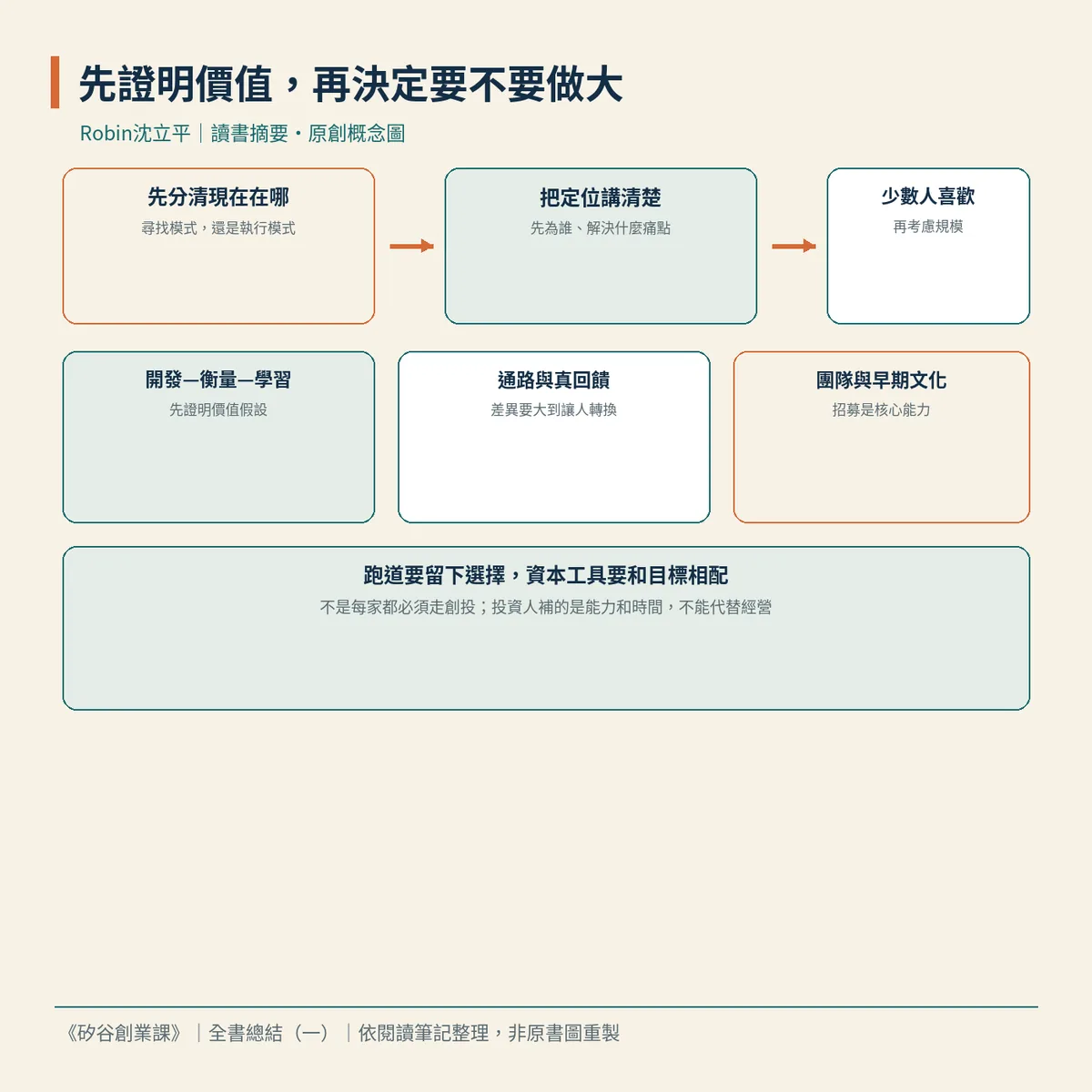
A Dozen Lessons for Entrepreneurs — Summary 1: For Entrepreneurs
After reading A Dozen Lessons for Entrepreneurs, the most useful thread for founders is not learning how to raise the next round first. It is distinguishing whether you are searching for a repeatable model or executing one you have found. Then turn the mission and pain point into clear positioning, use “Build-Measure-Learn” to prove that a small group genuinely loves the product, and add distribution, a team, and sufficient runway. Investors can help, but cannot make these judgments for you. The ten insights below draw on Notes 00–36. The ten actions turn the same thread into steps you can check.
Ten deeper insights
- First ask whether you are searching for a model or executing one you have already found. Steve Blank defines a startup’s purpose as searching for a repeatable, scalable business model. A comprehensive-looking plan cannot replace tests of customers and costs. If the search continues, senior leaders still need direct contact with users, low-cost experiments to gather feedback, and room to revise.
- A mission and a pain point experienced firsthand must become clear positioning: whom the product serves first and what it solves. Jim Goetz, Sam Altman, and John Doerr all connect the starting point to product and execution. If someone unfamiliar with the business still cannot tell what you sell after hearing that sentence, the differentiation, fundraising story, and recruiting that follow rest on unvalidated assumptions.
- Make a few people genuinely love the product before considering scale. Paul Graham cautions that a broad solution many people find “okay” often loses to a narrow problem people truly care about. An idea that initially looks bad is not automatically an opportunity. The question is whether the team is both determined and able to adjust to evidence. The Airbnb judgment was Graham’s own. The point was the people, not a story made inevitable in hindsight.
- A minimum viable product is not about minimizing features for its own sake. It tests a value hypothesis at lower cost and greater speed. The process can be expressed as “Build-Measure-Learn”: make a version users can get their hands on, examine feedback, then decide whether to continue or adjust. Eric Ries validates value before growth. Naval Ravikant caps the loss on each attempt while preserving upside.
- Market demand is usually a harder reality than founders’ self-assessment. Andy Rachleff asks whether anyone truly needs the product through “Will the dogs eat the dog food?” Roelof Botha separately considers customer value, whether a market can scale, and whether a business fits venture capital’s patience and returns over many years. Without demand, even a great team struggles to turn things around. Starting a business does not automatically make venture capital the right path.
- Growth should come back to users experiencing core value through use, not merely increasing arrivals. Chamath Palihapitiya advocates measuring only behavior that reveals core value. Kirsten Green describes product value, gross margin, customer acquisition cost and payback, retention, word of mouth, and the full experience as mutually reinforcing. Gross margin is not net profit after all expenses. Organically acquired users may be more likely to stay, but this route cannot be assumed to emerge.
- A good product still needs distribution and candid feedback. Reid Hoffman cautions that being slightly better is often not enough to make people switch. The product must reach enough people. Ben Horowitz likewise believes differentiation must be substantial enough to drive switching, and warns against running out of money. Lay out the information behind a conflict, understand it, and then decide, rather than hide problems for the sake of apparent agreement.
- There is a long road between building a product and building a company. Doug Leone and Bill Campbell both connect product, people, and operations. Important parts of early culture become established quickly, recruiting is a core capability, and mistakes in the first few hires are costly. The company must then sell and gradually expand distribution. Equity is an expensive asset for founders to sell, and terms matter as much as price.
- Cash runway should preserve options, and founders need to sell the product themselves. Josh Kopelman and Mark Suster recommended 18 to 24 months of runway at the time and advised preparing for the next round before money was needed. Too much money can sometimes substitute spending for strategy. Too little can force a company to pull back before validation is complete. Founders who delegate sales entirely struggle to truly understand why customers want the product or why they do not.
- I think founders most often assume money is what they lack most. What they lack more is clarity about value, advice from people who truly understand, and judgment about whether the business needs venture capital at all. Vinod Khosla says mature founders know whom to ask about markets and whom to ask about technology. Heidi Roizen also cautions that not every company needs venture capital. Savings, operating cash, or loans can sometimes be more suitable. A fund’s return requirements must not dictate what the company should become. Choosing an investor means choosing capabilities and time, not just a check.
Ten suggestions
- Write a paragraph stating whether you are searching for a repeatable model or executing one you have already found. If you are still searching, list the users you will contact this week, the feedback you need, and what findings would prompt a change.
- Reduce your product positioning to a few sentences: whose problem you solve first, what that problem is, and why this pain point deserves priority. Explain it to someone unfamiliar with the business. If they still do not know what you sell, narrow the focus before talking about expansion.
- Write down the small group you most want to genuinely love the product and the observable actions that would show it, such as continued use or spontaneously telling others. If all you have is “Everyone might use it,” narrow the audience before validating.
- For the current idea, list what the minimum viable product must retain, whose feedback you need and what kind, and “What would make us continue, and what would make us adjust?” If you cannot explain how you will get feedback, this is not yet a real “Build-Measure-Learn” experiment.
- Write down the strongest evidence that someone genuinely needs the product, and what market evidence remains if the founder’s self-assessment is removed. If the evidence is insufficient, return to users before strengthening the pitch or starting advertising.
- Identify the user behavior that best reveals core value, and check whether your current metrics match it. If you count arrivals without looking at whether people stay, change the metrics before discussing how to grow the numbers.
- Write down the specific distribution channels that will get the product into users’ hands and whether its difference from existing options is large enough to make people switch. If distribution remains unclear or the difference is merely “slightly better,” address both before increasing development.
- List the culture and working practices actually used since the start, how people in key roles were found, and whether you are still proving the product or already building sales and distribution. Different stages call for different people. Do not fill gaps only by replicating yourself.
- Calculate roughly how long current cash will last, what kind of value spending adds to the company, and which customers the founders personally contacted this week. If the list is empty or the money merely sustains burn, address sales and validation before discussing how much to raise next.
- Write separately whether this business must use venture capital, which capabilities and time you most need investors to add, and whom to ask about markets and technology. If the only answer is “Raise more money,” first find people who truly understand the problem and reconsider whether the financing tool matches the goal.
#ADozenLessonsForEntrepreneurs #Summary #ReadingNotes
These are reading notes and reflections based on my personal understanding. I recommend reading them alongside the original book for the full context.
Comments
What do you think? Share your experience or questions.
Sign in to comment, reply or like. Sign in / Sign up
Loading comments…