Note 2 | A Business Plan Is Not a Rocket: Steer with Feedback
These are Robin Shen’s original reading notes and commentary, written in his own words after reading Eric Ries’s The Lean Startup: How Today's Entrepreneurs Use Continuous Innovation to Create Radically Successful Businesses. They are not the original book, excerpts from it, or an official publication. Methods and concepts from the book are attributed to Eric Ries; other sources are identified where stated. For reference only; not investment advice.
English translation of Robin’s Chinese reading notes and commentary. Passages are paraphrased, not verified verbatim quotations from the original English edition.
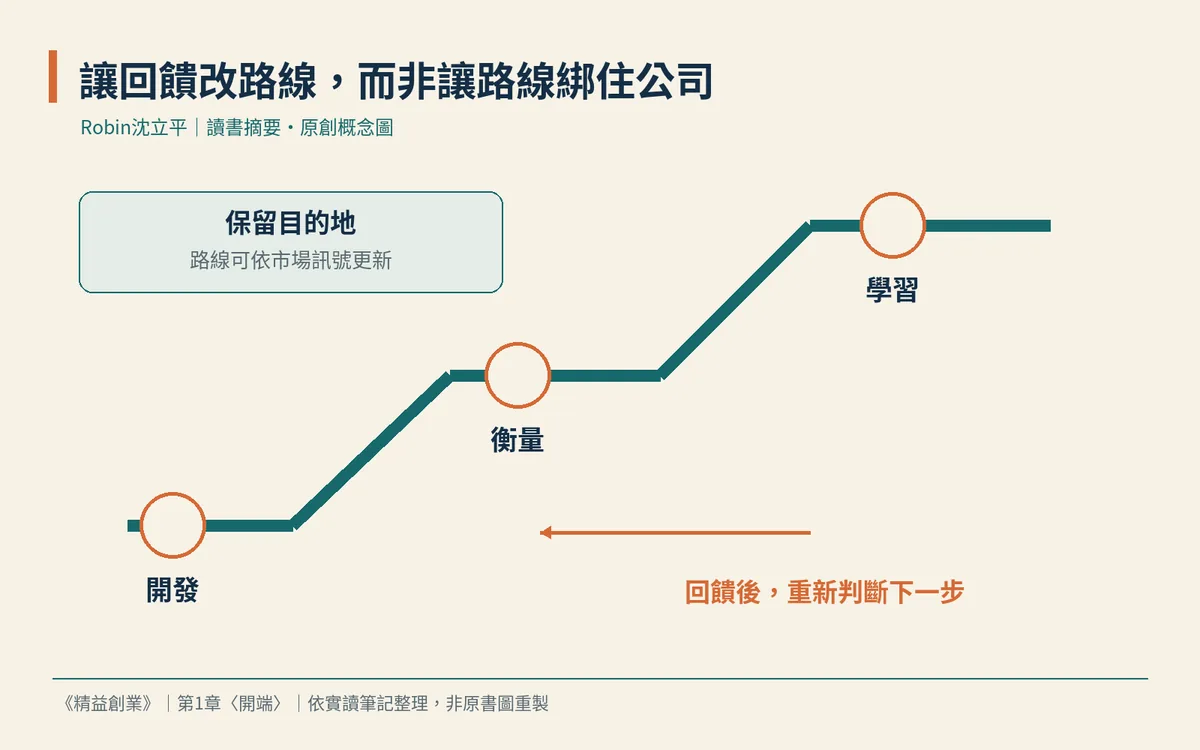
The more precise the plan, the less willing a team is sometimes to admit that the starting point was wrong. In Chapter 1, Eric Ries uses the contrast between a car and a rocket to argue that a startup should not aim only at faithful execution. While the market is still full of unknowns, the ability to keep correcting course matters more than laying out the entire route at the start.
The rocket metaphor points to a logic of advance calibration: heading, thrust, and the sequence of ignition all have to be exact, because a small initial error can become a large deviation far away. Ries is not dismissing rocket engineering. He is warning that burying a mass of untested assumptions in a business plan, then demanding that the organization execute it to the letter, lets the error grow with every increment of effort.
He describes an anonymous company that was highly optimistic about the user scale of a new product. The team held a launch event as planned and invested early in infrastructure, headcount, and customer service. When the market response fell short, the commitments and costs already bound the company, leaving almost no room to adjust. This was not simply weak execution. It was executing a fundamentally flawed plan too completely.
A car’s first feedback loop is in the engine. Ries uses this to say that startups in every industry need an engine of growth that can keep the business running. Product iterations, new features, and marketing campaigns should help improve that engine, not be pushed out simply because they are on a list. Adjustments will not always work, so tuning is itself part of the job.
The second loop is between the driver and the road. The steering wheel and the accelerator are not operated once before departure and then left alone; the driver watches and corrects along the way. In a startup, Ries describes this continuous feedback as Build-Measure-Learn: make something that can meet the market, observe the response, then decide the next step, rather than treating launch as the finish line.
The two loops must not be collapsed into one. Making a feature run more smoothly may be tuning the engine. Discovering that you chose the wrong customer or the wrong route may require a change of direction. If you only speed up execution of a settled plan and never ask whether it is taking the company toward its destination, the engine grows more powerful while the car keeps driving the wrong way.
Ries is not arguing for abandoning the destination. The driver still knows where they are going; a detour is not the same as giving up the journey. That is what separates lean from casual experimentation: you have a direction, so you know what the feedback is about; you are willing to correct, so the first route does not become an untouchable article of faith. The purpose of a plan is to help you act, not to forbid reality from speaking.
For the allocation of resources, the metaphor has a clear implication. When the key assumptions are still shaky, committing to a full-scale configuration makes later corrections more expensive. That is the warning from the anonymous case. It does not mean every early investment is wrong. It means that before you spend, you should distinguish what demand has already been seen from what exists only in a forecast table.
The two loops also remind you not to set only one review point at the end. If all feedback waits until the resources are gone, even a precise postmortem may come too late to allow a correction. Putting observation and decisions back into the course of action makes the plan a tool you can update, not merely a basis for judging at close-out who failed to hit the target.
My reading is that a good business plan should make it easier for the team to recognize a deviation, not easier to explain one away. Driving-style management is not a lack of discipline. It moves discipline from “do not depart from the script” to “do not ignore the feedback along the way.” The route can be revised; the destination and the responsibility for judgment cannot be abandoned.
Three suggestions
List the plan’s assumptions about customers, needs, and scale separately, and mark the ones that, if wrong, would change later commitments.
Build time to observe and discuss into the next product or marketing adjustment, so every cycle of action has an outlet for feedback, and a completed launch is not treated as the close of the work.
Check whether expansion commitments are running ahead of evidence of demand, and keep room to change course, so the company is not unable to turn before the market has answered.
#TheLeanStartup | Source: Chapter 1, “Start”
These are reading notes and reflections based on my personal understanding. I recommend reading them alongside the original book for the full context.
Comments
What do you think? Share your experience or questions.
Sign in to comment, reply or like. Sign in / Sign up
Loading comments…