Note 11 | Before You Prove You Can Build It, Confirm You Are Solving the Right Problem
These are Robin Shen’s original reading notes and commentary, written in his own words after reading Eric Ries’s The Lean Startup: How Today's Entrepreneurs Use Continuous Innovation to Create Radically Successful Businesses. They are not the original book, excerpts from it, or an official publication. Methods and concepts from the book are attributed to Eric Ries; other sources are identified where stated. For reference only; not investment advice.
English translation of Robin’s Chinese reading notes and commentary. Passages are paraphrased, not verified verbatim quotations from the original English edition.
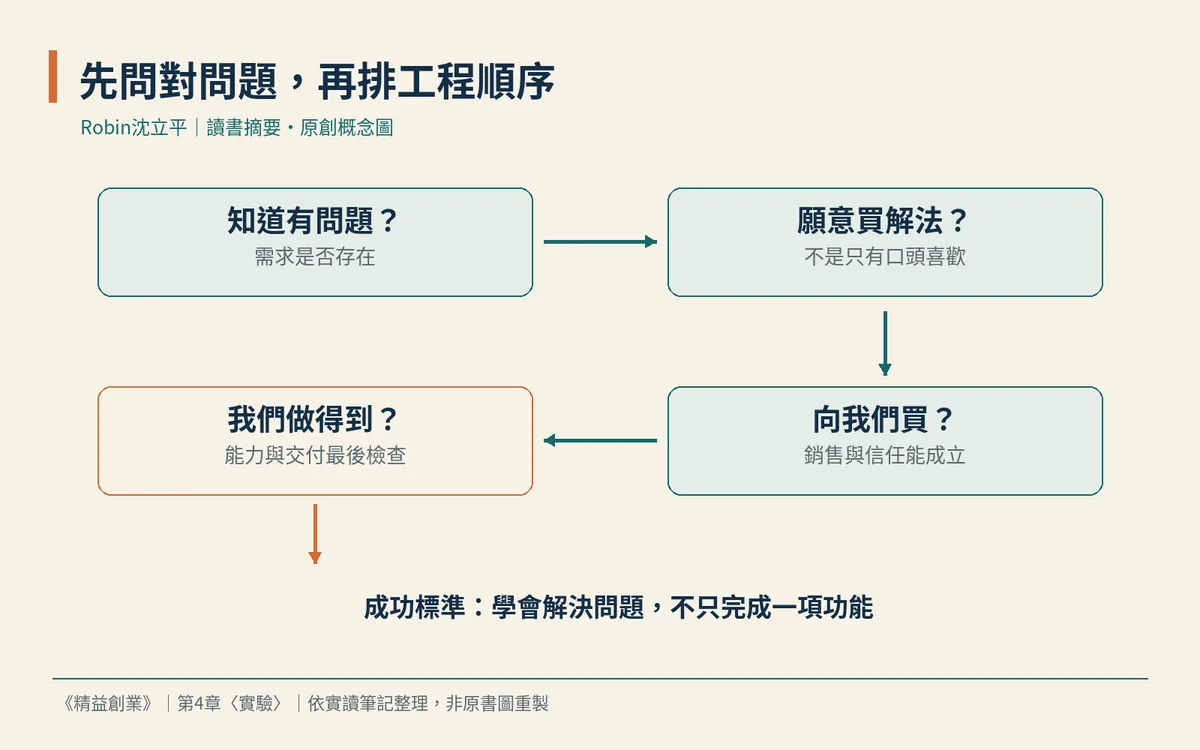
The question a team knows best is often “can we build it?” In Chapter 4, when Eric Ries introduces Kodak Gallery, he puts that question later: technical and development skill matters, but if users do not see a problem, will not buy, or will not buy from you, shipping a feature does not mean you have created value.
He quotes a sequence of four checks proposed by Mark Cook: whether users recognize the problem; whether they would buy if a solution existed; whether they would buy from us; and only then whether we have the ability to deliver it. The common reversal is to start with the last question, and only after engineering has been invested discover that the earlier doubts were never answered.
As Ries describes it, Kodak Gallery had been well received for wedding invitations and then expanded into cards for other holidays. The design and research process seemed to support the direction, but near launch the team found that the website could not clearly convey the quality of the cards, and production had problems as well. The popularity of existing items could not automatically testify for a new way of selling and delivering.
The lesson is not that you should never develop a new product. It is that before you develop, you should first know where the new offering is still uncertain. Something the market says it likes may not be understood through the existing interface; a design that looks feasible may not be easy to produce. A product is not only a set of features. It also includes whether the user can complete the whole experience.
A later case, an event photo album, shows a different order of work. The team first identified risks and assumptions, including whether users had a need to create albums, and whether people at an event would be willing to upload photos to an album someone else had created. That made the prototype more than a display of the design. It was a way to find which necessary behaviors still could not be completed.
The first test was frustrating. Early users did not complete the setup flow smoothly, and some complained about missing features. Mark Cook’s reading, as Ries recounts it, was not to treat every complaint as a rejection: the interactions still supported the existence of a need, while exposing flaws in the implementation. Judging the need and the solution separately is more useful than summarizing the result as “like” or “dislike.”
The absence of a complaint, however, cannot directly prove that a feature has no value. Ries describes the team using this to reorder importance, not to declare that anything users did not mention could be deleted forever. We should keep that range of judgment: early responses help decide the next step, but later product interaction is still needed, and one test should not be read as a complete list of requirements.
In later tests, the team also found that some people wanted to adjust the order of photos before inviting others. Even though early responses had improved, Cook still judged that a full launch was not yet appropriate, and chose to keep iterating. This is different from the simplified slogan “ship as early as possible”: reaching customers early, and starting a full marketing campaign at once, are two different decisions.
For managers, the difficulty is that a launch date is often already on the calendar, while the evidence may not keep to the schedule. The case does not endorse every delay of a launch. It returns the reason for delay to whether the problem has been solved. Saying only that you want it a little more perfect may still be a way of avoiding the market; if you can point to a key behavior users have not yet completed, the discussion has a basis.
I think the most memorable change in this note is the definition of success. Ries quotes Cook’s view that success is not implementing a feature, but learning to solve the user’s problem. That turns product management from chasing the completion of tasks to chasing the resolution of problems. Engineering skill is no longer only clearing a requirements list. It is sharing, with the other roles, responsibility for whether the solution works.
Three suggestions
Discuss the four questions one by one before engineering effort is committed, and especially mark where the need, the willingness to buy, and the choice of seller are still unknown. Do not let technical feasibility answer them.
Let the prototype correspond to necessary behaviors, and record signals of need and obstacles to use separately, so that a failed attempt is not equated with the absence of a need, and so that flaws in the solution are not ignored.
Decide early contact with users and a full launch separately, and arrange the next step according to whether the key problem has been solved, not only according to the original date or the rate of feature completion.
#TheLeanStartup | Source: Chapter 4, “Experiment”
These are reading notes and reflections based on my personal understanding. I recommend reading them alongside the original book for the full context.
Comments
What do you think? Share your experience or questions.
Sign in to comment, reply or like. Sign in / Sign up
Loading comments…