Note 12 | What You Scale Down Is Not Only Cost, but Also a Service Context You Do Not Yet Understand
These are Robin Shen’s original reading notes and commentary, written in his own words after reading Eric Ries’s The Lean Startup: How Today's Entrepreneurs Use Continuous Innovation to Create Radically Successful Businesses. They are not the original book, excerpts from it, or an official publication. Methods and concepts from the book are attributed to Eric Ries; other sources are identified where stated. For reference only; not investment advice.
English translation of Robin’s Chinese reading notes and commentary. Passages are paraphrased, not verified verbatim quotations from the original English edition.
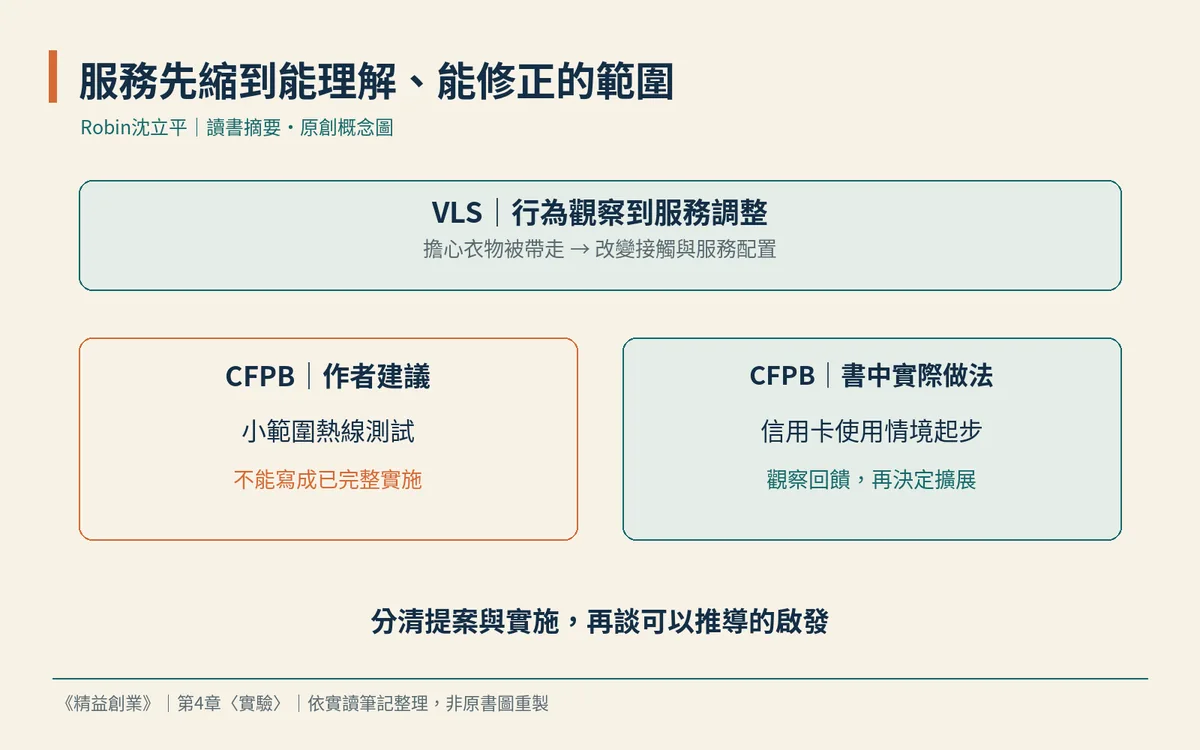
When a service does not work, the reason may not be that the need is absent. It may be that customers do not believe you will finish what you promised. In Chapter 4, Eric Ries describes VLS, a laundry service in India, and then a service idea for the CFPB, extending the experiment from features on a screen to trust, methods of contact, and the identification of actual problems.
As Ries describes it, VLS first approached potential customers with a household washing machine placed on a pickup truck, while the actual laundry was sent to a fixed location. The team wanted to know whether people would pay, and what they required of speed, cleanliness, and service. This was not a matter of first building a complete network of sites and then waiting for customers to accept it. It was identifying the unknowns while making contact.
Unexpectedly, some people were willing to hand over clothes, yet worried that the truck would drive off with them. Besides whether the wash was clean, whether the service looked reliable became a problem that had to be addressed. Ries then describes the team changing to a more solid mobile laundry kiosk, and also trying to combine the service with existing convenience-store locations, continuing to watch customer responses.
Later tests also found that ironing and faster pickup were valued. As Ries recounts it, these findings gradually shaped the service configuration. The point is not that a particular mobile device can be copied everywhere, but that the value customers actually care about may differ from the equipment the team first wanted to emphasize. Without real contact, it is easy to mistake a hardware arrangement for an understanding of the need.
The business results in the case come from Ries’s quotation of people involved, and cannot be generalized as a conclusion about laundry markets in every region. What they can better support is how stepwise tests turn an unfamiliar doubt into a design problem that can be handled. If a success narrative is used to declare that a particular form of site is bound to work, that would in fact depart from this chapter’s emphasis on seeking evidence.
In the government-service section, fact and proposal have to be kept even more carefully apart. When Eric Ries was advising on the setup of the CFPB, he proposed testing demand with a small-scale hotline: offering limited service through voice menus, reaching people in a limited area, and learning about the actual problems they brought and their responses to different messages. This was his suggestion, not a fully confirmed result of complete execution.
What the suggestion was meant to test was whether people would seek help once they knew the service existed, and whether their problems matched what the agency expected. Those affected may not understand their situation in the same way, and may need different kinds of assistance. If you first plan a complete staff and then discover that the content of the calls does not match expectations, adjustment becomes much harder.
Ries also recounts that the CFPB in fact split its first products by use case, first launching credit-card services, then closely watching other complaints and feedback as a basis for later scope and sequence. That is not the same as the regional hotline proposed in the advice, and the two should not be stitched into a single story that “the agency followed the plan and succeeded,” nor used to describe how the agency operates today.
What the two materials share is first making the scope of the service commensurate with the problems already understood. Scaling down is not only cheaper. It also makes it easier for the team to see which point of contact is failing, and which needs go beyond what was originally imagined. This is an inference I draw from the cases, not a claim that any public service can simplify its responsibilities, or that every industry is suited to copying a small experiment directly.
I think that before expanding, it is more practical to clarify “why customers are still uneasy” and “what problems are actually arriving” than to rush to prove that you can do something large. Service capacity, understanding of need, and trust have to grow together. Only when there is a starting point that can be corrected will later expansion be more than an enlargement of assumptions that have not yet been clarified.
Three suggestions
In an early service, record refusals and doubts, and distinguish the absence of a need, a lack of trust, and inconvenience in the process. Do not treat every obstacle as a problem of price.
Observe actual requests for help and patterns of use in a limited setting, then revise the method of contact and the content of the service, and say clearly what a small-scale result still cannot represent.
When writing up a case, keep the author’s proposal, the actual practice, and participants’ own accounts of results separate, and before expanding check which key assumptions still exist only in imagination.
#TheLeanStartup | Source: Chapter 4, “Experiment”
These are reading notes and reflections based on my personal understanding. I recommend reading them alongside the original book for the full context.
Comments
What do you think? Share your experience or questions.
Sign in to comment, reply or like. Sign in / Sign up
Loading comments…