Note 13 | The Most Dangerous Thing in a Plan Is Not the Unknown. It Is Pretending You Already Know
These are Robin Shen’s original reading notes and commentary, written in his own words after reading Eric Ries’s The Lean Startup: How Today's Entrepreneurs Use Continuous Innovation to Create Radically Successful Businesses. They are not the original book, excerpts from it, or an official publication. Methods and concepts from the book are attributed to Eric Ries; other sources are identified where stated. For reference only; not investment advice.
English translation of Robin’s Chinese reading notes and commentary. Passages are paraphrased, not verified verbatim quotations from the original English edition.
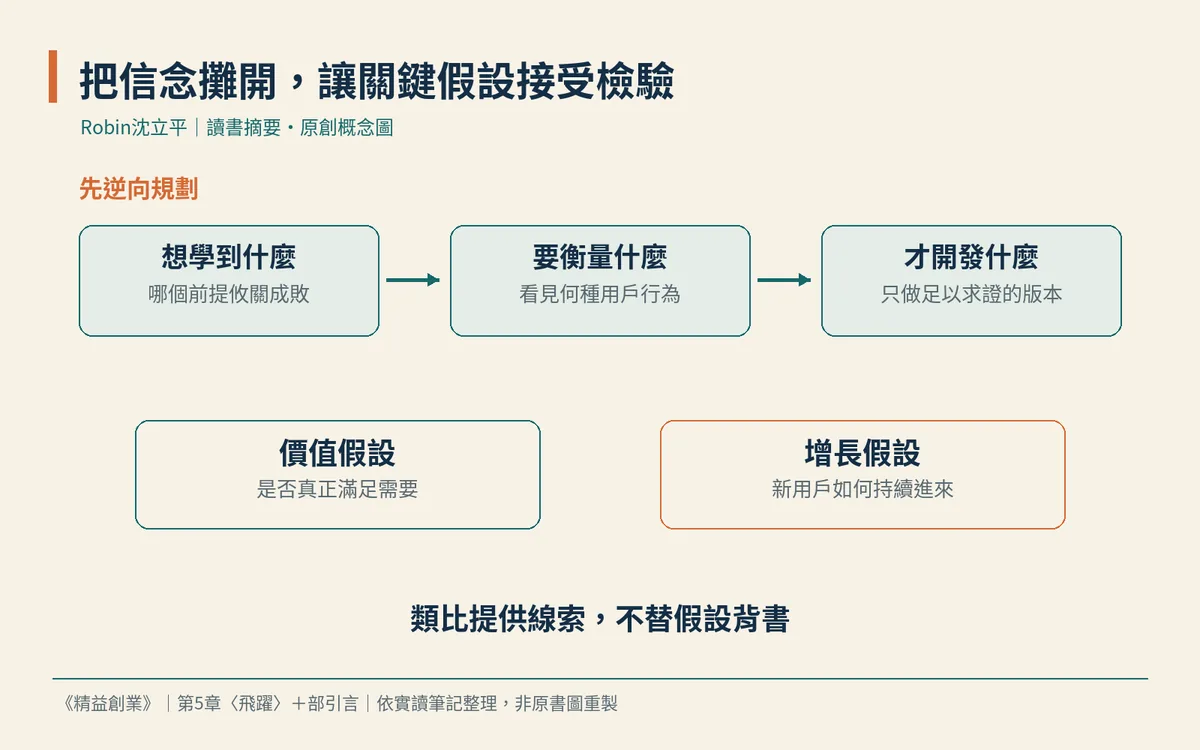
The more fluent a business plan, the easier it is to forget that some of its key sentences have not yet been proved. In Chapter 5, Eric Ries calls these premises, on which success or failure depends and which can only be believed for now, leaps of faith. The point is not to blame founders for having beliefs, but to remind us that the beliefs that carry the whole company forward must have a chance to meet reality.
The introduction to Part Two first explains the Build-Measure-Learn loop. Engineers making development faster, and managers making analysis deeper, do not by themselves guarantee that the whole is effective. What should be shortened is the time a complete feedback cycle takes. Planning therefore has to be reversed: first decide what you want to learn, then decide what to measure, and only then choose what to build, rather than looking for usable data after the product is finished.
Leaps of faith often hide in ordinary sentences: consumers badly need us; channels will naturally be willing to sell. These statements are not necessarily wrong. The problem is that the team treats them as facts, so all later work is built on a foundation that has not been checked. The work of early strategy is to lay that foundation open and, without departing from the vision, find the premises most worth testing first.
Ries especially warns against handsome analogies. That another company won a market with a particular technology does not mean that we will succeed by adopting something similar. An analogy may quietly treat “the need already exists; only a technical barrier remains” as settled. Rewritten in concrete terms, you still have to ask: who is in a hurry to use this? Do they understand the use, can they afford the price, and are they really blocked only by the current technology?
This is not a rejection of earlier experience. Ries uses the examples of the Walkman and music downloads to show that analogies and counterexamples can help rule out some unknowns, and can also point to questions that have not been answered. That people were willing to wear headphones outdoors, and that people would be willing to pay for digital music, are two different things. The value of a reference case is in distinguishing which premises already have clues and which you still have to cross yourself, not in endorsing an entire plan.
The two most critical leaps are the value hypothesis and the growth hypothesis. The former asks whether the product truly creates value; the latter asks where new users come from and how growth happens. Ries does not let short-term profit stand in for value, and he reminds us that some kinds of growth can destroy value: if a product has not yet established a real use, but continues to stay busy on the strength of financing and advertising, rising numbers may not mean that the business has become more reliable.
The converse is also untrue: not all paid customer acquisition is unhealthy, and an unprofitable company is not automatically worth supporting. What Ries asks for is a deeper understanding of the drivers, and a quantitative model that can gradually be tested against real data. Intuition can be a starting point early on, but it cannot be exempt from validation forever. Traditional strategy helps us identify assumptions; an entrepreneurial organization still has to be able to take those assumptions to the market and test them.
An honest disclosure of what is unknown should not automatically be treated as a lack of preparation. The more useful question is whether the team can say clearly how it will seek evidence, and what it is willing to change if the evidence is different.
I think the most useful progress in an investment discussion is not necessarily making the forecast more precise, but making the most critical unknowns more honest. If a premise, once it fails, would overturn the whole model, it should not hide in a footnote on a slide. Saying it plainly is not a reduction of ambition. It is a way of aiming capital, people, and the next round of work at the question of whether the company can actually be built.
Three suggestions
Rewrite the success analogy you use most often into who has the need, what currently blocks them, and what behavior you expect, and mark each sentence as fact or assumption.
Write the value and growth hypotheses separately, state the consequences if each failed, and first arrange tests for the questions that could shake the entire model.
Check what currently sustains growth, discuss new users separately from real value, and do not let a continued injection of capital stand in for a need that has not yet been proved.
#TheLeanStartup | Source: Chapter 5, “Leap” (including the introduction to Part Two)
These are reading notes and reflections based on my personal understanding. I recommend reading them alongside the original book for the full context.
Comments
What do you think? Share your experience or questions.
Sign in to comment, reply or like. Sign in / Sign up
Loading comments…