Note 14 | Getting Out of the Building Is Not Asking Customers to Design the Product for You
These are Robin Shen’s original reading notes and commentary, written in his own words after reading Eric Ries’s The Lean Startup: How Today's Entrepreneurs Use Continuous Innovation to Create Radically Successful Businesses. They are not the original book, excerpts from it, or an official publication. Methods and concepts from the book are attributed to Eric Ries; other sources are identified where stated. For reference only; not investment advice.
English translation of Robin’s Chinese reading notes and commentary. Passages are paraphrased, not verified verbatim quotations from the original English edition.
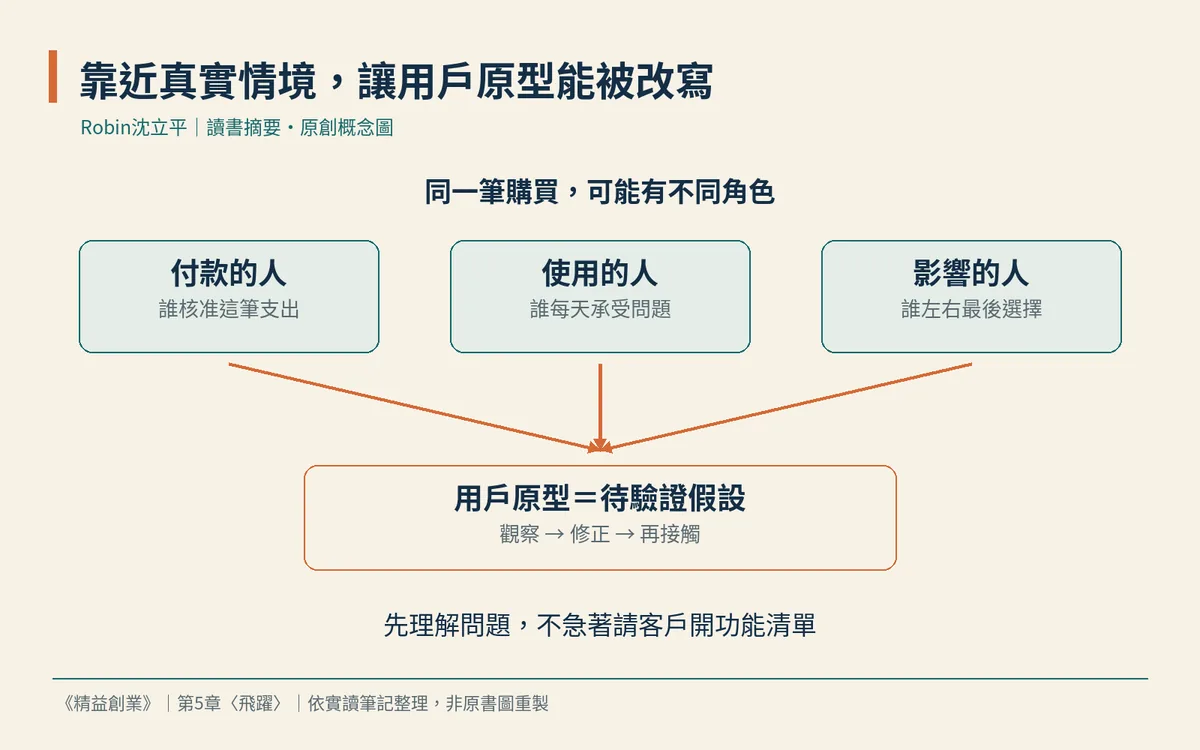
A report can describe a market without telling us who actually influences a purchase. In Chapter 5, when Eric Ries discusses first-hand information, he borrows Toyota’s idea of genchi genbutsu: do not rely only on what seems obvious or on second-hand material; go in person into the context of use and understand how the problem arises. For a startup, this is not a tour. It is a way of identifying which assumptions most need to be tested.
As Ries recounts, Yuji Yokoya, chief engineer of the Sienna, drove through North America himself in order to understand the market, and met car owners in different places. He found that although parents or grandparents paid, children strongly influenced the choice of car. Rear-seat space was not an accessory in an adult’s eyes, but the setting of a child’s long journey. Asking only the person who paid could miss the experience that actually shaped the decision.
The finding led the new model to put more resources into ride comfort. Ries is careful, however, to distinguish this as a sustaining innovation at a mature company, not a formula for startup success that can be copied directly. Toyota already roughly knew its target customers and market, so field observation could deepen understanding. A startup often has not even determined whom to serve, or whether the problem matters. The more important task of going out and making contact is to correct the direction of the search.
Another starting point is more modest. As Ries narrates, when Scott Cook was starting Intuit, he picked up phone books from two cities and called people at random to ask how they managed their bills. What he wanted to confirm was whether handling finances by hand was a source of trouble, not to ask respondents to score software that did not yet exist. Most people at the time were unfamiliar with personal computers. If he had begun by asking them to imagine computer features, he might not have obtained a meaningful answer.
These conversations supported his judgment of the problem, but they did not therefore prove that every product detail was correct. Ries does not provide a sample size, and he does not say that one telephone survey can complete commercial validation. The important distinction is that people can describe the trouble they are now bearing, yet may not be able to say accurately what the future should look like. Understanding the problem and deciding on a solution are connected but different tasks.
Ries goes on to discuss a user archetype: a brief description of the target person’s traits and situation, so that the team has a shared basis for everyday decisions. For a startup, however, it is still a set of assumptions, not a fact that can be sealed once a design report is finished. Even the most complete early research cannot anticipate every interaction after the product is in use. Only continued validation gives the description a chance to come closer and closer to real people.
Getting out of the building is therefore neither taking every customer request at face value, nor stopping once you have interviewed people who support you. Ries reminds us that users may not understand their own needs, and that the purpose of early contact is to build a first understanding and find the problem. If interviews are packaged as a settled list of requirements, or if a polished persona is mistaken for market evidence, you have only returned to desk work in another form.
I think this reminder also applies to selling to businesses. The company may be the customer, but the person who states the need, the person who actually uses the product, the person who bears the consequences, and the person who approves the purchase may not be the same. This is an observation I extend from the chapter, not a standard process Ries provides. The conclusion is simple: first-hand understanding should give the original view a chance to be changed. Otherwise, no matter how many people you meet, you are only taking the original answer out for a walk.
Three suggestions
Arrange one encounter in a real setting of use. First ask the other person to describe a recent problem and how they handled it. Do not rush to introduce the product, and do not ask them to invent features for the team.
Mark the current user archetype as a hypothesis still to be tested, and record in each round which observations support it and which overturn it, so the description is updated with contact rather than fixed by a closing report.
Map the people who use, pay, and influence the purchase, and follow up with roles that have not yet been heard, especially checking whether someone, like the children in the Sienna case, actually affects the final choice.
#TheLeanStartup | Source: Chapter 5, “Leap”
These are reading notes and reflections based on my personal understanding. I recommend reading them alongside the original book for the full context.
Comments
What do you think? Share your experience or questions.
Sign in to comment, reply or like. Sign in / Sign up
Loading comments…