Note 16 | A Minimum Viable Product Is Not Making Quality Smaller Along with Everything Else
These are Robin Shen’s original reading notes and commentary, written in his own words after reading Eric Ries’s The Lean Startup: How Today's Entrepreneurs Use Continuous Innovation to Create Radically Successful Businesses. They are not the original book, excerpts from it, or an official publication. Methods and concepts from the book are attributed to Eric Ries; other sources are identified where stated. For reference only; not investment advice.
English translation of Robin’s Chinese reading notes and commentary. Passages are paraphrased, not verified verbatim quotations from the original English edition.
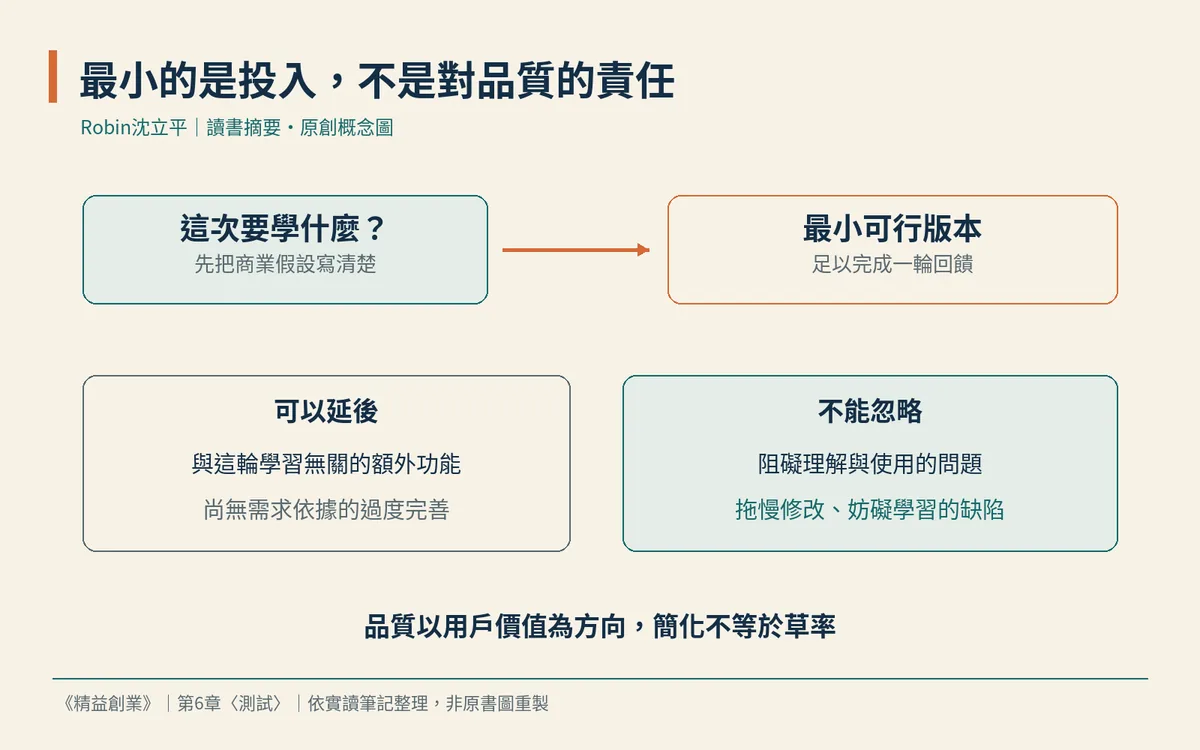
The most common misunderstanding of a minimum viable product is that you first ship a version with very few features and very poor quality. In Chapter 6, Eric Ries offers a different standard: use the least effort to complete a Build-Measure-Learn loop as quickly as possible. “Minimum” refers to the work needed to obtain a particular understanding, not to cutting the product at random until it cannot be used, and not to giving carelessness a fashionable name.
As founder Andrew Mason later recounted, and as Ries quotes him, Groupon in its early days posted deal information with off-the-shelf website tools, produced coupons with database software, and sent them by email. The system was incomplete, yet it already allowed real users to buy, and tested whether people liked the model. For the question at that time, first building a complete and polished platform was not a necessary condition. Whether you could begin to understand the transactions was the basis for judging the work.
This also shows the difference between a minimum viable product and an ordinary prototype. A prototype may be used to solve a design or technical problem; here the point is to touch a basic business assumption. If a model assumes that a certain share of visitors will sign up for a free trial, that claim should first be treated as unproven. Ries uses a hypothetical conversion rate of ten percent as an illustration. It is not a market rule, still less a guaranteed value. It is a premise that should be written in plain view and tested first.
If no one is even willing to walk through the entrance to a trial, a large set of features behind that entrance may not be worth building first. Conversely, even if people do register, you still have to ask how many features are actually needed to attract early adopters. Ries points out that this group is willing to fill product gaps with imagination, and cares about solving a problem first or gaining an advantage. A degree of polish beyond what they need at the moment may only be extra effort that postpones learning.
Early adopters are not, however, the whole market, and a willingness to accept gaps is not indifference to value. Ries uses IMVU’s teleportation experience to challenge developers’ intuitions about quality. The team had assumed that letting avatars move freely required complex walking and obstacle avoidance. Short of resources, they first tested arrival by click, and users liked it. Ries has an interest in IMVU, so this should be read as a participant’s account of experience, not as a general experimental conclusion.
In the case, engineers thought the omitted process was crude, while users cared about reaching a destination quickly. What Ries wants to show is that if you do not yet understand consumers, you cannot fully define quality as they see it in advance. Professional standards have value, but more time invested and more technical realism do not necessarily mean more of the need is met. Some simplifications that look like a step backward may in fact come closer to what people actually want to finish.
Ries also draws a clear line: a minimum viable product does not permit sloppiness or a lack of discipline. If a defect makes the product hard to change, slows iteration, or even prevents you from obtaining useful feedback, it cannot be ignored. If even early users do not understand how to use it, more design effort may be needed. Cuts have to be aimed at the learning goal. Not every correction should be treated uniformly as waste.
I think what this chapter truly reduces is not responsibility for the product, but the infatuation with “finishing everything before we know what customers want.” A minimum viable product is the starting point of learning, not the end of an assignment. The conclusion is to first use a sufficiently reliable experience to answer the key questions, and then put resources into the parts that have been shown worth expanding. Doing less is not itself an achievement, and doing more is not itself a proof of quality.
Three suggestions
Rewrite the most critical conversion number in the model as a clear hypothesis: who, in what situation, will take what action. Do not let a cell in a spreadsheet pretend to be a known fact.
Check each planned feature for a direct contribution to this round of learning, defer unrelated items, and keep the work needed to obtain useful feedback and to continue making changes.
First test with suitable early adopters, state clearly that defects which block use or slow iteration cannot be ignored, and then adjust the investment in quality according to real responses rather than lowering it at random.
#TheLeanStartup | Source: Chapter 6, “Test”
These are reading notes and reflections based on my personal understanding. I recommend reading them alongside the original book for the full context.
Comments
What do you think? Share your experience or questions.
Sign in to comment, reply or like. Sign in / Sign up
Loading comments…