Note 17 | Finish the Service with People First, Then Decide What the Software Should Do
These are Robin Shen’s original reading notes and commentary, written in his own words after reading Eric Ries’s The Lean Startup: How Today's Entrepreneurs Use Continuous Innovation to Create Radically Successful Businesses. They are not the original book, excerpts from it, or an official publication. Methods and concepts from the book are attributed to Eric Ries; other sources are identified where stated. For reference only; not investment advice.
English translation of Robin’s Chinese reading notes and commentary. Passages are paraphrased, not verified verbatim quotations from the original English edition.
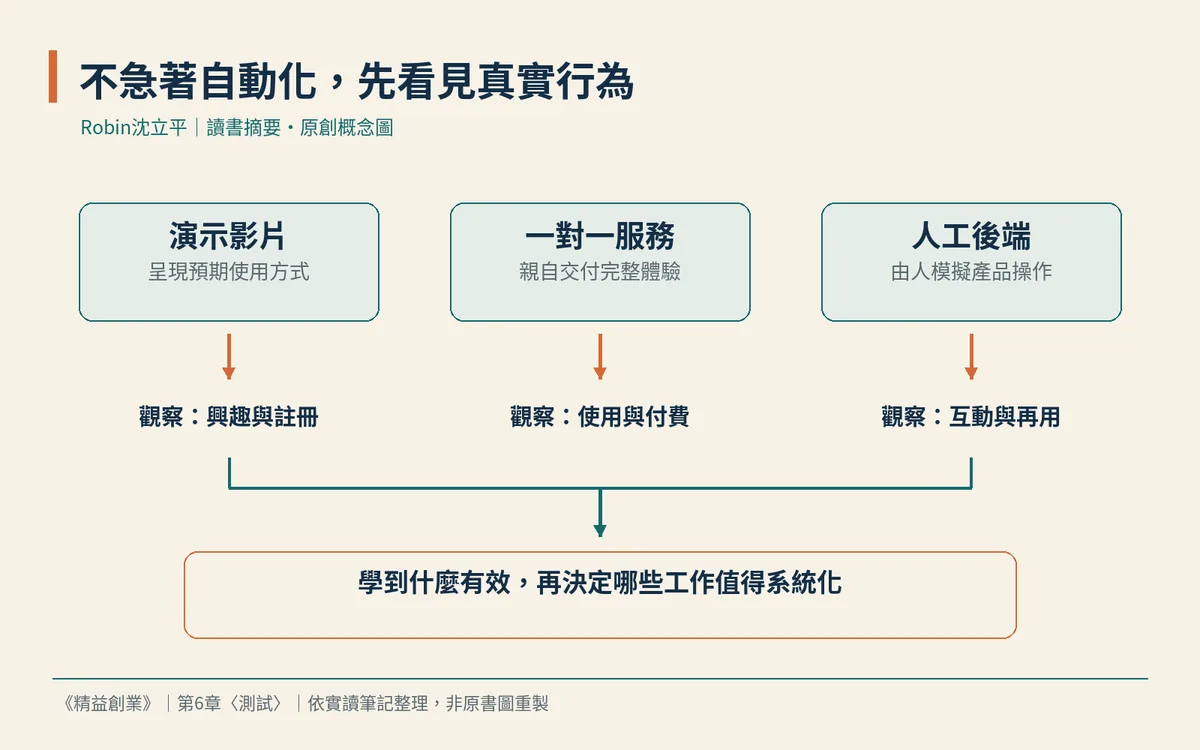
“Without a complete system, we cannot know whether users will want it.” In Chapter 6, Eric Ries uses three different approaches to open this seemingly reasonable constraint: a demonstration video, a one-to-one service, and manual operation behind the scenes. They are not the same tool, but they answer the same management question: before investing in expensive automation, can the key business assumptions first meet real behavior?
Dropbox required deep integration across platforms, and seamless operation was itself the core experience, which a simple prototype could not easily show. The team did not only wait for the engineering to be complete. It used a video of a little more than three minutes to let early adopters in the technical community see the intended way of using it. The purpose of the video was not to persuade everyone with a polished picture, but to test whether, if such an experience existed, the target audience would actually be willing to try it.
As Drew Houston later recounted, and as Ries quotes him, the waiting list grew overnight from 5,000 to 75,000 after the video was released. This was registration behavior, not merely respondents saying they liked it. It still did not prove long-term retention, payment, or that all of the technology was already established. I take the value of the case to be that it found a lower-cost way to check demand, not that it declared any popular video a sufficient endorsement of a business model.
Food on the Table reduced the service to one user and one supermarket. As Ries narrates, the founder and the head of product personally studied promotions, chose recipes that fit a family’s preferences, delivered a shopping list, and charged $9.95 a week. In terms of traditional operating efficiency, a manager personally delivering a list is a poor use of time. In terms of learning, it made it possible to know directly why a family needed the service, where they were dissatisfied, and whether they were willing to keep paying.
Only as the service gradually grew did the team turn work it already understood into email delivery, software processing, and online payment. Ries stresses that a concierge service is not the final product itself, but an activity for testing the growth model. Even if a small scale can be profitable, that does not mean the model can be expanded. This kind of test may even overturn the original imagination of growth, and a first modest profit should not stop the questioning.
Aardvark took another approach: in front of the user it looked like an interaction with a product, while behind the scenes people first handled the questions and the matching. As participants later recounted, the team used several short-cycle prototypes to observe repeat use, and did not immediately finish every technical problem. This Wizard of Oz test let the team first judge whether users would use and recommend the service, and whether the solution could produce an experience of market value.
The boundaries of evidence differ among the three. A video can first observe interest and registration; a one-to-one service can deepen understanding of use and transactions; a manual back end can check a complete interaction. None can directly prove the cost structure and scale of service after automation. Ries does not ask that people permanently fill the gaps. He puts automation after you more clearly know what works, so that you do less of the features that have not been shown worth existing.
I think starting with people is not a slight on engineering. It is a way of finding the right problem for engineering. Human effort, however, can sometimes rescue an experience through enthusiasm. If the extra handling is not recorded, a founder’s over-service can be mistaken for the product’s capability. This is an additional reminder of my own. The real conclusion is that what people can do by hand is a chance to learn, not a license to expand at once. After the learning, you still have to say clearly which parts are worth turning into a system.
Three suggestions
Choose the method according to the question you want to test: a demonstration video to see interest first, personal delivery to understand the service, and a manual simulation to observe a complete interaction. Do not mix different kinds of evidence.
Personally deliver a complete service once for the earliest few users, record the reasons for repeat use, payment, and refusal, and mark the places that required extra human rescue.
List work that recurs and has been shown useful as a candidate for automation, and separately list the problems of scale and cost that have not yet been solved. Do not treat the success of a manual test as a declaration that expansion is established.
#TheLeanStartup | Source: Chapter 6, “Test”
These are reading notes and reflections based on my personal understanding. I recommend reading them alongside the original book for the full context.
Comments
What do you think? Share your experience or questions.
Sign in to comment, reply or like. Sign in / Sign up
Loading comments…