Note 18 | Tests Need Not Fear Bad News. What They Should Fear Is the Absence of Prior Agreement
These are Robin Shen’s original reading notes and commentary, written in his own words after reading Eric Ries’s The Lean Startup: How Today's Entrepreneurs Use Continuous Innovation to Create Radically Successful Businesses. They are not the original book, excerpts from it, or an official publication. Methods and concepts from the book are attributed to Eric Ries; other sources are identified where stated. For reference only; not investment advice.
English translation of Robin’s Chinese reading notes and commentary. Passages are paraphrased, not verified verbatim quotations from the original English edition.
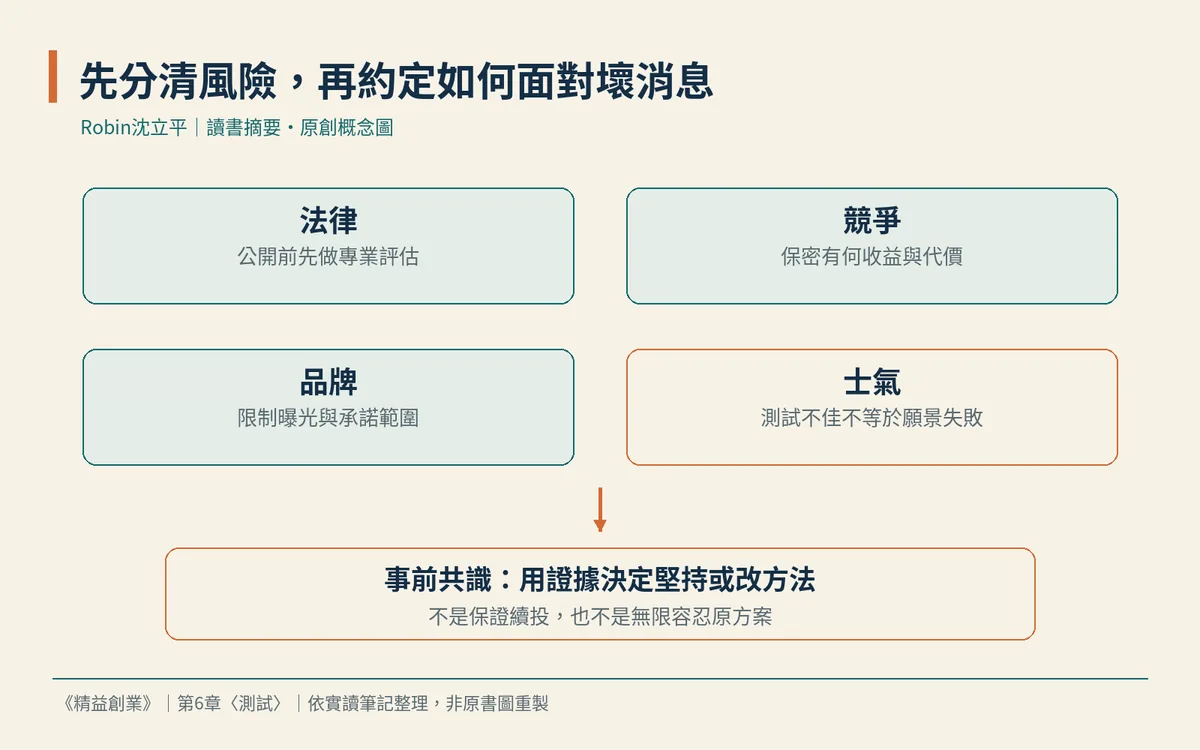
As soon as a minimum viable product is about to ship, objections often appear at once: will patents be affected? Will competitors copy it? What about the brand and the team’s morale? In Chapter 6, Eric Ries does not say these concerns do not exist. He asks that they first be understood, otherwise both real risks and imagined ones can keep a company from beginning to learn.
The first category is legal. Ries reminds us that in some jurisdictions, patent procedures may be affected by a public release, and cross-border protection may face different requirements. This is a general risk reminder in the book, not a legal judgment about Taiwan’s current system. Teams whose advantage is scientific innovation, in particular, cannot treat “test quickly” as a reason to skip professional assessment. Ries explicitly recommends seeking legal counsel.
The second category is fear that the idea will be stolen. Ries’s counter-question is sharp: many large companies do not lack ideas; they are busy lining up existing work and find it hard to execute. A startup’s real room to survive lies in completing Build-Measure-Learn faster. If you stay away from users in the name of secrecy, you may keep an idea nobody needs, and lose the chance to understand the market and correct course in time.
This passage should not be read as saying that competitive risk never matters, nor as homework that every company must literally go looking for a giant to “steal the idea.” I take Ries to be taking apart the premise behind the fear: what advantage do we actually have, and why could we not stay ahead after going public? If the only answer is that others do not yet know the idea, the problem may not be insufficient secrecy, but that the team has not yet built the ability to keep learning faster.
The third category is brand. Ries suggests shipping under a different name, quietly reaching a small number of users, and then iterating on the feedback. A loud campaign that fails to deliver on its promises, and an early test in a limited scope, are not the same situation. These arrangements are a way of reducing unnecessary exposure, not a claim that a change of name removes responsibility. Nor can the name of a test be used to make users promises you cannot yet keep.
The fourth category is the easiest to overlook: morale. A minimum viable product often brings bad news, because it asks not only whether the product can be built, but whether the business premises are right. If the team still uses a traditional “go or kill” gate, a disappointing test may be treated as a rejection of the entire vision. To avoid that outcome, some companies simply wait until every feature is complete before they will be tested, and the cost is only piled higher.
Ries’s remedy is to reach agreement in advance: a poor result is not a casual reason to abandon the vision, but a reason to keep experimenting and, when necessary, to pivot in search of a viable path. This does not mean unlimited investment in the same direction, and it does not mean that every result is called a success. True resilience includes changing the method. If you only cling to the original plan, learning becomes a performance with no option to say no.
Investors and finance leads also need a shared language of progress. If the original optimistic forecast is not realized, is that laziness, an error of judgment, or a valuable update in understanding? Ries hands this responsibility to innovation accounting in the next chapter. I think one of the most important preparations before shipping is to explain how you will assess what has been learned, rather than asking everyone for forbearance only after the fact. Agreement is not a guarantee of continued investment. It is a way of ensuring that evidence can change direction, and is not drowned by the emotion of a single success or failure.
Three suggestions
Before shipping, examine legal, competitive, brand, and morale issues separately. Refer patent questions to legal counsel, and do not let general startup lore stand in for a concrete legal judgment.
Write clearly what secrecy is meant to protect and at what cost, then assess whether users can be reached in a smaller scope or under a different name, so that a vague fear does not stop all validation.
Before the test, agree with the team and investors on how hypotheses, evidence, and the next step will be recorded. When the result is poor, first check the direction and the method, and do not equate one missed expectation with the failure of the vision.
Robin’s note | Taiwan startups and venture capital
If a Taiwanese technology team is also planning for international markets, professional assessment before a public test can be included in the experimental preparation, rather than waiting to remedy things only after results are exposed. This is a conditional suggestion about process. It does not involve patent terms or legal conclusions for any jurisdiction.
#TheLeanStartup | Source: Chapter 6, “Test”
These are reading notes and reflections based on my personal understanding. I recommend reading them alongside the original book for the full context.
Comments
What do you think? Share your experience or questions.
Sign in to comment, reply or like. Sign in / Sign up
Loading comments…