Note 19 | Innovation Accounting: Turn Work Completed into Progress in Learning
These are Robin Shen’s original reading notes and commentary, written in his own words after reading Eric Ries’s The Lean Startup: How Today's Entrepreneurs Use Continuous Innovation to Create Radically Successful Businesses. They are not the original book, excerpts from it, or an official publication. Methods and concepts from the book are attributed to Eric Ries; other sources are identified where stated. For reference only; not investment advice.
English translation of Robin’s Chinese reading notes and commentary. Passages are paraphrased, not verified verbatim quotations from the original English edition.
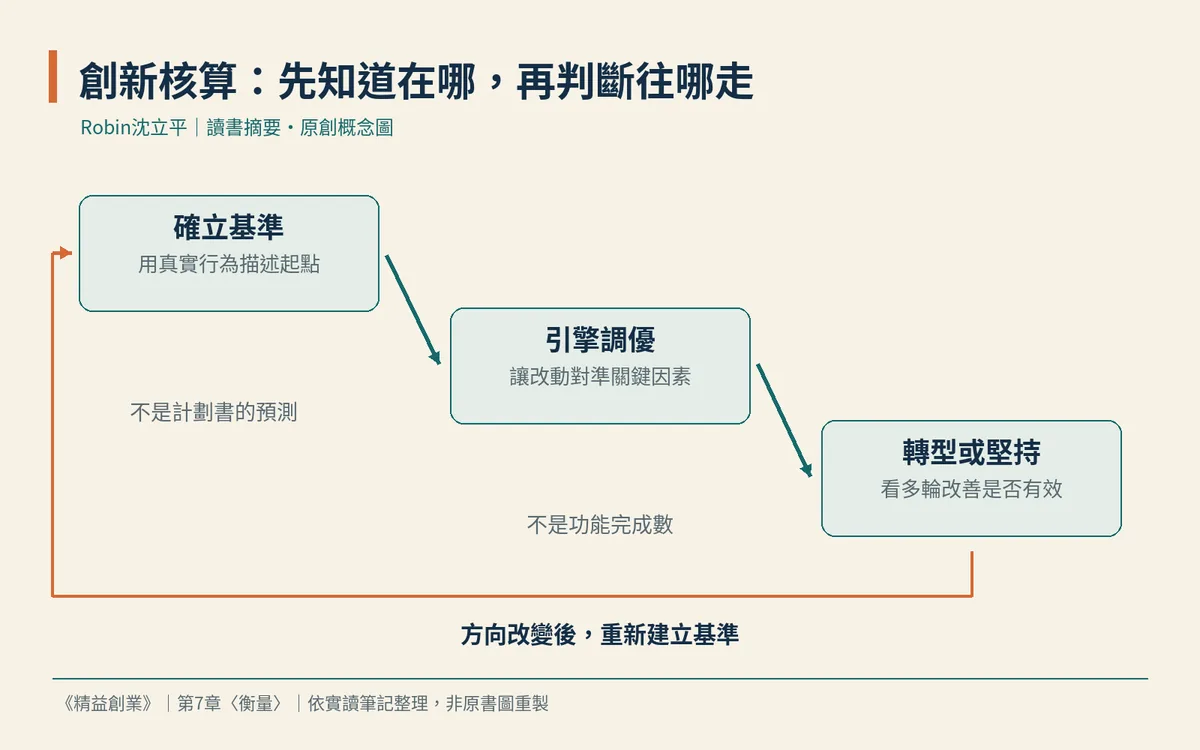
Has the product improved? Most teams will say yes. How they know often comes down to listing features, repeating a few users’ compliments, or pointing to a rise in this month’s totals. In Chapter 7, Eric Ries introduces innovation accounting to fill that gap: not by turning effort into more reports, but by letting the team answer whether this round of work truly improved the conditions on which a sustainable business depends.
A traditional plan often includes forecasts of revenue, spending, and users, but a startup’s real starting point is usually far from the ideal. Ries asks that you first face the present situation, then learn by experiment how to approach the model, rather than judging everything by the original forecast. The most dangerous thing is not necessarily zero results. It is having a few users and a little revenue, enough to keep hope alive, but not enough to prove that the company has the capacity for long-term development.
The first step is to establish a baseline. Use a minimum viable product to obtain real data on registration, trial, payment, or other key behaviors, so you know where you are now. Unflattering numbers do not mean this step has no value. If you do not even understand the starting point, you cannot judge whether later improvements are effective. Ries also allows interest to be tested first with marketing materials, but reminds us that such a smoke test answers only part of the question and cannot validate the entire growth model.
The baseline is not the same table for every company. Ries compares ordinary manufacturing with a platform that matches transactions: the former may care about revenue per customer, cost of acquisition, and repeat purchase; the latter has to ask whether retention on both the buy and sell sides can support a network effect. The framework is the same; the drivers differ. If you report a number only because peers often report it, you can easily get a dashboard that looks standard but is not in fact aligned with your own model.
The second step is tuning the engine. Every change to the product, marketing, or anything else should correspond to a clear driver. If the assumption is that newcomers find the product hard to use and that this is blocking growth, then a change to the interface has to be tested against activation behavior. You cannot declare success only because the screen is more beautiful and the team is more satisfied. Ries pulls the criterion of successful design back to user behavior, and requires that the purpose of development and its results can be discussed.
What matters most here is saying it clearly in advance. If you make many changes at once, then pick one rising number to celebrate, it is hard to know where the result came from. Ries contrasts companies that have a baseline, a hypothesis of improvement, and a validating experiment with companies that merely keep discussing product improvement. The difference is not who is more diligent. It is that the former treats each step as an inference that can be checked, rather than an explanation attached after the fact.
The third step is to pivot or persevere. If key metrics are gradually approaching the conditions a sustainable business requires, learning is driving progress. If several rounds of optimization still cannot improve the important factors, optimistic forecasts cannot be used to cover the stall. Ries points out that after a change of direction you still have to re-establish a baseline and tune again. A new direction should also be judged by whether later effort can move development more effectively than before, not only by the enthusiasm at the moment the pivot is announced.
I think this moves accountability from “how much did you do” further toward “what did you prove, and what will you therefore do.” It is not a way of finding reasons for poor results, and it is not a way of turning every ideal number in the model into a commitment that must be forced through. The conclusion is to connect hope back to reality with a real baseline and testable improvements, so that the team, managers, and investors can see the same stretch of road, rather than each judging progress by a different story.
Three suggestions
First draw your own growth model, select the assumptions most likely to make the model fail, then use a suitable small test to establish a real baseline, and mark the question each number answers.
Before each change, write the driver to be improved, the expected behavior, and how it will be observed. When the result does not match, keep a record of the failure, and do not let a rise in some other total reverse the verdict to success.
Periodically put several rounds of improvement next to the original expectations. If a key factor has long been stalled, discuss a change of direction. A new direction still begins again from a baseline and from validation.
Robin’s note | Taiwan startups and venture capital
If an early-stage team in Taiwan and its investors see progress differently, they can discuss it with three shared columns: the baseline, the hypothesis behind a change, and the result. This does not replace financial management, and it does not guarantee a successful raise, but it can first help both sides tell whether execution still needs improvement, or whether a business premise needs to be rethought.
#TheLeanStartup | Source: Chapter 7, “Measure”
These are reading notes and reflections based on my personal understanding. I recommend reading them alongside the original book for the full context.
Comments
What do you think? Share your experience or questions.
Sign in to comment, reply or like. Sign in / Sign up
Loading comments…