Note 3 | Hold the Vision Steady, Be Ready to Change the Strategy, and Keep Tuning the Product
These are Robin Shen’s original reading notes and commentary, written in his own words after reading Eric Ries’s The Lean Startup: How Today's Entrepreneurs Use Continuous Innovation to Create Radically Successful Businesses. They are not the original book, excerpts from it, or an official publication. Methods and concepts from the book are attributed to Eric Ries; other sources are identified where stated. For reference only; not investment advice.
English translation of Robin’s Chinese reading notes and commentary. Passages are paraphrased, not verified verbatim quotations from the original English edition.
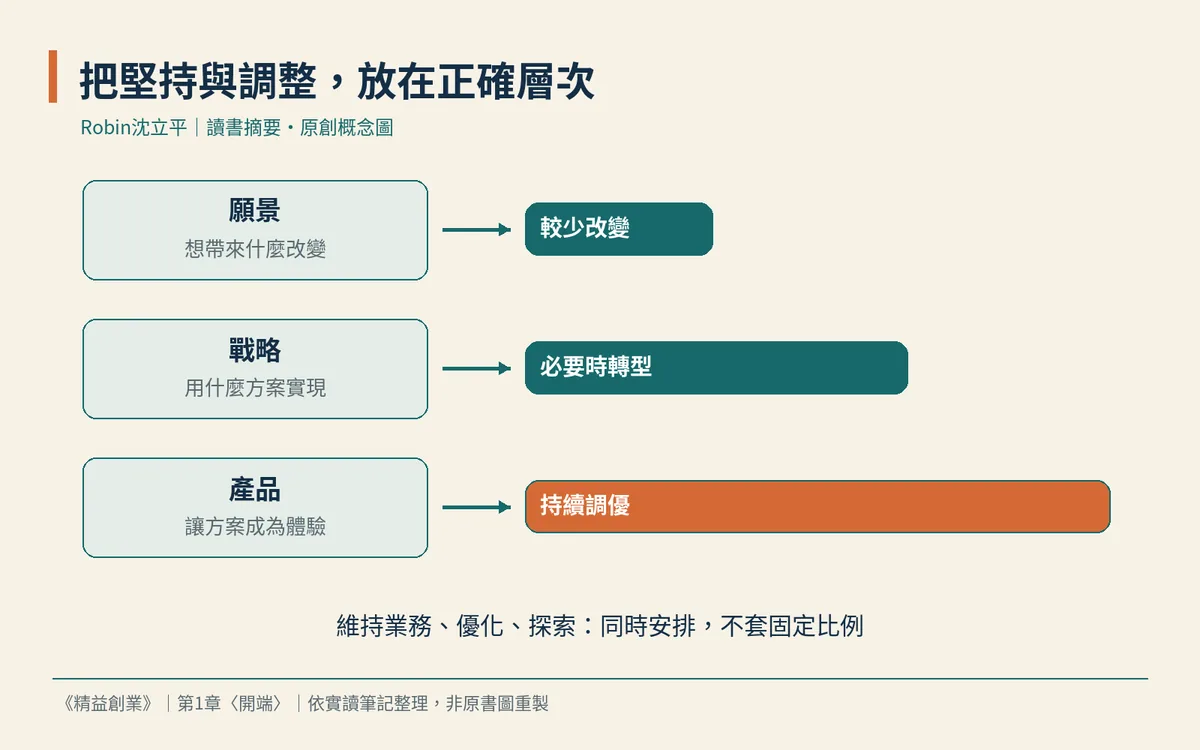
The easiest way for a startup conversation to go wrong is to mix up levels. Changing a feature is treated as a betrayal of first principles; a customer assumption has already collapsed, yet the team refuses to move in the name of holding the vision. In Chapter 1, Eric Ries separates vision, strategy, and product, so that “what we should stick to” is no longer decided only by feeling.
As he explains it, vision is what the company wants to become and what change it hopes to bring. Strategy is the plan for realizing the vision, including the business model, the product roadmap, the target customer, and how partners and competitors are understood. Product is the concrete expression of the strategy. The three are connected, but they should not change at the same frequency.
The product changes often in everyday optimization, which Ries calls tuning the engine. Sometimes the problem is not that the features are not good enough, but that the route to the vision is wrong, and the strategy needs a pivot. The overall vision usually changes less often. This is a way of judging levels, not a promise that the vision is always right, and not a claim that strategy should be overturned at the first setback.
Without the distinction, a team can fall into two kinds of waste. In one, strategic conviction is used to protect every old feature, and any correction looks like disloyalty. In the other, every poor market response is taken as a reason to rewrite the company’s purpose as well. The first cannot learn; the second cannot accumulate. They look like opposites, and both leave action without a clear standard.
Ries also reminds us that a company does not first finish innovating and only then begin to operate. In practice, keeping the business running, optimizing what already works, and considering a strategic adjustment often happen at the same time. The smallest startup still has to look after existing customers; the most mature company still has to invest in innovation. The difference is the mix of resources as the company grows, not that only one stage requires one of these tasks.
That makes resource allocation a real management problem. Serving current customers is an immediate responsibility, improving the product and operations is an ongoing need, and exploring a different route cannot be stopped entirely. If only the most urgent work fills the calendar, strategic questions may never get time. If only new directions are chased, existing customers may pay the cost of being ignored.
Chapter 1 does not give an allocation ratio that fits every company, or a resource table you can copy. What Ries asks for is the ability to keep a balance. We should not read this as a formula that “innovation always gets a fixed share,” but return to what the company most needs to clarify now, what it must maintain, and which kind of spending is crowding out other necessary work.
The predicament of the internal innovation lead described at the end of the chapter can also be understood from here. If she can only say that there are no new customers and no new revenue, but that a great deal has been learned, traditional reporting will struggle to see progress. The problem is not finding an excuse for thin results. It is that the organization needs to recognize the difference between exploratory work and a mature business, and not apply the same yardstick to entirely different tasks.
Trade-offs in resources therefore cannot be made only by sorting work into old and new. A change to an old product may be mere maintenance, or it may be a test of a new strategy. A project that wears the name of innovation may only be an extension of a familiar process. Only when you say which purpose the work is meant to serve can you see whether the allocation actually fits the company’s situation.
I think discussions of investment and of operating decisions can both start by making the level clear. If you are changing the product, explain how it serves the current strategy. If you are changing the strategy, explain how it comes closer to the vision. This is a way of talking I draw from the chapter, not a fixed table Ries provides. The point is that resources should follow the judgment, not the person who shouts the loudest.
Three suggestions
Write the vision, the strategy, and the current product in a paragraph each, and check whether the three actually connect, rather than letting one slogan stand in for every level.
Sort recent work into running the business, optimization, and strategic exploration, and see which category has long been missing or has been quietly crowded out by other tasks.
When you discuss a change, first mark the level you are on, and require a statement of the reason and the aim, so that product inertia is not mistaken for vision, and so that setbacks do not produce a random change of direction.
Robin’s note | Taiwan startups and venture capital
If a Taiwanese founding team is serving existing customers and exploring a new segment at the same time, I would first list the maintenance commitments and the exploratory work separately. This is not a demand for a fixed ratio. It is a way of keeping all the resources from being eaten by immediate delivery while the team still believes it has the capacity to pivot.
#TheLeanStartup | Source: Chapter 1, “Start”
These are reading notes and reflections based on my personal understanding. I recommend reading them alongside the original book for the full context.
Comments
What do you think? Share your experience or questions.
Sign in to comment, reply or like. Sign in / Sign up
Loading comments…