Note 26 | Releases Can Be Fast. The Safeguards Cannot Be Missing
These are Robin Shen’s original reading notes and commentary, written in his own words after reading Eric Ries’s The Lean Startup: How Today's Entrepreneurs Use Continuous Innovation to Create Radically Successful Businesses. They are not the original book, excerpts from it, or an official publication. Methods and concepts from the book are attributed to Eric Ries; other sources are identified where stated. For reference only; not investment advice.
English translation of Robin’s Chinese reading notes and commentary. Passages are paraphrased, not verified verbatim quotations from the original English edition.
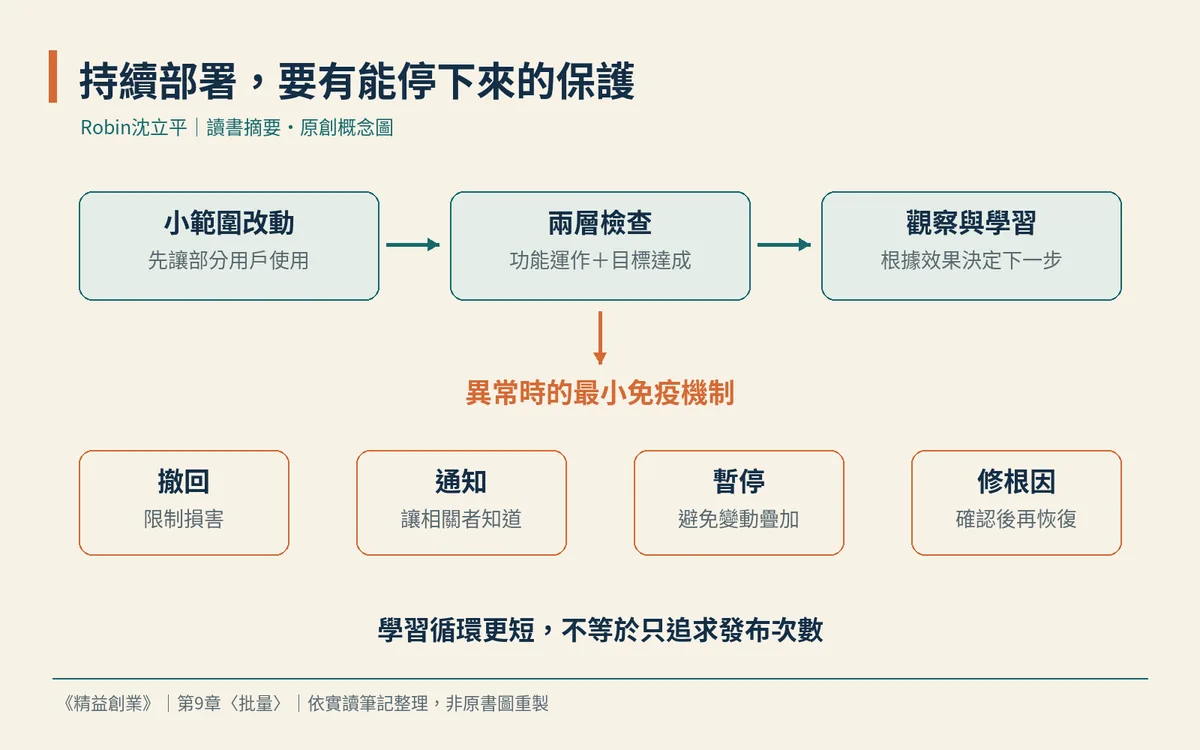
When people talk about continuous deployment, what usually catches the eye is how many times a day the product is changed. What Eric Ries really wants to discuss in Chapter 9 is not using the number of releases to prove how impressive the team is, but how to make each change small, give it early to a portion of users, and then decide the next step according to the effect. If you only copy the frequency and have no corresponding protection, speed can become a tool that enlarges the damage.
As Ries narrates, IMVU’s engineers and designers worked together, focusing on one feature at a time, and once it was ready for users to test, pushed a version to a small portion of users for observation. He says there were at the time about fifty changes a day on average. This is a particular practice in the book, not a standard quota for every team. Experience involving IMVU should also be read with Ries’s holding and interest in the company in mind.
The first layer supporting this cadence is comprehensive automated testing. If a code change deletes the checkout button, the system should stop it before damage is done. Ries then offers a harder case: the button is still there and the function still works, but it has become the same white as the background. The machine may judge that the test has passed, yet users cannot find the entrance, and transactions are blocked.
The existence of a feature therefore does not mean that customers can complete the task. Ries says IMVU also had a mechanism like an immune system, monitoring not only whether the code was normal, but also the health of the business. When a change caused serious consequences, the system would roll back the problematic change, notify the relevant team, and pause further modifications, so that new changes would not make the problem more complicated, until the root cause was found and repaired.
My reading is that this arrangement puts speed and stopping in the same system. You must be able to send a change out quickly, and also be able to recognize an anomaly quickly and limit its impact. Otherwise, every time a problem is found you have to scramble to find someone and recall who changed what, and the more frequent the releases, the harder the investigation. Safeguards are not an administrative burden opposed to speed. They are the foundation that makes small batches sustainable.
Ries also admits that even in the fast software industry, continuous deployment remains contested. He mentions Wealthfront’s practice in a regulated environment as a case narrative of his own, from which one cannot infer that every financial, medical, or hardware product can adopt the same method; he also has an interest in Wealthfront. Readers should identify the principles that can be borrowed, and should not treat the case as a regulatory permission or a safety guarantee.
Beyond software, Ries proposes several paths to acceleration: more of the product’s value is determined by software, manufacturing processes become easier to adjust, and rapid prototyping tools lower the threshold for making small batches. What these paths share is bringing design and real feedback closer together, so that you need not wait for a large old version to be exhausted before you have a chance to change. They are not an argument that a physical product can be swapped at any moment like a website.
It is also necessary here to distinguish a release from an experiment. If a release has no observable question and no way of reading the effect, it may add no understanding even if it is technically smooth. Conversely, if some changes cannot be sent directly into the production environment, you can first think about how to narrow the scope of the test and isolate the risk. This is an extension of my own; the concrete approach still has to be assessed according to the consequences and constraints of the product.
I think that when investors look at technical speed, they should not only hear the number of versions. They should also ask who will first discover that customers cannot complete a goal, and how losses will be stopped after the discovery. Truly mature speed does not depend on a hero putting out fires when an anomaly appears. The conclusion is clear: pursue a shorter learning cycle, and at the same time build the minimum protection that can roll back, notify, and also has the authority to pause.
Three suggestions
Arrange rollback, notification, and pause mechanisms for one main flow, clearly name the person who judges and the conditions for recovery, and first test whether the protection can actually be activated.
Split the check into two layers: whether the feature works, and whether the user can achieve the purpose. Choose one key task and observe the result, and do not let a technical pass replace a real experience.
Set improvement goals by the time of a complete learning cycle, and record the scope of an anomaly’s impact. Do not treat the number of daily releases as the only performance metric.
#TheLeanStartup | Source: Chapter 9, “Batch”
These are reading notes and reflections based on my personal understanding. I recommend reading them alongside the original book for the full context.
Comments
What do you think? Share your experience or questions.
Sign in to comment, reply or like. Sign in / Sign up
Loading comments…