Note 27 | It Is Not a Queue of Requests. It Is a Hypothesis That Pulls the Next Step
These are Robin Shen’s original reading notes and commentary, written in his own words after reading Eric Ries’s The Lean Startup: How Today's Entrepreneurs Use Continuous Innovation to Create Radically Successful Businesses. They are not the original book, excerpts from it, or an official publication. Methods and concepts from the book are attributed to Eric Ries; other sources are identified where stated. For reference only; not investment advice.
English translation of Robin’s Chinese reading notes and commentary. Passages are paraphrased, not verified verbatim quotations from the original English edition.
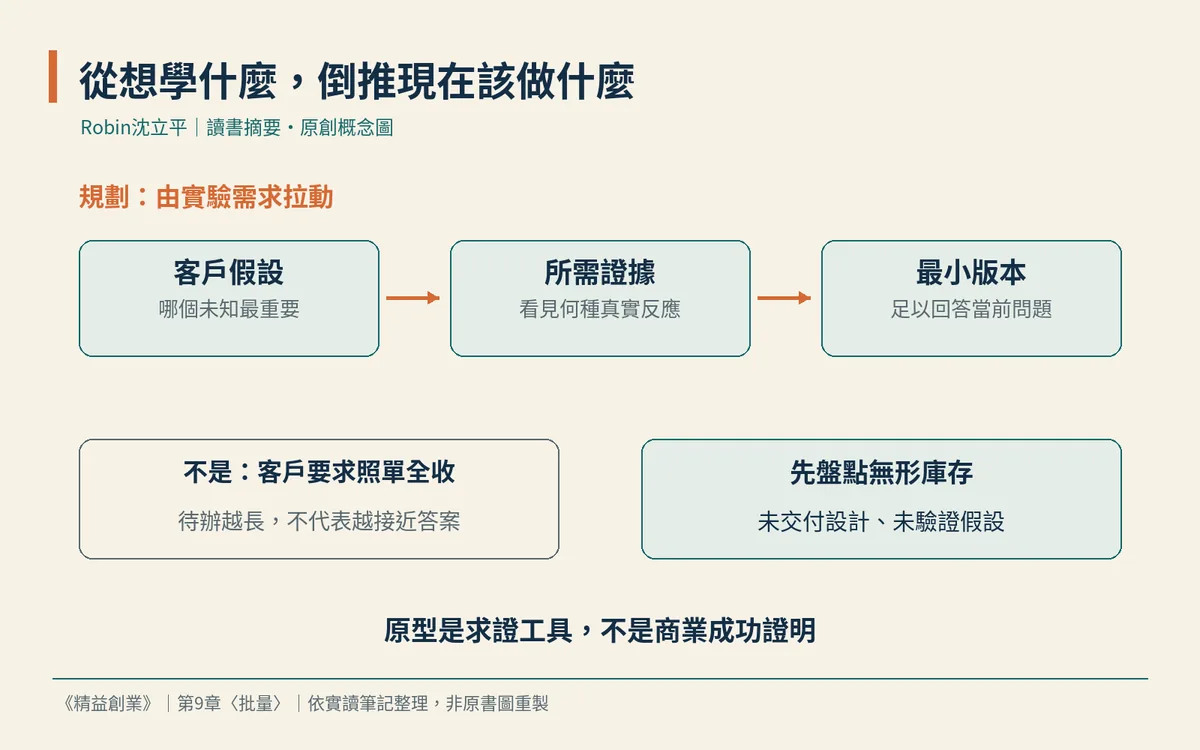
A product backlog that keeps growing is often read as a sign that the market is hot and the team has plenty to do. In Chapter 9, Eric Ries reminds us that designs not yet delivered, hypotheses not yet validated, and even most of a business plan may be invisible work-in-process inventory. They may not appear in a warehouse, but they likewise occupy resources, and they may become scrap because the understanding of demand is wrong.
Ries first uses Toyota’s parts replenishment to explain a pull system: as the front end uses parts, the gap is passed back layer by layer, and the back end supplies what is needed. Compared with making a great deal in advance just in case, this can reduce inventory and waste. Moved into a startup, however, the source of the pull is not taking every customer request at face value. Ries says plainly that customers may not know what they truly want.
More precisely, what pulls development is our hypothesis about the customer, and the experiment needed to validate it. In execution the sequence is Build-Measure-Learn; in planning it has to be reversed: first decide what you want to know, then choose evidence that can be read, and only then decide which version must be built. If a feature cannot help answer the important question at hand, it should not automatically enter the work because someone proposed it.
Ries describes SGW Designworks helping to develop a support structure for field X-ray equipment. It first used a three-dimensional model to discuss with the customer, then quickly produced a physical object so that the people who would use it could assess requirements of stability, deployment, and portability. As the main text recounts, the first prototypes were delivered in three days, and a round of design iteration was then completed in five. This note uses only the main text, and does not use the timeline in Table 7, which was not inspected in the original.
The point of the story is not to require any hardware company to deliver in the same number of days. It is to turn the prototype into a tool for communication and correction. Whether a support is actually usable need not be imagined entirely from a written specification. When a design decision can receive feedback more quickly, a stretch of the wrong road can be avoided. I take the value of a prototype to be not only a display of completeness, but also a way of making previously unspoken constraints concrete for both sides.
Alphabet Energy offers another reminder. As Ries narrates, it borrowed an existing silicon-chip production line to shorten the path of thermoelectric materials from concept to physical object, without first building an expensive new factory. Being able to make the technology, however, does not mean that people willing to adopt it have already been found. Power companies in the early hypotheses could not bear the corresponding risk, and small-batch trials let the team see this barrier to adoption earlier.
The team later turned the search toward manufacturing settings, letting companies first try the product in part of a process and then decide whether to expand. Early deployments also revealed that users did not value the pursuit of extreme performance at any cost, but practical economic conditions such as cost per watt. These are all as Ries described them at the time. He states clearly that whether the company would ultimately succeed still awaited an answer from time, and faster learning should not be rewritten as commercial success already achieved.
My extension is that a development list is best able to answer two different questions: why the item is worth validating, and why it needs to be taken to this degree of completeness now. If you first need to validate the conditions of adoption, optimizing performance alone may answer the wrong question. If you need to observe real operation, a handsome presentation is not enough. Small batches are not a fixed pursuit of cheapness. They make the investment commensurate with the most important unknown at the moment.
I think an inventory count should not look only at materials. It should also look at how much work is built on premises that have not yet been confirmed. True pull is not letting the loudest customer decide the route. It is letting the need for evidence decide the next step. The conclusion is: first find the question the work is meant to answer, then decide how much to do. Busyness with no experimental purpose should have a chance to be deferred.
Three suggestions
For each development task, write the customer hypothesis to be validated, the observable result, and the conditions for reading it. Work whose experimental purpose cannot be stated should not be started yet.
Take stock of undelivered designs and unvalidated hypotheses, defer features that do not serve the current question, and let the team see how much attention invisible inventory is occupying.
Look for production lines, models, and prototyping tools that can be borrowed, first make the smallest version that can obtain real feedback, and do not treat building a complete capability as a precondition for a test.
Robin’s note | Taiwan startups and venture capital
If a Taiwanese hardware startup can borrow an existing supply chain, an investment discussion can first ask which hypotheses of adoption can be validated with a small prototype, and only then decide whether to expand capacity. This is a conditional suggestion about the allocation of resources. It does not mean that every product can omit certification or safety testing.
#TheLeanStartup | Source: Chapter 9, “Batch”
These are reading notes and reflections based on my personal understanding. I recommend reading them alongside the original book for the full context.
Comments
What do you think? Share your experience or questions.
Sign in to comment, reply or like. Sign in / Sign up
Loading comments…