Note 28 | First Recognize the Engine of Growth, Then You Know Where to Put the Effort
These are Robin Shen’s original reading notes and commentary, written in his own words after reading Eric Ries’s The Lean Startup: How Today's Entrepreneurs Use Continuous Innovation to Create Radically Successful Businesses. They are not the original book, excerpts from it, or an official publication. Methods and concepts from the book are attributed to Eric Ries; other sources are identified where stated. For reference only; not investment advice.
English translation of Robin’s Chinese reading notes and commentary. Passages are paraphrased, not verified verbatim quotations from the original English edition.
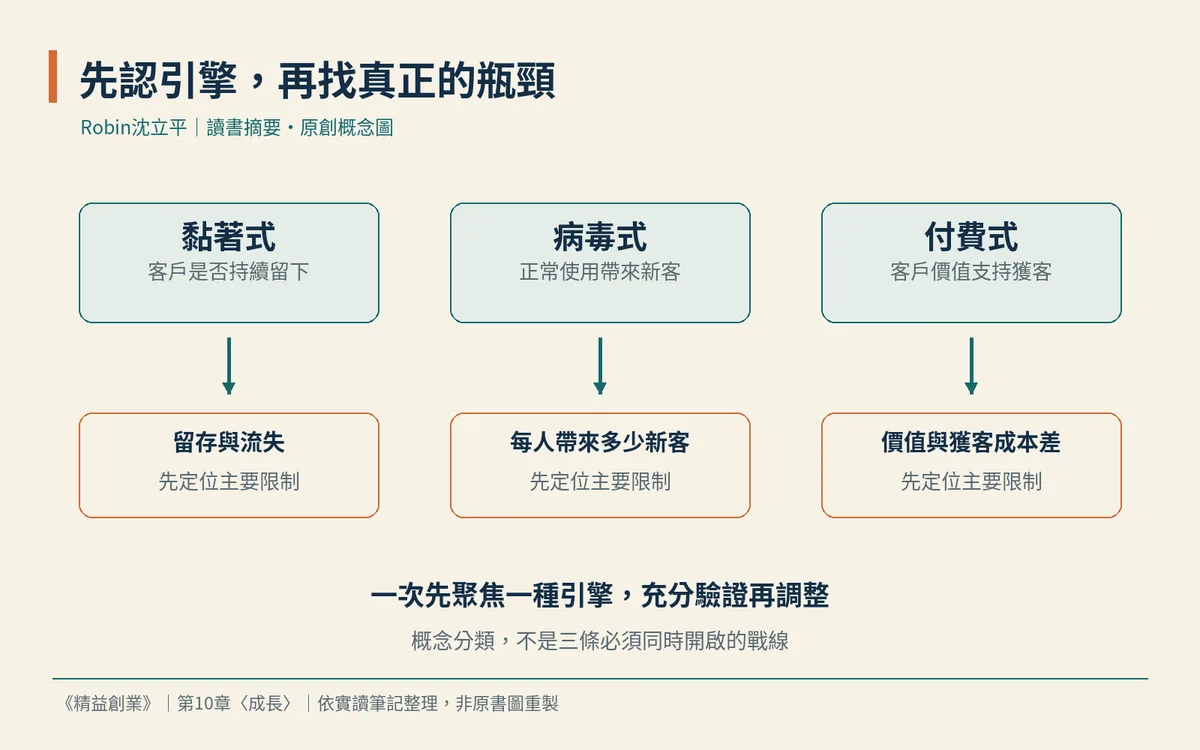
When growth stalls, many answers often appear at once around the meeting table: add advertising, fix quality, adjust prices, add features. In Chapter 10, Eric Ries points out that the problem is not necessarily a lack of ideas, but a lack of a basis for judging priority. The role of an engine of growth is first to say clearly what loop brings new customers, and then to aim scarce resources at the places that truly affect that loop.
Ries opens with two unnamed companies, one a platform for trading collectibles, the other a seller of enterprise database software. Their products, customers, and methods of sale differed greatly, yet they faced a similar stall in growth. Ries’s view is that they used the same kind of engine, and that a countermeasure cannot be chosen only by an industry label. Companies that look completely different may be stuck on the same problem of customer behavior.
He connects sustainable growth to the actions of existing customers. An active recommendation after satisfaction is word of mouth. Use of the product that causes others to encounter it is a side effect. Revenue created by customers that supports the next round of acquisition is a paid source. A subscription or a repurchase continues to bring use and revenue. A crowd that pours in from a single campaign, if there is no subsequent loop, should not be treated directly as sustainable growth.
On these sources, Ries organizes three engines of growth: sticky, viral, and paid. The sticky engine’s focus is whether customers continue to stay; if new arrivals are constantly offset by churn, even a lively scene may be standing still. The viral engine cares how many new customers each new customer brings through ordinary use. Spreading is not only users thinking the product is good and saying a kind word for the company.
Hotmail is the example Ries uses to explain the viral mechanism: a sign-up link added at the end of an email gave every outgoing message one more chance of being seen by a recipient. This note takes Ries’s historical account, and does not treat the case as an acquisition prescription that is still effective today. What is worth borrowing is how spreading joins the use of the product, not copying a line of copy.
The paid engine looks at whether the value a customer brings, after variable costs are deducted, can be higher than the cost of acquiring the customer. Ries describes this relationship with customer lifetime value and cost per acquisition. Related costs such as salespeople and installation support also cannot be ignored merely because no advertising was bought. High revenue per customer does not mean the engine is faster. You still have to know how much was paid to obtain that customer.
This also shows that outside capital can temporarily support acquisition, but the scale of spending alone cannot prove that the loop is established. My reading is that financing and a sustainable engine have to be accounted for separately: the former provides resources for trial and expansion; the latter has to explain how the conditions created by existing customers support the next round of growth. If every additional customer deepens the gap, enlarging the numbers will not automatically correct the mechanism.
Ries does not deny that a company may have more than one engine at the same time, but he warns that if a startup chases all three at once, it will need complex operating capability and may instead fall into confusion. He suggests first focusing on one, trying it fully, and only then considering a change. This is not a permanent ban on other sources. It is a warning not to turn every good idea into work that must be done now, so that in the end no important question is properly validated.
I think that when a team reports on growth, it is best able to explain the loop in one sentence, and then use a few metrics to explain the bottleneck. Without that step, marketing, product, and sales can all find reasons for their own proposals, yet it is hard to compare effects. The conclusion is to identify the main engine first, then arrange the optimizations. Focus is not doing less. It is making sure that every experiment has a clear object of judgment.
Three suggestions
Draw how existing customers lead to the next round of growth, distinguish recommendation, incidental spread through use, the reinvestment of revenue, and repurchase, and choose the loop that matters most now.
Track only the core metrics of the main engine, and state which link this round of experiment is meant to change. Do not treat total registrations as a common answer to every question.
Agree with the team on a period for validating a single engine and on the conditions for review, first test the main hypotheses fully, and do not open a new front the moment a new idea appears.
#TheLeanStartup | Source: Chapter 10, “Grow”
These are reading notes and reflections based on my personal understanding. I recommend reading them alongside the original book for the full context.
Comments
What do you think? Share your experience or questions.
Sign in to comment, reply or like. Sign in / Sign up
Loading comments…