Note 29 | New Customers Keep Arriving. Why Does the Company Still Feel Like a Leaky Bucket?
These are Robin Shen’s original reading notes and commentary, written in his own words after reading Eric Ries’s The Lean Startup: How Today's Entrepreneurs Use Continuous Innovation to Create Radically Successful Businesses. They are not the original book, excerpts from it, or an official publication. Methods and concepts from the book are attributed to Eric Ries; other sources are identified where stated. For reference only; not investment advice.
English translation of Robin’s Chinese reading notes and commentary. Passages are paraphrased, not verified verbatim quotations from the original English edition.
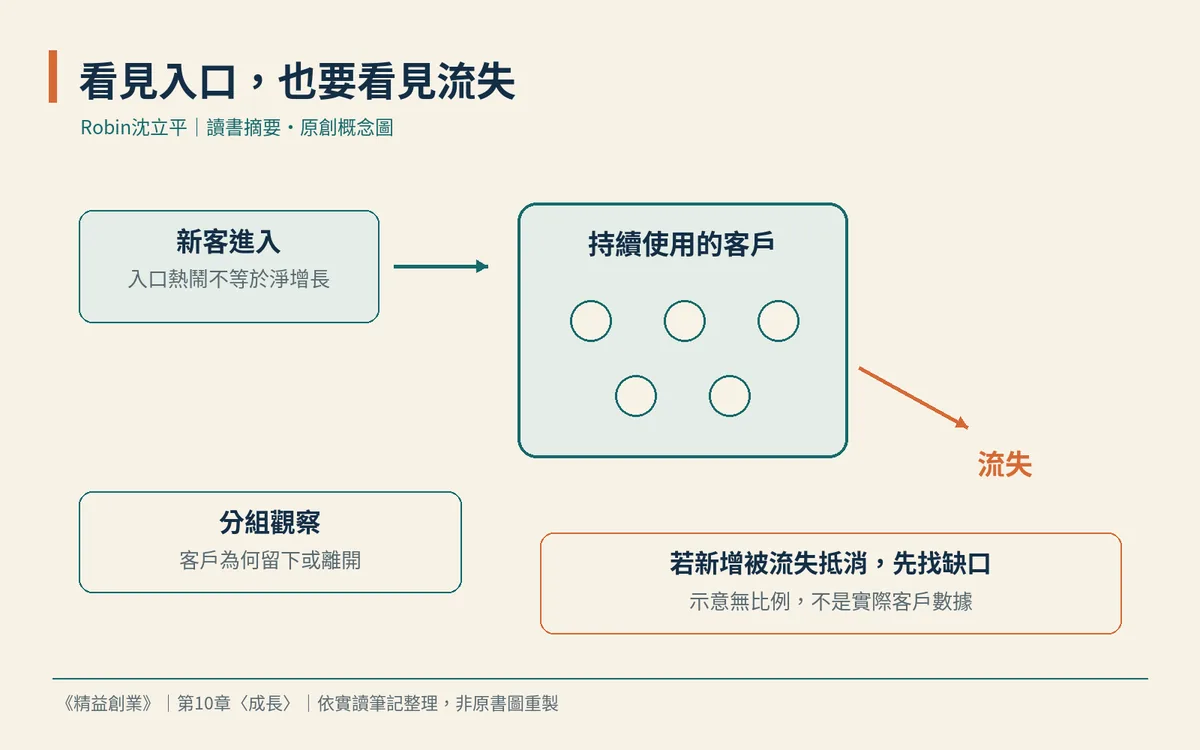
When new customers keep coming, a team usually feels that at least the direction is not wrong. If the total number of people has not fallen in any obvious way, it is even easier to think that advertising is simply not yet enough. In Chapter 10, Eric Ries’s sticky engine of growth turns the gaze to the other side: how many customers are leaving? If new arrivals happen to replace those who churn, continued acquisition may only be keeping the company in place.
The design of a sticky product is focused on attracting and retaining customers over the long term. The reasons for staying need not be the same. Ries mentions a collectibles platform, where experienced players return to see new items, sell, or exchange collections; enterprise database software may be hard to replace because customers have already built products on it. The former depends on continued participation; the latter also includes switching risk. The two cannot be handled with the same kind of promotion.
Ries calls the share of customers who stop using the product in a given period the churn rate. In the sticky model in the book, the natural growth rate minus the churn rate is what he calls the compounding rate. The point is not to put the nouns into a slide deck, but to see whether new arrivals and churn are placed under comparable definitions. If the time range and the definition of a customer differ, two handsome percentages may still not be usable for judging progress.
As Ries describes it, one of the unnamed companies, following the model in a simulation, had a retention rate of 61 percent and a new-customer growth rate of 39 percent, yet a compounding rate of only 0.02 percent. These are simulated results in Ries’s account. The main text does not give the complete conversion details, so this note does not derive them on its own. What can be confirmed is the argument that new arrivals were almost entirely offset by churn, not that the company lacked the ability to attract new people.
This diagnosis changes the order of work. If the problem is that people will not stay, adding sales or spending may bring more people without addressing why they leave. Ries therefore suggests paying more attention to existing customers: for example, making the offering richer, improving quality, or using an appropriate reminder to prompt a return visit. Whether a practice works still has to be tested. Sending a promotional message does not automatically create stickiness.
Here especially one must avoid treating any return visit as good news. My reading is that you should first define the core use the product wants customers to complete, and then judge whether staying represents a continued receipt of value. A customer who is called back by a notification but cannot complete the task may only have produced one more click. A customer who does not log in often but continues to depend on an enterprise system also cannot be held to the daily-active expectations of a consumer product.
The total number of customers is not useless. It can describe scale, but it cannot by itself tell us where the leak is. Ries also reminds us that even if activation rate or revenue per customer looks more specific, if it is not the key constraint of the engine at this moment, it may still be unable to solve a stall in growth. Not all quantifiable metrics are equally important. Choosing the right question is more valuable than adding numbers to a dashboard.
I would extend this idea into a grouped check: let customers who joined at different times be observed over comparable periods of use, and ask which group stayed and why, and which group churned and where. This is a practical suggestion drawn from Ries’s line of thought, not an additional research result provided by the original text. The purpose is to keep a continuous influx of a new group of customers from covering up the fact that older customers have not improved.
I think a growth report truly worth praising is willing to put the people who left on the table as well. This does not mean always putting retention first and never acquiring customers. It means that when the evidence shows churn offsetting new arrivals, you should not rely only on enlarging the entrance to prove effort. The conclusion is to look at acquisition and churn together, first repair the gap that is blocking the loop, and then judge whether expanding the investment truly makes sense.
Three suggestions
Define clearly when a customer counts as having churned, compare new arrivals over the same period and the same definition of the customer group, and check by time of joining, so that totals do not cover up differences.
If churn is the current bottleneck, first test one measure that can improve continued use, write down the expected change in behavior, and only then decide whether to expand marketing spend.
Regularly report the direction of both churn and net growth, add the reasons customers leave, and keep totals as information about scale, but do not let them alone represent product progress.
#TheLeanStartup | Source: Chapter 10, “Grow”
These are reading notes and reflections based on my personal understanding. I recommend reading them alongside the original book for the full context.
Comments
What do you think? Share your experience or questions.
Sign in to comment, reply or like. Sign in / Sign up
Loading comments…