Note 30 | After Product/Market Fit, You Still Have to Guard Against the Engine Stalling
These are Robin Shen’s original reading notes and commentary, written in his own words after reading Eric Ries’s The Lean Startup: How Today's Entrepreneurs Use Continuous Innovation to Create Radically Successful Businesses. They are not the original book, excerpts from it, or an official publication. Methods and concepts from the book are attributed to Eric Ries; other sources are identified where stated. For reference only; not investment advice.
English translation of Robin’s Chinese reading notes and commentary. Passages are paraphrased, not verified verbatim quotations from the original English edition.
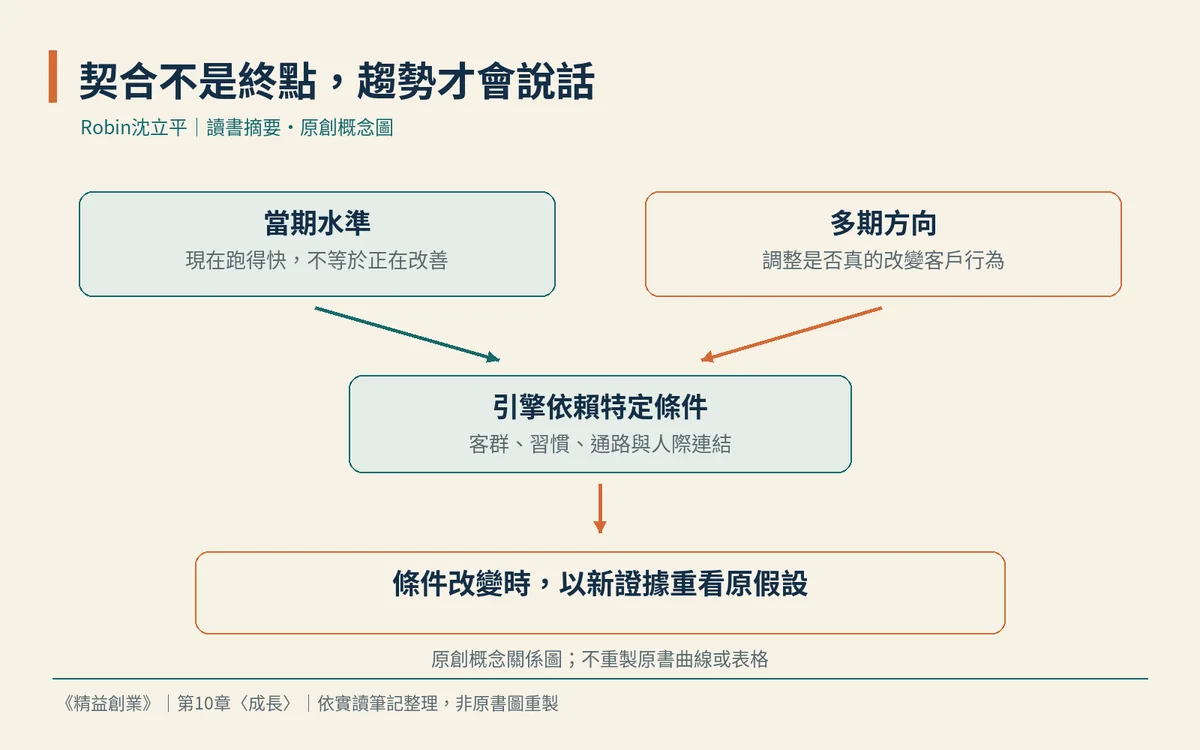
Finding product/market fit is often imagined as the moment a startup succeeds in passing a gate, as if afterward you need only expand by the existing method. In Chapter 10, Eric Ries rejects two inferences: that needing to pivot means failure, and that once fit is found you never have to pivot again. A market is not a single examination, and an engine of growth is not a machine that, once installed, can run forever.
Ries attributes the concept of product/market fit to Marc Andreessen, meaning that the product has finally met a large number of users who like it. But only asking yourself whether you already have fit is of little help to a team that has not yet arrived. Ries therefore adds a more operable perspective: observe the metrics of the main engine of growth, and judge whether each adjustment is bringing the company closer to a loop that can keep turning.
Care is needed here not to treat a particular number as a universal certification of success. Different engines have different constraints, and virality, retention, and the economics of acquisition cannot substitute for one another. My reading is that the purpose of a metric is to let a hypothesis be compared and revised, not to manufacture a magical dividing line for a fundraising deck. Crossing a threshold once does not mean that every business problem has from then on been solved.
Table 8 provides an important contrast. According to notes from the table as inspected, Ries lists the compounding rates of two sticky companies: Company A rose gradually from 0.1 percent six months earlier to 5 percent one month earlier; Company B started at 9.8 percent and went only as far as 10 percent, fluctuating at a similar level in between. This is comparative material in the book, not a sample of companies I have tracked separately.
Looking only at the latest period, B is still faster. Looking at the direction over several periods, A is improving, and B has almost stopped. What Ries wants to highlight is not that low growth is necessarily better than high growth, but that when we judge whether tuning is effective, we have to look at the direction and degree of improvement. Otherwise an engine that started higher but is not improving may continue to provide cover for product work that has no effect.
A longer-term constraint is that every engine has a particular fuel: a group of customers, a habit, certain social ties, or a channel of acquisition. Ries’s view is that these conditions will eventually be exhausted. A minimum viable product that early adopters like may be enough to drive an early market, and still not have all the conditions mainstream customers require. A slowdown may appear very late, leading the team to mistake all existing development for effective work.
Ries uses a stall IMVU once encountered to illustrate this danger. This is an account of his company’s experience, and his holding and interest should also be kept in mind. If totals are still growing, but product adjustments have not changed customer behavior, the prosperity in front of you may come mainly from the original engine, not from recently added features. Only when the engine weakens does the team discover that what has accumulated is busyness, not a new capacity for growth.
My reading is that this does not mean a startup must now open three engines at once. Ries still argues for focusing first on one. A more reasonable extension is to state clearly the mechanism that is running, while keeping an observation of the applicable customer group and its limits. When the evidence shows that the original conditions have changed, there is a basis for discussing the next hypothesis, rather than panicking and changing course at the first fluctuation, or insisting that what once worked will work forever.
I think fit is best treated as a relationship that needs to be maintained, not as a permanent medal. When assessing a team, besides looking at whether growth is currently fast, one should also look at whether it can distinguish a tailwind in the market from its own improvement. The conclusion is to keep tracking the direction, and honestly recognize the boundaries of the engine. A pivot does not necessarily negate the past. It may be precisely a way of taking what was learned into the next set of conditions.
Three suggestions
Keep a continuous record of the main engine’s metrics and the corresponding experiments, review the direction over several periods, and do not treat a higher growth rate in the current period as direct evidence that the team has improved more.
List the customer groups and channels the engine depends on, watch whether the responses of similar customers are changing, and treat anomalies as clues for investigation rather than immediately declaring that the market is saturated.
Agree in advance what evidence will start a discussion of a new hypothesis, and at the same time keep the focus on the main engine, avoiding on the one hand a belief in permanent fit and on the other a blind expansion on several fronts.
Robin’s note | Taiwan startups and venture capital
If a Taiwanese investor is reviewing growth at a board meeting, the team can be asked to explain the current level, the trend of improvement, and the boundaries of the customer group separately. When the conditions of the early market change, then discuss the resources a new hypothesis requires, rather than demanding a full pivot only because one quarter has slowed.
#TheLeanStartup | Source: Chapter 10, “Grow”
These are reading notes and reflections based on my personal understanding. I recommend reading them alongside the original book for the full context.
Comments
What do you think? Share your experience or questions.
Sign in to comment, reply or like. Sign in / Sign up
Loading comments…