Note 4 | A Startup Is Not Defined by Age. It Is Defined by How Much Is Unknown
These are Robin Shen’s original reading notes and commentary, written in his own words after reading Eric Ries’s The Lean Startup: How Today's Entrepreneurs Use Continuous Innovation to Create Radically Successful Businesses. They are not the original book, excerpts from it, or an official publication. Methods and concepts from the book are attributed to Eric Ries; other sources are identified where stated. For reference only; not investment advice.
English translation of Robin’s Chinese reading notes and commentary. Passages are paraphrased, not verified verbatim quotations from the original English edition.
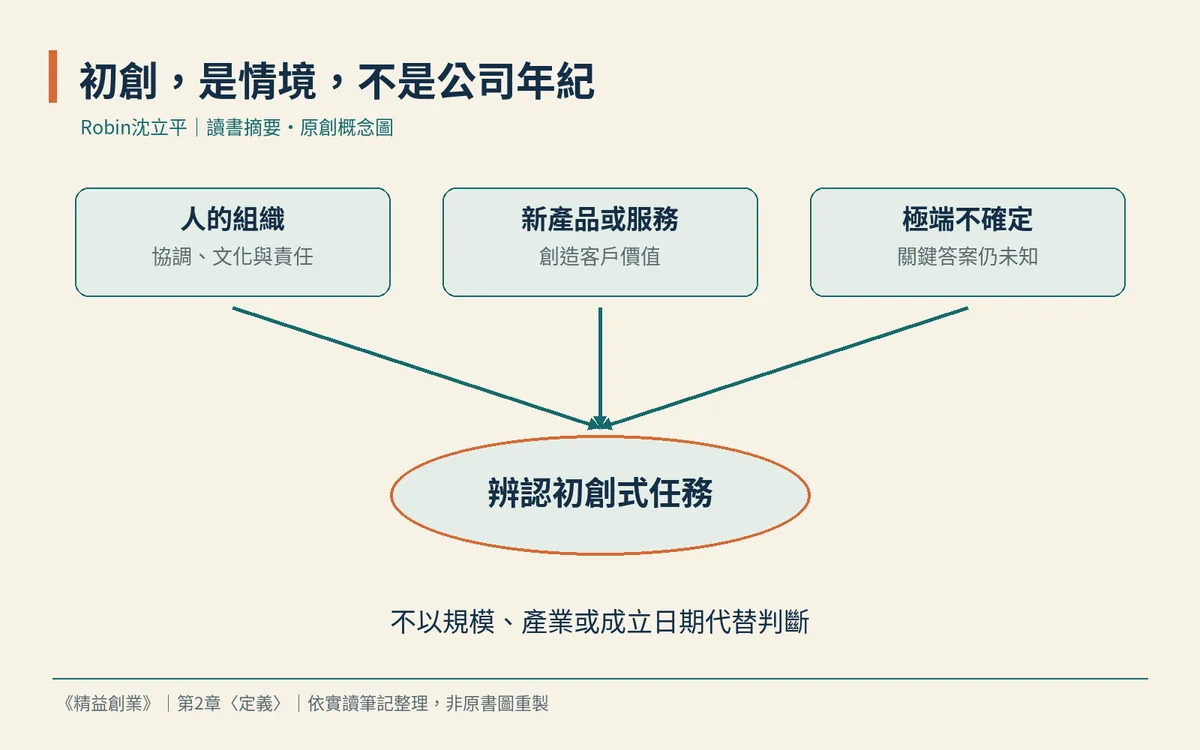
A newly founded company does not necessarily need startup-style management, and a company that is already large may be genuinely starting something new. In Chapter 2, Eric Ries redefines the startup. The emphasis is not on garages, youth, or scarce resources, but on whether a group of people is developing a new product or service under conditions of extreme uncertainty.
The definition has three important parts. First, “a human institution”: entrepreneurship is not only a technical breakthrough or a product idea. It also involves hiring, coordination, and culture. If you look only at the product itself, it is easy to underestimate the work of organizing people. What Ries emphasizes is an organization of people, not an object waiting to be made.
Next, “product or service.” Ries takes a broad view: any source of value for potential customers can count as a product, and what customers experience when they interact with a company is more than a single feature. A shop, a consulting service, or a nonprofit therefore cannot be left out of the discussion of entrepreneurship simply because it does not look like a tech company.
Last, and most important, is the condition of the environment: extreme uncertainty. Ries does not draw the line by whether a company carries risk, but by whether key conditions such as customers, product, and business model can already be understood from existing experience. Simply building a known model as it stands, even when it is a new business worth investing in, is different from a startup that is still searching for its model.
This line should not be misread as “copying a model can never fail.” As I understand the chapter, the point is to tell apart operating risk that can be estimated from existing data and situations in which even the answers to the important questions are still unknown. Both kinds of work need management, but they call for somewhat different tools of judgment, and the choice cannot be made from a company’s founding date alone.
Ries describes a manager at a large company, whom he calls Mark, who had already dealt with internal politics and could put a team together, yet did not know how to actually get innovation started. His difficulty was not a lack of organizational resources. It was that management theory had given him the materials without opening the black box of the innovation process. Once the team was formed, he still had no method for what to do next or how to recognize progress.
The case makes the practical use of the definition clear. If every new venture inside a large company is treated as a mature business, it will be asked for stable forecasts from day one. If innovation is treated as a gift only a few people have, it is easy to believe that finding the right talent and giving them enough room is all it takes. What Ries wants to supply is a management process that, amid the unknown, turns ideas step by step into a sustainable business.
Likewise, innovation is not limited to new scientific discoveries. Eric Ries also counts new uses of existing technology, new business models, and serving new markets or customers who were previously underserved. This does not mean every change is a major innovation. It is a reminder not to let an industry label hide the real source of uncertainty.
Managers and teams are therefore better off first agreeing on a shared description of what they do not yet know. Otherwise a manager may think it is only a matter of execution while the team is still looking for customers; both can be working hard and still judge the same work on different premises. The definition here is not wordplay. It keeps you from assigning the wrong responsibility or applying the wrong standard.
I think the most valuable thing about this definition is that it moves the discussion from identity back to the task. A company can run mature businesses and unknown new ventures at the same time; there is no need to label the whole company “very innovative” or “very traditional” in one stroke. Only by first identifying the conditions of each piece of work can you choose a fitting way to manage it, and make reasonable demands of the people who support innovation.
Three suggestions
Check item by item whether a new venture has the conditions of a human organization, a new product or service, and a high degree of the unknown, rather than judging only by company size and age.
List the questions where experience can be reused and the questions that still need exploring, and manage them separately, so that every risk is not lumped together as “uncertainty.”
Beyond forming the team, add a process for exploration and clear responsibility for judgment at each stage, so that an internal venture gets not just a department name but a practical way to move forward.
#TheLeanStartup | Source: Chapter 2, “Define”
These are reading notes and reflections based on my personal understanding. I recommend reading them alongside the original book for the full context.
Comments
What do you think? Share your experience or questions.
Sign in to comment, reply or like. Sign in / Sign up
Loading comments…