Note 31 | The Five Whys Are Not More Meetings. They Are a Way of Aiming the Fix at the Root Cause
These are Robin Shen’s original reading notes and commentary, written in his own words after reading Eric Ries’s The Lean Startup: How Today's Entrepreneurs Use Continuous Innovation to Create Radically Successful Businesses. They are not the original book, excerpts from it, or an official publication. Methods and concepts from the book are attributed to Eric Ries; other sources are identified where stated. For reference only; not investment advice.
English translation of Robin’s Chinese reading notes and commentary. Passages are paraphrased, not verified verbatim quotations from the original English edition.
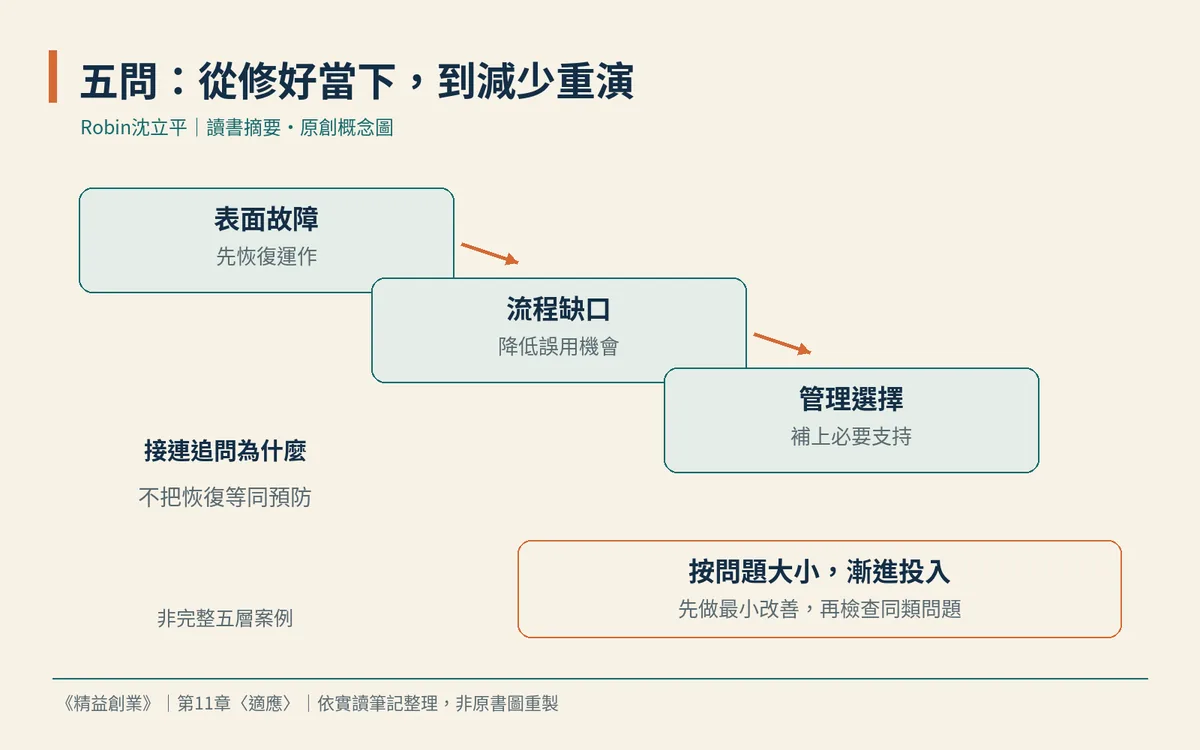
A team racing a deadline fears another problem most, and is also most likely to end every crisis by saying “fix it first and talk later.” In Chapter 11, Eric Ries proposes the Five Whys not to make everyone discuss everything longer, but to turn the present failure into an entrance for improving the system: neither letting the same loss happen again and again, nor building in advance a heavy set of institutions for every imagined risk.
Ries first reminds us that speed cannot be bought by sacrificing quality. Defects cause rework, complaints, and a drain on morale, and what they finally slow is still development and learning. This is not in contradiction with a minimum viable product. Avoiding excessive polish early is for the sake of validating sooner. When quality already keeps users from using the product or from providing useful feedback, continuing to ignore defects in fact blocks the learning you originally wanted to accelerate.
The Five Whys come from Taiichi Ohno’s systematic analysis of problems: by asking why in succession, you move from the surface phenomenon toward the root cause. Ries uses the example of a machine that stops. If you only replace a burned fuse and do not deal with lubrication and the filter, the equipment may soon stop again. The spirit of the tool is not to mistake restoring operations for having already removed the source of the failure.
Ries also constructs a training scenario at IMVU: a customer feature fails; the inquiry goes down to a server failure and an engineer’s misuse of a subsystem; then it is found that the engineer had not been trained, and that the manager thought the team was too busy and training was unnecessary. This is an imagined example Ries uses to explain the method, and should not be written as a verified incident. Involvement of IMVU also requires attention to Ries’s holding and interest in the company.
What it exposes is that a surface technical problem may be connected to a management choice. Only reminding the engineer to be careful may still leave the next newcomer stepping into the same hole. Immediately stopping work to build a comprehensive training program, however, may be an overreaction. Ries proposes a proportional investment: make commensurate improvements at each layer of the cause, from repairing the equipment and reducing the chance of misuse to adding necessary training, without having to complete an entire ideal system at once.
He uses doing the first hour of an eight-week training plan to illustrate gradual investment. If the problem does not recur, this bit of investment may not be expensive. If it appears again, further improvement can be added according to a new Five Whys. This is not permission for the same error to return without limit. It lets preventive investment adjust to the actual pain point, rather than deciding between doing nothing and doing everything complete at once.
This method also forms what Ries calls an automatic speed regulator. When there are many problems, the team invests more time in improving the process. When prevention works, crises decrease, and speed naturally returns. Managers need not guess how fast or how complete things should be by first hearing extreme demands from each department and then splitting the difference. Concrete losses and learning can be the basis for adding or reducing process. The premise is still a willingness to let problems come to light, rather than punishing the person who reports them.
My reading is that the product of the Five Whys should not be only a diagram of causes. If every layer of analysis is brilliant, yet no one is responsible for improvement and there is no check of effect, the next time will still begin the discussion from scratch. Conversely, if many improvement projects are listed but are not connected back to actual causes, each failure can easily become an opportunity to compete for budget on behalf of an existing wish list.
I think a good investment in process should be able to say clearly which loss it is preventing, how much will be done first, and how you will know it is working. This is a management extension I draw from proportional investment, not a fixed scoring formula Ries provides. The conclusion is to let repair and prevention happen together, and to use small improvements with an owner of responsibility to build speed on a foundation of fewer repeated firefights.
Three suggestions
Choose a recent, recurring problem of clear scope, and, with a manager’s support, inquire into the causes. Record the facts first, and do not treat a guess as the root cause.
For each layer of cause, arrange the smallest preventive measure commensurate with the loss, name the person responsible, and do not immediately start a comprehensive institutional overhaul because a management problem has been found.
Agree on a date to check and a criterion for recurrence, confirm whether the fix has reduced problems of the same kind, and adjust the investment according to the actual effect, rather than declaring the matter closed when the meeting ends.
#TheLeanStartup | Source: Chapter 11, “Adapt”
These are reading notes and reflections based on my personal understanding. I recommend reading them alongside the original book for the full context.
Comments
What do you think? Share your experience or questions.
Sign in to comment, reply or like. Sign in / Sign up
Loading comments…