Note 32 | Before You Ask Why, First Make It Unnecessary for People to Protect Themselves
These are Robin Shen’s original reading notes and commentary, written in his own words after reading Eric Ries’s The Lean Startup: How Today's Entrepreneurs Use Continuous Innovation to Create Radically Successful Businesses. They are not the original book, excerpts from it, or an official publication. Methods and concepts from the book are attributed to Eric Ries; other sources are identified where stated. For reference only; not investment advice.
English translation of Robin’s Chinese reading notes and commentary. Passages are paraphrased, not verified verbatim quotations from the original English edition.
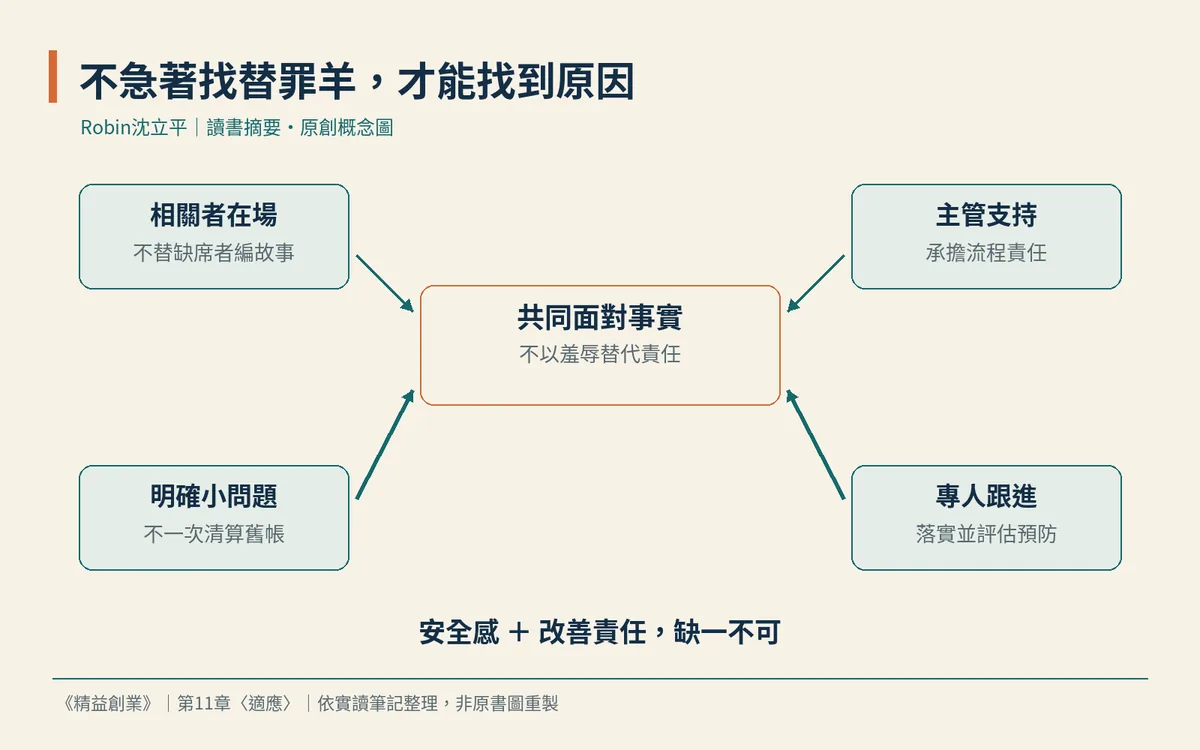
The Five Whys sound rational, yet in an actual meeting they may make people still more eager to defend themselves. In Chapter 11, Eric Ries reminds us that once the method becomes the Five Blames, people no longer ask why the process failed; they look for who should be held responsible for the failure. The more intractable the problem and the more pressure a department is under, the easier it is to rewrite a systemic gap that needs to be handled together as a matter of someone’s ability or attitude.
He therefore requires that the people who are affected and who hold the facts all be present, including those who discovered the problem, diagnosed it, tried to repair it, and are responsible for the related system. If the cause involves a decision at a senior level, the person with the authority to change it also cannot be permanently absent. Inviting fewer busy people may look like a saving of time, and may only make those who are not present convenient scapegoats, leaving a story that cannot be checked.
The most senior manager also has a clear responsibility: when discussion begins to turn into mutual blame, bring the gaze back to how the organization allowed the error to occur. Ries discusses IMVU’s practice of having a new hire change the production environment on the first day, and stresses that if a process is so fragile that a newcomer’s first touch breaks it, the manager cannot only blame the newcomer. The person involved should take part in the repair, and the system that protects the next newcomer should also be improved. Ries has a holding and an interest in IMVU.
This is not a complete cancellation of individual responsibility. My reading is that responsibility should fall on ascertaining the facts, carrying out the improvement, and preventing a recurrence, not on exchanging humiliation for silence. The simplified principle Ries offers is to be tolerant of a first mistake, but serious about preventing the same mistake from happening again. If there is no corresponding investment, merely telling everyone not to do it again only leaves the pressure with the individual and does not add to the organization’s capability.
IGN’s first attempt shows that willingness is not enough. As Ries narrates, when the team discussed problems such as discrepancies in analytical data, people familiar with the situation did not take part, and there was also a wish to solve old problems accumulated over many years all at once, so the meeting easily drifted from the subject. Ries therefore reminds us to meet first on a newly appearing, clearly bounded problem. If a historical problem is still important, it will naturally appear again in a new incident.
Later, with Tony Ford responsible for facilitation, the team accumulated experience and gradually became able to keep the scope and make a proportional investment. In an example Ries recounts from Tony, a failure that kept a blog from being written to was traced down to gaps in the dependency of package management and in the testing process. If you only warn engineers not to touch something at a particular time, you miss the chance to make problems of the same kind less likely to occur.
The details of these cases are accounts by Ries and by people involved, not an investigation I have independently verified. What can be taken away with confidence is that facilitation and follow-through cannot be missing: at the start of each session, restate the purpose of the process, and make sure those involved understand that the aim is to find the cause, not to win a debate. After it ends, someone has to arrange the measures, track the results, and check whether the investment has brought a return.
Ries especially reminds us that, without the support of a manager or a team lead, an ordinary employee should not rashly push a complete Five Whys. The process may expose embarrassing management choices, and it will also require that resources that could have been used to develop features be taken for prevention. Without enough authority to keep the rules and handle disagreement, well-intentioned analysis may only increase conflict. One can first practice, in one’s own work, how to avoid repeating the same path.
I think whether a company can learn is not a matter of whether “mistakes are allowed” is written on the wall, but of what a manager does when something goes wrong. A willingness to bring in the person with authority, and to let the facts revise the original account, is what will determine the quality of the Five Whys. The conclusion is first to establish the conditions in which a problem can be faced together, and only then to use the analytical tool. Psychological safety and responsibility for execution have to exist at the same time.
Three suggestions
Before the meeting, confirm that the relevant people and decision-makers can take part, and have a manager first state the system’s responsibility. Forbid personal attributions that have not been checked, and do not avoid concrete facts.
Start with a new problem of small scope and a clear trigger, limit the range of discussion, and restate the purpose of the method. Do not pack all historical arrears into the first meeting.
Appoint a facilitator of sufficient seniority to lead and to follow up, give every measure an owner and a checkpoint, and assess the effect of prevention, rather than only keeping the minutes of the meeting.
Robin’s note | Taiwan startups and venture capital
If a Taiwanese portfolio team is preparing to introduce the Five Whys, the board can first confirm that management is willing to own the process, and can reserve a modest amount for preventive investment. Investors can ask whether the measures have been completed, but should not turn a review into an occasion that requires the team to find someone to blame on the spot.
#TheLeanStartup | Source: Chapter 11, “Adapt”
These are reading notes and reflections based on my personal understanding. I recommend reading them alongside the original book for the full context.
Comments
What do you think? Share your experience or questions.
Sign in to comment, reply or like. Sign in / Sign up
Loading comments…