Note 5 | Internal Ventures Are Not About More Budget. They Are About the Right Autonomy
These are Robin Shen’s original reading notes and commentary, written in his own words after reading Eric Ries’s The Lean Startup: How Today's Entrepreneurs Use Continuous Innovation to Create Radically Successful Businesses. They are not the original book, excerpts from it, or an official publication. Methods and concepts from the book are attributed to Eric Ries; other sources are identified where stated. For reference only; not investment advice.
English translation of Robin’s Chinese reading notes and commentary. Passages are paraphrased, not verified verbatim quotations from the original English edition.
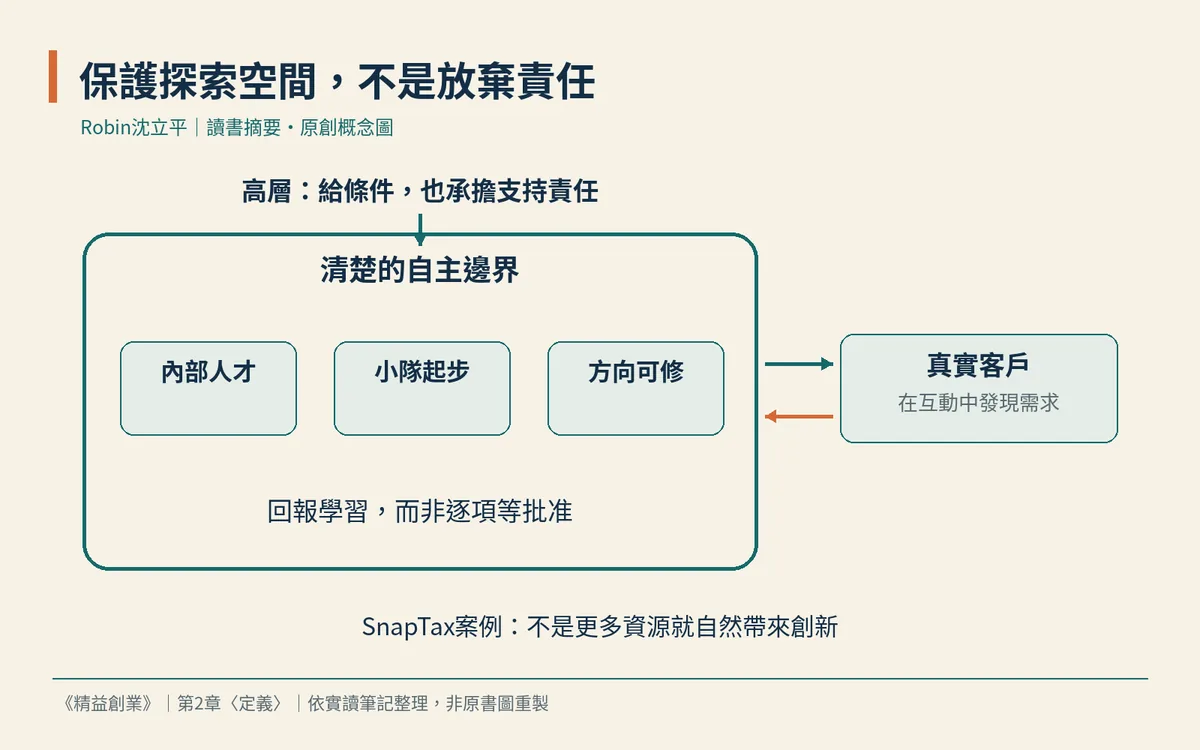
Large companies do not lack resources, so why do new ventures still struggle to grow inside them? The SnapTax case in Chapter 2 reminded me that the total amount of resources and the conditions for entrepreneurship are not the same thing. What Eric Ries wants to discuss is not how to dress a mature company up as a garage, but whether managers can build the right environment for exploratory work.
As Ries describes it, the team first wanted to help users collect data from their tax forms automatically and ease the burden of organizing information. After talking with potential customers, they saw the possibility of taking a photo with a phone; during testing, customers went further and said they hoped to file their taxes entirely on the phone. The product direction was not fully drawn up by senior management and then handed to the team to build to the blueprint.
The first version of SnapTax was narrow in scope: it handled only simple tax returns and was limited at first to one region. Ries uses this to show that a team can focus first on one clear situation instead of trying to cover every user’s needs from the start. What is worth learning here is the order of exploration, not treating the feature boundaries of one particular tax product as a general template.
Once the background is revealed, the team turns out to be inside Intuit, and its product could even compete with the company’s existing desktop tax software. That sharpens the question: a company hopes new products will bring its future, yet it is used to protecting its current business first. What an internal venture really has to get past is not only a technical hurdle, but how the organization handles conflict between new and old offerings.
Eric Ries cites the team’s own account and points to three conditions. The talent came from inside the company rather than from star outside hires; senior management gave trust and autonomy and avoided constant intervention; and the team started small, without a huge budget or marketing support. These are the explanations of the people involved in the case. They are not enough to prove that any company that follows them can repeat the same result.
Still, the case does challenge a common assumption: innovation does not have to wait for a legendary figure to join, or for all the resources to arrive at once. Ries attributes the result to processes and conditions that senior management deliberately built, not to luck. And if management can make exploration happen, then those who support, guide, and oversee innovation cannot push all the responsibility onto the entrepreneurial spirit of the front line.
A so-called innovation enclave does not mean leaving the team entirely alone. This is my own reading of the case: managers need to tell protecting the space for exploration apart from giving up accountability. If they grant authority while still requiring every detail to be approved first, the autonomy exists in name only. But if no one ever discusses what has been learned and what comes next, the team may simply be prolonging its original assumptions in an isolated space.
The case also shows that conversations with customers can change how a product is imagined. The original task was handling data; only later did the team see the need to file taxes entirely on a phone. This is not taking every request at face value. It is giving the team the authority to respond to signals that emerge in testing. If every new finding has to be proven, layer by layer, to fit the original plan, exploration easily degenerates into finding support for a predetermined direction.
It is also a reminder that authority cannot exist only when results match expectations. If the decision space is taken back the moment a team reports findings that do not fit senior management’s original picture, people will learn to report only good news. What exploration needs protecting is the chance to discuss reasonable corrections, not a promise that every originally planned route will succeed.
My conclusion is that the point of a small team is not only that it is cheap, but that it keeps decisions close to contact with customers. The chapter also admits, however, that success like this is uncommon in large companies. Treating it as a reference for organizational design, rather than as a recipe guaranteed to succeed, is more faithful to the uncertainty Ries is trying to address.
Three suggestions
Spell out what the team can decide on its own, especially the authority to adjust its plan in response to customers, so that empowerment does not shrink to verbal encouragement.
Limit the initial service situation and team mission to something that can be fully explored, avoid loading the whole company’s needs onto the team at the start, and do not treat budget size as progress.
Have the venture’s supporters regularly review the direction of exploration and what has actually been learned, while cutting item-by-item intervention, so that protected space, accountability, and the ability to adjust can coexist.
#TheLeanStartup | Source: Chapter 2, “Define”
These are reading notes and reflections based on my personal understanding. I recommend reading them alongside the original book for the full context.
Comments
What do you think? Share your experience or questions.
Sign in to comment, reply or like. Sign in / Sign up
Loading comments…