Note 41 | After You Finish the Book List, the Answer Has to Be Found in Practice
These are Robin Shen’s original reading notes and commentary, written in his own words after reading Eric Ries’s The Lean Startup: How Today's Entrepreneurs Use Continuous Innovation to Create Radically Successful Businesses. They are not the original book, excerpts from it, or an official publication. Methods and concepts from the book are attributed to Eric Ries; other sources are identified where stated. For reference only; not investment advice.
English translation of Robin’s Chinese reading notes and commentary. Passages are paraphrased, not verified verbatim quotations from the original English edition.
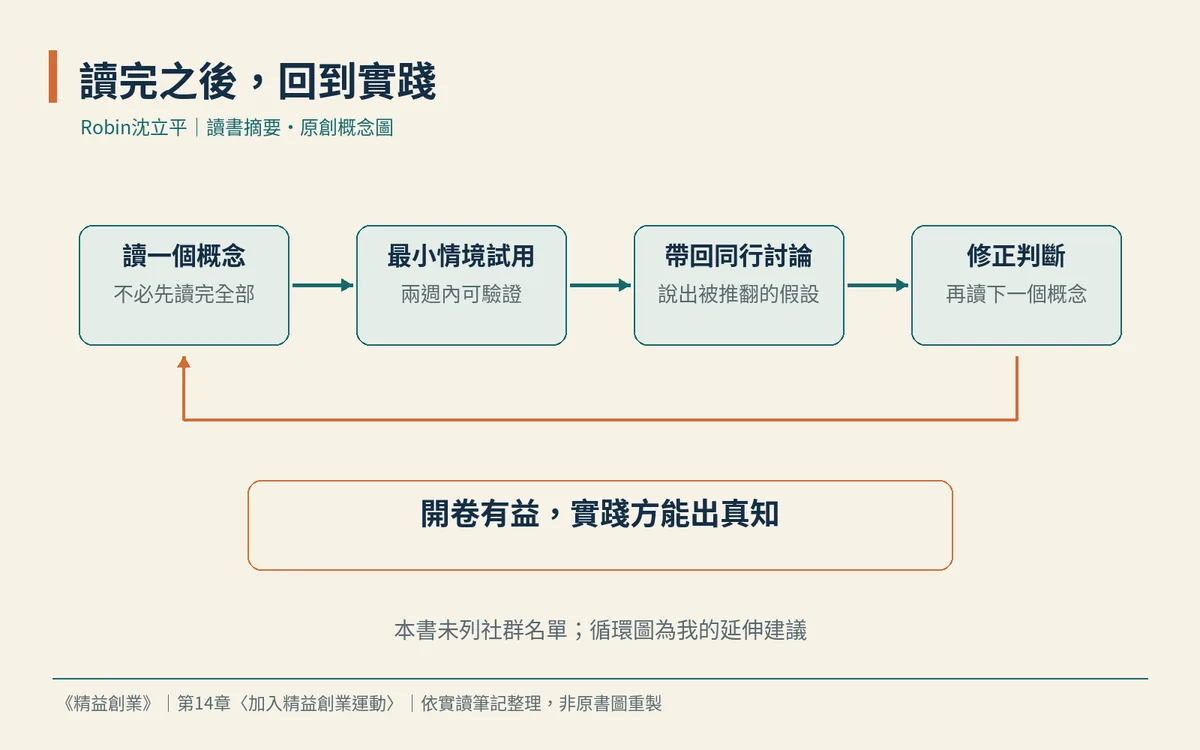
The argument of Chapter 14 is only a few short paragraphs, yet one sentence is worth taking out on its own: books are useful, but only practice yields true knowledge. Before recommending a long list of books, Eric Ries first says that the road ahead has to be walked by the reader. This note is not about which book to read, but about what to do after you have read.
Ries’s first view is that the most important resources are in fact already around you. He says that in the past you had to be in Silicon Valley to find partners in starting a company and to exchange ideas, and that the situation is now completely different; but joining an entrepreneurial ecosystem is still an important step in starting a company, and these ecosystems are appearing around the world. Ries also set up an official website for the book as an entrance to further resources. This note mentions it only from the record in the book, and has not actually browsed the site.
The second view is hidden in the explanation of the book list. Ries recalls that when he first began writing a blog on entrepreneurship, few people discussed new entrepreneurial ideas, and many of the ideas were discussed and refined together online. In other words, the Lean Startup itself has a component of being polished by a community, and is not a finished draft written alone by one author in a study. For the reader, this means that finishing the book is not the end. Bringing your own experience of practice back into the discussion is also a way of continuing this process.
It should be said that this chapter has only general statements. Ries does not provide a list of communities, and he does not give statistics on the scale or results of ecosystems in different places, so I do not add for him which organizations a given city has. What follows is an extension of my own thinking, offered only for reference.
My reading is that the value of taking part in a community is not in exchanging business cards, but in giving your own hypotheses a chance to be challenged by others. Reading alone, it is easy to pick only the passages that fit your own ideas. Saying in front of peers what you have validated and what has been overturned is when you discover that places you thought were clear are in fact quite vague. People willing to make the process public also find it harder to show only the successful side to the outside world.
Another extension is the ratio of reading to experiment. The book list is long. If you wait to start acting until every book is finished, you may remain forever in the stage of preparation. A more practical approach is, for each concept you read, to find a smallest setting in which to try it, then bring the result back to the community for discussion. The fruit of reading is then not a thicker notebook, but one more judgment in your hands that has been tested.
There is also the choice of people with whom to exchange. If everyone around you has the same background as you, the feedback is often only a confirmation of one another’s original ideas. My extended view is that deliberately finding peers from different industries and different stages makes it easier to hear unexpected questions. This, however, is only an inference from experience. Whether it works still depends on each person’s results in practice.
For investors, this also has meaning. If a team can only say which books it has read and which talks it has heard, and cannot say which hypotheses were recently overturned, learning may still be in the stage of absorption. Conversely, founders who are willing to share failed experiments are often also more likely to obtain genuine feedback from peers. This is my observation, not Ries’s conclusion, and it has no data behind it.
I think an entrepreneurial ecosystem is like a mirror. What it reflects is not how much you know, but whether you dare let others examine your reasoning. The conclusion is that Chapter 14 places the book list in the reader’s hands, and at the same time hands the responsibility back: reading is only the starting point. True learning has to be completed in practice and in exchange.
Three suggestions
Where you are, find a community or a peer group that regularly exchanges entrepreneurial practice, first take part once in fact, and then decide whether to keep investing.
Each month, share in front of peers one hypothesis that has been validated or overturned, state the evidence, and ask the other person to point out the weakest link in the reasoning.
Set for yourself a ratio of reading to practice: for example, after finishing each important concept, run a trial of the smallest scale within two weeks.
Robin’s note | Taiwan startups and venture capital
If a Taiwanese founder wants to take part in a local community, they can first choose a peer group that is willing to share failed experiments and data, rather than looking only at the scale of events. This is a conditional suggestion about participation. The names and results of communities have to be checked for yourself; this book does not list them.
#TheLeanStartup | Source: “Join the Movement”
These are reading notes and reflections based on my personal understanding. I recommend reading them alongside the original book for the full context.
Comments
What do you think? Share your experience or questions.
Sign in to comment, reply or like. Sign in / Sign up
Loading comments…