Note 42 | One Source of Build-Measure-Learn: The OODA Loop
These are Robin Shen’s original reading notes and commentary, written in his own words after reading Eric Ries’s The Lean Startup: How Today's Entrepreneurs Use Continuous Innovation to Create Radically Successful Businesses. They are not the original book, excerpts from it, or an official publication. Methods and concepts from the book are attributed to Eric Ries; other sources are identified where stated. For reference only; not investment advice.
English translation of Robin’s Chinese reading notes and commentary. Passages are paraphrased, not verified verbatim quotations from the original English edition.
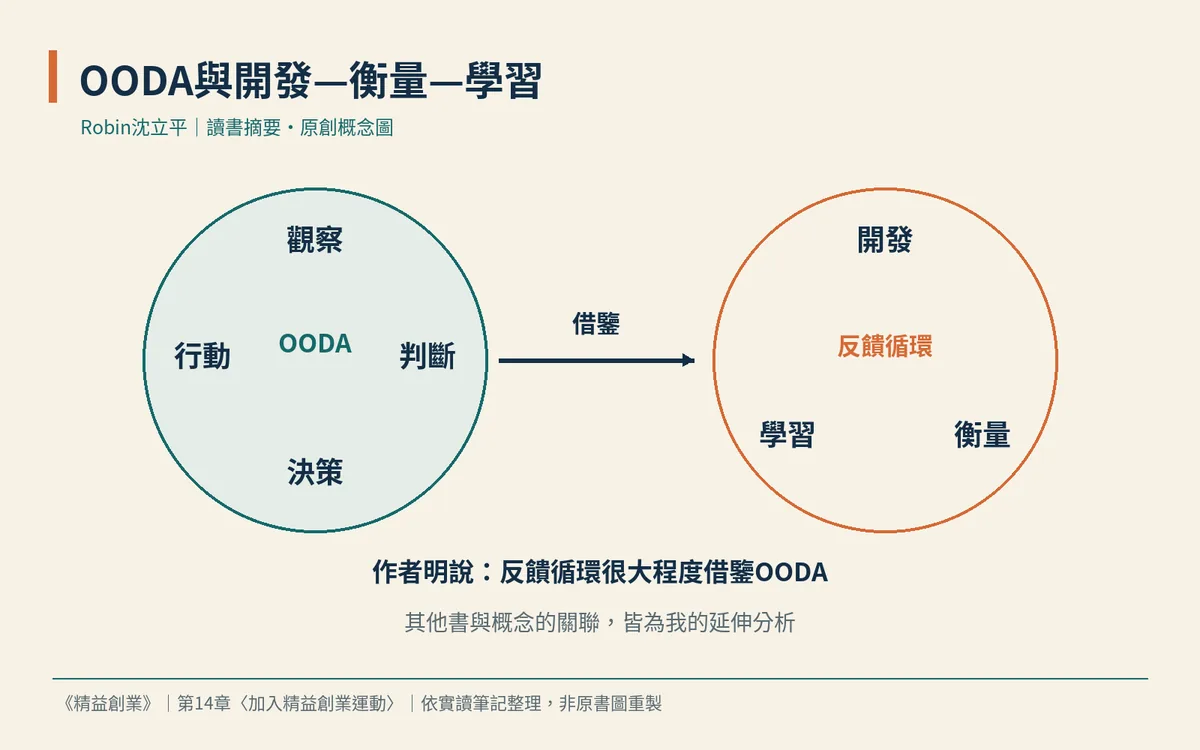
In the further reading of Chapter 14 there is a sentence that is easy to skip. Eric Ries says that the Build-Measure-Learn feedback loop draws in large part on military strategy, especially John Boyd’s OODA loop—Observe, Orient, Decide, Act—and he recommends Chet Richards’s Certain to Win as an introduction. This is the source of ideas that Ries states clearly in Chapter 14.
The sentence matters because, in this chapter, Ries mostly only lists titles for the other books. Which books influenced which concepts, apart from a few comments, the book does not say. This note therefore has to distinguish carefully: the relationship of borrowing between OODA and the Build-Measure-Learn loop is Ries’s own meaning. The other comparisons and associations below are extensions of my analysis. They do not represent Ries’s views, and they do not represent the contents of those books. This note is organized only from Ries’s titles and comments, and does not summarize them.
First, the places the two loops share. Both are processes that repeat in cycles, not a one-time plan. Both put observation after action back into the next round of judgment. If one understands the relationship of borrowing as Ries describes it, the point of the Build-Measure-Learn loop is also to let every action bring back new information, not merely to get the work done.
Next is an extension of my own. OODA begins with Observe; the Build-Measure-Learn loop is written as beginning with Build. My reading is that the starting points the two emphasize differ slightly. The former reminds us to see the environment clearly before acting. The latter reminds founders that, rather than imagining in the mind, they should first make something that can be measured, so that a real response becomes the material of observation. The two reminders can complement each other: before you do, you should know what you want to see; after you do, you should actually look.
Another extension is speed and completeness. The value of a loop is that it turns quickly enough, and also turns completely enough. If you observe but do not orient, or orient but do not act, the loop is broken. For a founding team, the most common break may be that after Measure, no one decides whether to adjust. My observation is that many teams do not lack data. What they lack is a fixed point in time, and a clear decision-maker, for turning data into a decision.
The book list also places side by side the works of Taylor, Taiichi Ohno, Deming, Drucker, and Sloan. Ries does not in this chapter say which concept they are connected to, so I can only say that the composition of the list shows that the Lean Startup’s range of reading crosses military strategy, the factory floor, the history of management, and software development. This is an inference from the makeup of the list, not a statement of Ries’s.
Why distinguish so carefully? Because the easiest place for a reading note to go wrong is to present the reader’s own associations as the author’s meaning. Ries states only this one place clearly, so we treat only this one place as fact. The other comparisons we treat as hypotheses, which anyone interested can go and validate by reading the original books. The distinction itself is also a small exercise in validated learning: first write the hypothesis, then look for evidence, rather than first stating a conclusion.
For an investor or an operator, knowing a method’s lineage helps in judging where it can be used, and to what degree. If the Build-Measure-Learn loop is treated only as a tool for a product team, one may miss the way of thinking behind it: adjusting repeatedly in an uncertain environment. This is still an extended reading of my own.
I think the conclusion can be put very simply: one of the roots of the Build-Measure-Learn loop is OODA. That is the clue Ries gives. As for the other connections, they are best treated as hypotheses still to be validated, not as ready-made answers.
Three suggestions
Draw the current round of the team’s work as Observe, Orient, Decide, and Act, and mark the step at which it most often stops, where no one makes a decision.
Set a fixed decision point for every round of measurement, name who will decide on the spot whether to continue, adjust, or stop, and do not wait until the next meeting.
When reading a note or a book list, record in two columns the facts the author states clearly and your own associations, and treat the associations uniformly as hypotheses still to be validated.
#TheLeanStartup | Source: “Join the Movement”
These are reading notes and reflections based on my personal understanding. I recommend reading them alongside the original book for the full context.
Comments
What do you think? Share your experience or questions.
Sign in to comment, reply or like. Sign in / Sign up
Loading comments…