Note 43 | A Book About Validation Was Itself Tested Again and Again
These are Robin Shen’s original reading notes and commentary, written in his own words after reading Eric Ries’s The Lean Startup: How Today's Entrepreneurs Use Continuous Innovation to Create Radically Successful Businesses. They are not the original book, excerpts from it, or an official publication. Methods and concepts from the book are attributed to Eric Ries; other sources are identified where stated. For reference only; not investment advice.
English translation of Robin’s Chinese reading notes and commentary. Passages are paraphrased, not verified verbatim quotations from the original English edition.
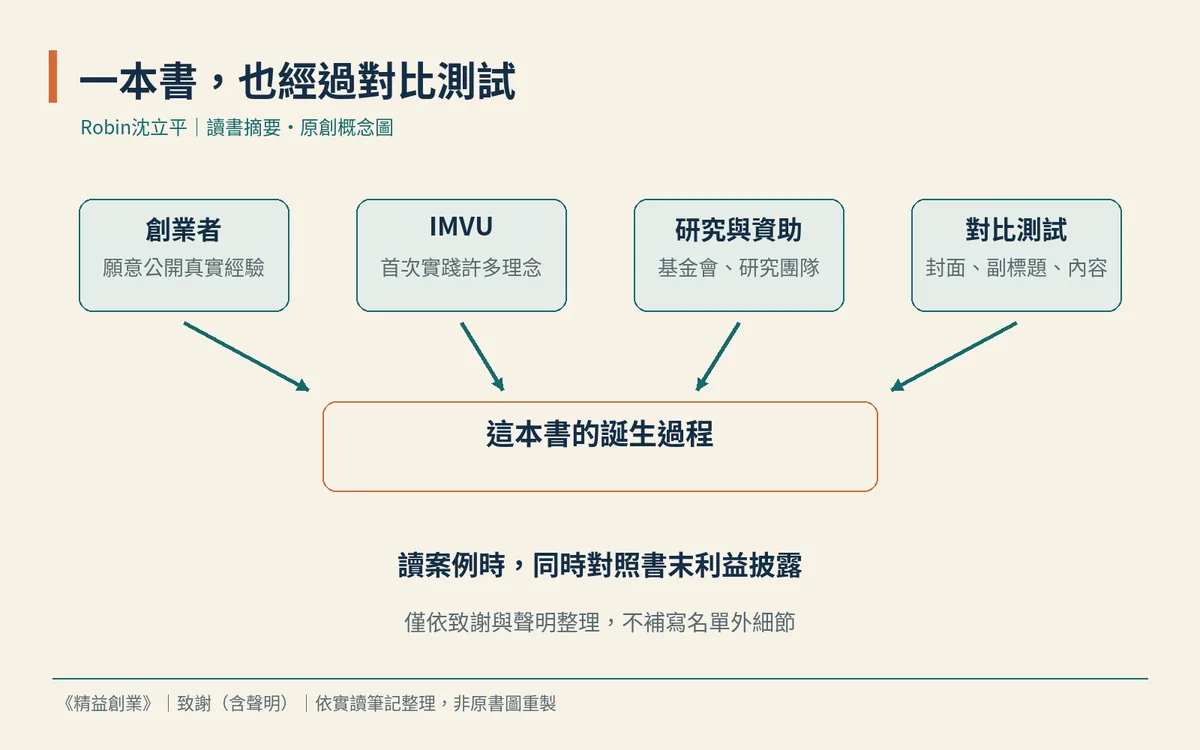
Coming to the acknowledgments, it is easy to turn the page. Eric Ries’s acknowledgments, however, in fact reveal how this book was born. He first thanks the tens of thousands of entrepreneurs around the world who tested, challenged, and revised these ideas. He says that most entrepreneurs and managers are unwilling to make their real work public, so he especially thanks those who were willing to be interviewed and to check the facts, because the real entrepreneurial road is full of failure and confusion.
Then comes IMVU: Will Harvey recruited Ries to Silicon Valley and gave him trust, so that he first practiced many of the ideas in the book; there were also the other cofounders, employees, and users. He also thanks Steve Blank, who was already committed to customer development when it was still regarded as heresy.
The most interesting passage is that, while writing the book, Ries used a custom testing platform developed by Pivotal Labs to run split tests on the cover, the subtitle, and specific contents. In addition, the Kauffman Foundation funded most of the research, and the research team recorded cases and interviewed hundreds of startups.
The disclosure at the end of the book states that Ries has an equity or other interest in companies including IMVU, Votizen, Wealthfront, Grockit, Aardvark, Dropbox, and Food on the Table, and that he has also worked with several venture firms as an advisor or limited partner. I think this disclosure is worth reading together with the earlier cases. The conclusion is that this book does not only discuss a method. It also used the method to complete itself.
Three suggestions
Before reading a case in the book, first compare it with the disclosure at the end, and note the companies in which Ries has an interest.
In your next proposal, find one or two places where a small split test can replace a subjective decision.
At the end of a project, write specifically who helped at which point, rather than only saying thank you to everyone.
#TheLeanStartup | Source: Acknowledgments (including the disclosure)
These are reading notes and reflections based on my personal understanding. I recommend reading them alongside the original book for the full context.
Comments
What do you think? Share your experience or questions.
Sign in to comment, reply or like. Sign in / Sign up
Loading comments…