Summary 1 | From a Sentence of Vision to a Chain of Evidence: A Founder’s Lean Way of Working
These are Robin Shen’s original reading notes and commentary, written in his own words after reading Eric Ries’s The Lean Startup: How Today's Entrepreneurs Use Continuous Innovation to Create Radically Successful Businesses. They are not the original book, excerpts from it, or an official publication. Methods and concepts from the book are attributed to Eric Ries; other sources are identified where stated. For reference only; not investment advice.
English translation of Robin’s Chinese reading notes and commentary. Passages are paraphrased, not verified verbatim quotations from the original English edition.
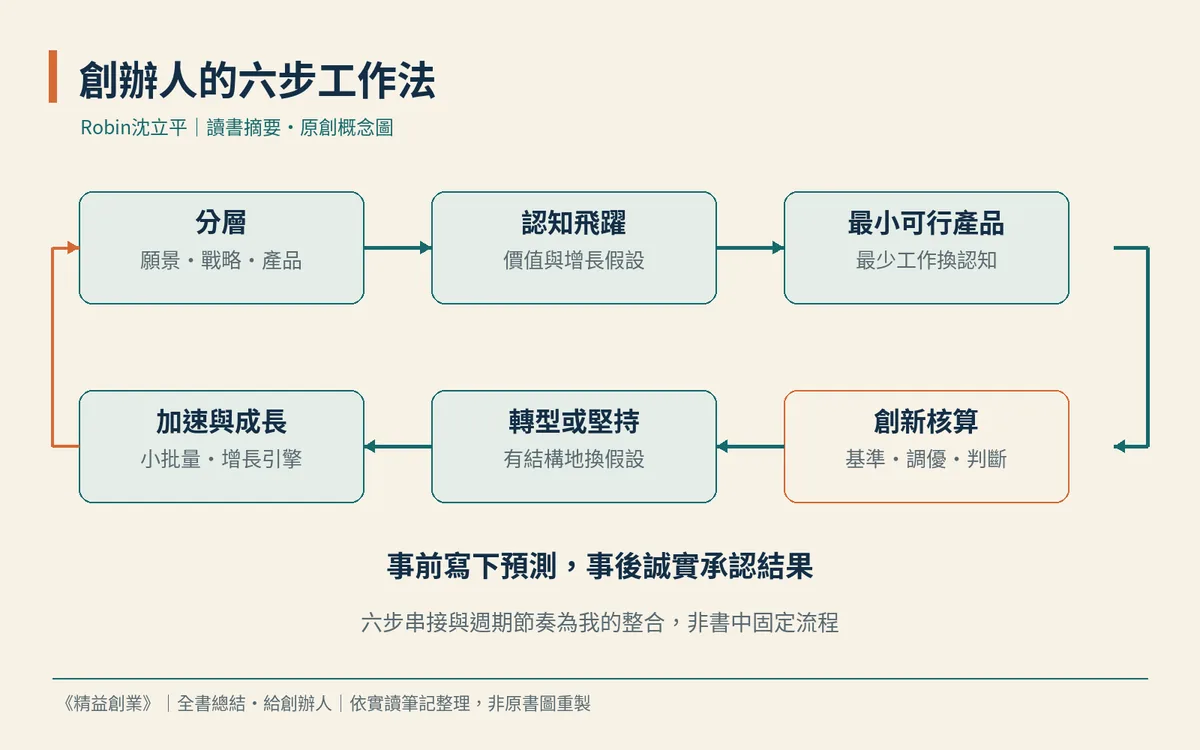
Looking back after finishing the book, what Eric Ries gives founders is not a sequence of steps that guarantees success, but a method of management for making decisions under conditions of extreme uncertainty. In Chapter 1 he already says that starting a company likewise needs management, only not the plans and layers of approval designed for a stable business. As I integrate it, the whole method can be gathered into one line: hold the vision, split the strategy into testable hypotheses, obtain evidence of real behavior with the least investment, then decide according to the evidence whether to tune, pivot, or expand.
The first step is to distinguish the levels. Ries separates vision, strategy, and product: the product is often being adjusted, the strategy may need a pivot, and the vision changes less often. Once the levels are clear, a founder will neither treat a change of feature as a departure from first principles, nor use holding the vision as a defense of a route that has failed. The second step is to find the leaps of faith, the premises on which the whole plan depends and which have not yet been proved, of which the most critical are the value hypothesis and the growth hypothesis. Ries reminds us that a handsome analogy is the easiest way to smuggle the unknown in as the known.
The third step is to seek evidence with a minimum viable product. The “minimum” Ries describes is the least work needed to complete one Build-Measure-Learn loop, not making quality smaller along with everything else. As he describes it, Zappos in its early days first photographed inventory in a shoe store, and only after someone ordered went to buy and ship; IMVU used teleportation by click in place of complex walking, and users liked it. The latter is the experience of Ries’s own company, and he has an interest in IMVU.
The fourth step is to measure. Ries proposes innovation accounting: first establish a baseline, then aim each tuning at one driver, and finally judge whether to pivot or persevere. He uses IMVU’s own account to show that when a curve of totals is rising, the key behaviors of new users in each period may not be moving, so you look at cohorts, not at vanity metrics.
The fifth step is to pivot. Ries defines a pivot as a structured change of a fundamental hypothesis, not a random change of direction. Runway can also be estimated by how many opportunities to pivot remain. He summarizes three sources of resistance that delay a pivot: vanity metrics, vague assumptions, and fear. In the case of Votizen’s several changes of course, Ries discloses a holding, so it should be read as a participant’s account.
Ries also reminds us of two details that are often overlooked. First, before a test the team has to have an agreement: however unflattering the result of a minimum viable product, it will not therefore be abandoned, but the bad news will be treated as the starting point of the next round. Successful founders neither give up lightly nor persevere blindly. Second, success itself can make people relax. As Ries recounts, after IMVU had a substantial business, it treated growth in totals as a source of security, and overlooked that the incompleteness early adopters could accept is not necessarily suitable for mainstream users. Later it had to make a customer segment pivot, and understand customers again as if starting a company for a second time.
Finally there is acceleration and growth: smaller batches make the loop faster, and continuous deployment needs safeguards; first recognize the main engine of growth—sticky, viral, or paid—and concentrate effort on one; when a problem appears, use the Five Whys and a proportional investment to repair it. Ries quotes his mentor, the venture capitalist Shawn Carolan: startups usually do not starve; they drown in too many small ideas.
I think what is truly hard in this method is not any single tool, but writing the prediction down in advance, and honestly admitting the result afterward. The conclusion is that a founder’s discipline is not in making the plan more perfect, but in letting every round of investment return a piece of evidence that can change the next decision. Turning these into a working rhythm of fixed cycles is an extended suggestion of my own, not a process prescribed in the book.
Ten takeaways
Vision, strategy, and product change at different frequencies. Confirming which level you are discussing before an argument can remove much of the emotional tug-of-war.
Leaps of faith often hide in ordinary sentences, such as “customers badly need this” or “channels will naturally sell it.” The more they sound like common sense, the more they should be written out and tested.
The value hypothesis and the growth hypothesis are two questions. That someone is satisfied in use does not mean that others will arrive on their own, and the converse is also true.
What a minimum viable product scales down is the work needed to obtain a particular understanding, not the threshold of quality. Being so careless that you cannot obtain useful feedback is likewise waste.
Real behavior has more force as evidence than spoken intent. Completing a transaction, returning, and inviting are worth more than “we would probably use this” in a survey.
Of the three steps of innovation accounting, the baseline is the one most often skipped. Without a starting point, any improvement can only be announced by feeling.
A rise in totals may only be the afterglow of past decisions. Only a cohort can answer whether this round of product work has made new users better off.
A pivot keeps the vision and rewrites a strategic premise. What was learned in the past has to be clearly accounted for: what will be kept, and what will be dropped.
The idea of remaining opportunities to pivot is a reminder that indiscriminate thrift, if it slows feedback, may extend the calendar and reduce the chance of finding a way out.
Focusing first on one engine of growth is so that every experiment has a clear object of judgment, not so that other sources are forever excluded.
Ten concrete suggestions
On one page, write separately the company’s vision, current strategy, and product focus, and mark the time and reason of the most recent change to each.
List three to five premises that, once they failed, would overturn the business model, and note for each whether it is a value hypothesis or a growth hypothesis.
For the most critical premise, design a minimum experiment that can be completed this month, and write clearly which one question it answers.
Before the experiment begins, write the expected behavioral numbers and the threshold of judgment, and agree with the team that if the result falls short of expectation, learning will still continue.
Take stock of the vanity metrics in current reports, and replace at least one set with key behavioral metrics presented by cohort.
For every change to the product or to marketing, mark the driver it is meant to move, and afterward assess the effect only by the change in that factor.
Hold a regular pivot-or-persevere meeting: the product team brings long-term comparative data; the business team brings records of customer interviews.
Convert remaining cash into how many meaningful rounds of experiment can still be completed, then check which spending is in fact slowing feedback.
In one sentence, write the current main loop of growth, and pick only two or three metrics that best reflect the bottleneck, and keep tracking them.
When a recurring problem appears, use the Five Whys to reach the root cause, invest in a fix according to the size of the problem, be tolerant of a first mistake, and do not let the same error happen again.
#TheLeanStartup | Source: Book-wide summary for founders (based on notes from the front matter through the acknowledgments, and Notes 0–43)
These are reading notes and reflections based on my personal understanding. I recommend reading them alongside the original book for the full context.
Comments
What do you think? Share your experience or questions.
Sign in to comment, reply or like. Sign in / Sign up
Loading comments…